From Single Agents to Coordinated Teams
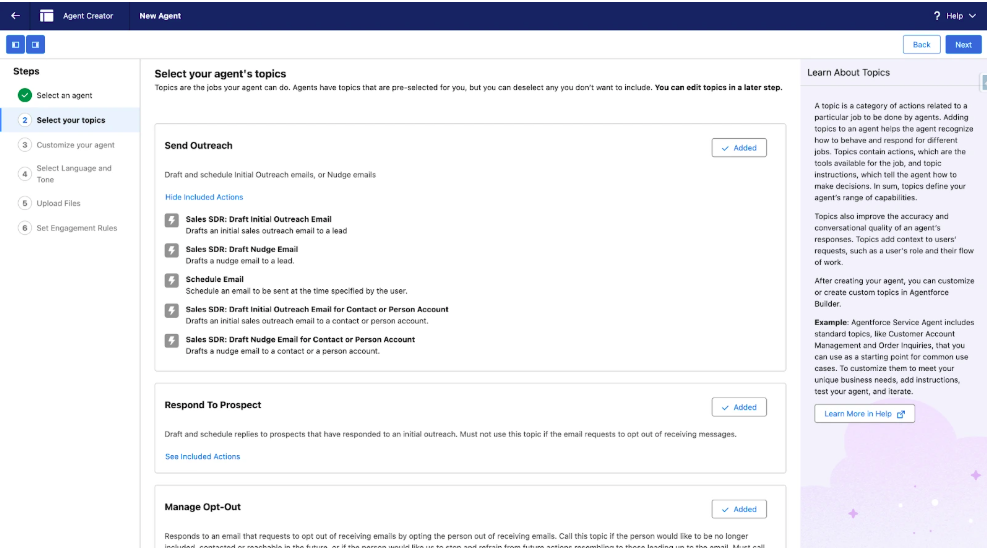
Salesforce's Summer '26 platform release reached general availability on June 15, with multi-agent orchestration in Agentforce as the headline capability. The feature lets multiple specialist AI agents work as a unified team across an end-to-end workflow while sharing context, so customers reach a single point of contact and never have to repeat themselves. This is a meaningful conceptual step beyond the single-agent paradigm that has dominated enterprise AI to date, where one agent handles one task in isolation.
We see the move to orchestration as the natural and necessary evolution of agentic software. Real business processes are rarely served by one agent; they span sales, service, billing, and operations, each with its own specialist logic. The hard problem is making those specialists collaborate without losing context or contradicting one another. Salesforce describes the goal directly: agents that "work together as a unified team to solve complex, end-to-end workflows so that the customer never has to repeat themselves or work to find the right agent for their question." Coordination, not raw capability, is the frontier.
Atlas 3.0 and the Open Protocol Bet
Under the orchestration sits the Atlas 3.0 reasoning engine, which routes requests between specialist agents, and support for an open agent-to-agent protocol that enables cross-vendor agent handoffs. The inclusion of an open A2A protocol is the strategically interesting choice. Salesforce could have built a closed system where only its own agents interoperate; instead it is betting that enterprises will run a heterogeneous mix of agents from many vendors and want them to cooperate.
That bet aligns with where we think the market is heading. No single vendor will supply every agent an enterprise needs, and customers will resist being locked into a monoculture. By supporting cross-vendor handoffs, Salesforce positions Agentforce as an orchestration hub rather than a walled garden, which is a more defensible long-term position. The risk is that open interoperability also lets competitors' agents into Salesforce's workflows, but the company appears to have concluded that being the orchestrator of a mixed ecosystem beats being the sole supplier of a closed one.
A Candid Note on the Limits
What we appreciated most in this launch was an unusual flash of candor about the technology's current limits. Salesforce's Adam Evans cautioned that the answer to enterprise scale "isn't to connect up a thousand agents and hope for the best," noting that current agent-to-agent approaches are "chatty" and that performance is "not there yet" for demanding live use cases like sub-second voice interaction. The fix, he argued, lies in context engineering and testable, separated functionality rather than sheer agent count.
This honesty is refreshing in a market saturated with breathless claims, and it should reassure rather than worry buyers. The realistic path to multi-agent systems is incremental: well-scoped agents, careful context management, and rigorous testing, not a thousand agents wired together on faith. We read Evans's caution as a sign that Salesforce is building for production reliability rather than demo theater. Enterprises evaluating multi-agent orchestration should hold their own deployments to the same standard, resisting the temptation to chain agents indiscriminately and instead designing for testability from the start.
The Numbers Behind the Narrative
The commercial momentum gives the technical story weight. Salesforce disclosed that Agentforce annual recurring revenue reached 800 million dollars, up 169 percent year over year, with combined AI revenue surpassing 2.9 billion dollars. The company closed 29,000 Agentforce deals over the prior year, up 50 percent quarter on quarter in its fourth quarter, and logged 2.4 billion agentic work units across Agentforce and Slack. These are not pilot-stage figures; they describe a business at meaningful scale.
We treat these numbers with measured interest. Vendor-reported metrics like agentic work units are difficult to benchmark against anything, and rapid percentage growth from a low base is easy to achieve. Still, 800 million dollars in ARR and 29,000 deals are substantial signals that enterprises are paying for agentic capability, not merely experimenting with it. The release also brings live Tableau analytics into agent workflows via the Model Context Protocol, an IT service management domain pack with roughly 50 prebuilt agents, Slack-first sales workflows, and Data Cloud triggered agents, broadening the surface where that paying demand can land.
Experimentation to Scaled Impact
Salesforce frames the release as moving customers "from experimentation to scaled impact," and that phrase captures the genuine inflection point the enterprise AI market has reached. The past two years were defined by pilots, proofs of concept, and cautious trials. The question now is whether organizations can operationalize agents across real workflows at scale, with the governance, reliability, and measurable outcomes that production demands. The vendors are racing to make that transition feel safe.
For CIOs, the practical implication is that the tooling for multi-agent deployment is arriving faster than most governance frameworks. Orchestration, prebuilt domain packs, and analytics integration lower the barrier to putting agents into core processes, which means the constraint shifts to organizational readiness: who owns agent behavior, how outcomes are audited, and where humans stay in the loop. We would advise treating releases like Summer '26 as a prompt to mature governance in parallel with deployment. The capability to scale agents now exists; the discipline to scale them responsibly is what separates value from risk.