A 3.6 Billion Dollar Vote for Proven Agents
Salesforce announced on June 15 that it will acquire Fin, the AI customer service company that spent fifteen years building its reputation as Intercom, for 3.6 billion dollars. The deal is the clearest signal yet that the agentic AI race has moved past slide decks and into the unglamorous business of resolving support tickets at scale. Salesforce is not buying a research lab or a foundation model. It is buying a working product that already sits inside thousands of help desks and closes conversations on its own, and it is paying a premium that values demonstrated outcomes over theoretical capability.
We read this as a maturity marker for the entire category. For two years, enterprise buyers were asked to trust that general purpose models would eventually master their workflows. Fin inverts that pitch. Its value is not that it might learn customer service someday but that it does the job now, across live chat, WhatsApp, SMS, phone, and Slack. Salesforce CEO Marc Benioff framed the rationale plainly, saying Fin brings proven agent technology and an incredible AI team that will complement Agentforce with powerful service agent capabilities. The operative word is proven.
Why Agentforce Needed This
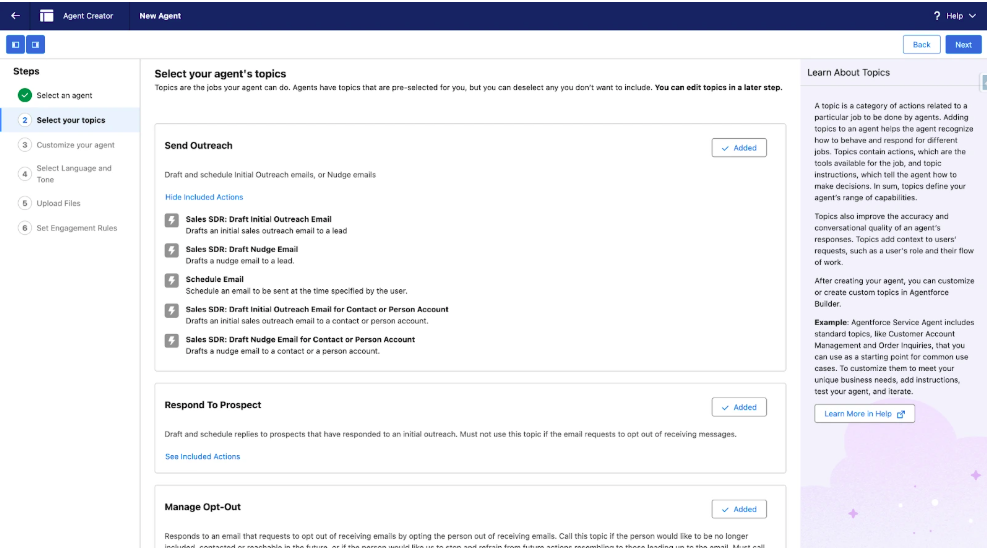
Agentforce has been Salesforce's flagship answer to the agentic moment, a platform for businesses to build custom AI agents that automate tasks across the CRM. But building agents and shipping an agent that reliably resolves customer issues are different problems, and Salesforce has faced persistent questions about how many of its deployed agents actually deliver autonomous outcomes versus assisted ones. Fin answers that question with a number: the company says its agent closes roughly 76 percent of incoming support requests with no human stepping in. That resolution rate is the kind of metric a CIO can take to a board.
Folding Fin into Agentforce gives Salesforce an immediate, credible service agent rather than a roadmap promise. It also imports an applied AI team that has spent years tuning a product against real customer conversations, which is harder to replicate than it looks. For enterprises evaluating Agentforce, the acquisition changes the calculus. The platform now arrives with a frontline workhorse attached, and that should compress the distance between signing a contract and seeing measurable deflection in support volumes.
The Apex Model and the Build Versus Buy Question
Powering Fin is Apex, a proprietary model the company purpose-built for support use cases. Fin claims Apex beats frontier models from the likes of OpenAI and Anthropic when measured by resolution rates, a deliberately narrow benchmark that favors a specialist over a generalist. We are skeptical of any vendor claim to outdo frontier labs, but the framing matters. Fin is arguing that for a bounded task like support, a tuned domain model can outperform a larger general one, and that specialization is a moat rather than a liability.
That thesis has implications well beyond this deal. If a focused model trained on a single workflow can outperform the biggest general models on the metric that pays the bills, then the enterprise AI market fragments into dozens of specialist agents rather than consolidating around a handful of frontier APIs. Salesforce, by buying Apex outright, hedges against its dependence on external model providers and gains a piece of intellectual property tuned to the exact problem its customers are paying to solve. For other vendors, the lesson is that owning the model for your core use case may be worth more than renting the best model for everything.
Thirty Thousand Customers and a Team That Stays
The acquisition brings more than 30,000 business customers into Salesforce, a meaningful distribution win in a market where switching costs and incumbency matter enormously. Many of those customers are smaller and mid-sized businesses that adopted Fin precisely because it was simpler to deploy than enterprise CRM suites. Salesforce now has a path to expand those relationships, and a reason to keep Fin's product approachable rather than absorbing it into a heavier stack that scares off the very buyers who made it valuable.
Crucially, leadership stays. Fin co-founder and CEO Eoghan McCabe will continue to run the business, and McCabe struck a reassuring tone for existing users, saying that with the resources of Salesforce this will only accelerate, and yet little will practically change. Acquirers say this often and deliver on it rarely. The test will be whether Salesforce resists the urge to rip Fin apart for parts and instead lets it operate as the fast-moving, outcome-obsessed unit that earned the 3.6 billion dollar price in the first place.
What It Means for the Customer Service Market
For competitors in the customer service space, this is a shot across the bow. Zendesk, ServiceNow, and a long tail of AI support startups now face a Salesforce that can pair the world's largest CRM install base with a top-performing autonomous agent. The combination threatens to commoditize the standalone support bot, because once resolution-grade agents come bundled with the system of record, buying a separate one becomes harder to justify. We expect this to accelerate consolidation across the category through the rest of 2026.
There is also a workforce dimension that leaders cannot ignore. An agent that resolves three of every four tickets reshapes the economics of support organizations, and the honest conversation is about what happens to the human teams that handle those volumes today. The best outcome routes humans to the complex, high-empathy cases that agents still botch, while the agent absorbs the repetitive load. The worst outcome is quiet headcount reduction dressed up as efficiency. How Salesforce and its customers handle that transition will shape whether agentic support is remembered as augmentation or attrition.
Our Take
Regulatory approval permitting, Salesforce expects to close the transaction before the end of its fourth fiscal quarter of fiscal 2027, which puts completion in early 2027. That timeline gives both companies room to plan an integration that preserves what makes Fin work. We think the deal is smart precisely because it is unsexy. Salesforce did not buy a bigger model or a louder demo. It bought measured results and the team that produces them, and it paid up because results are now the scarce commodity in enterprise AI.
The broader signal for technology executives is that the agentic market has entered its accountability phase. Buyers are done being impressed by capability and have started demanding deflection rates, resolution percentages, and total cost of ownership. Vendors that can show those numbers will command premiums, and vendors that cannot will be acquired or ignored. Salesforce just put 3.6 billion dollars behind that thesis, and the rest of the market will be measured against it.