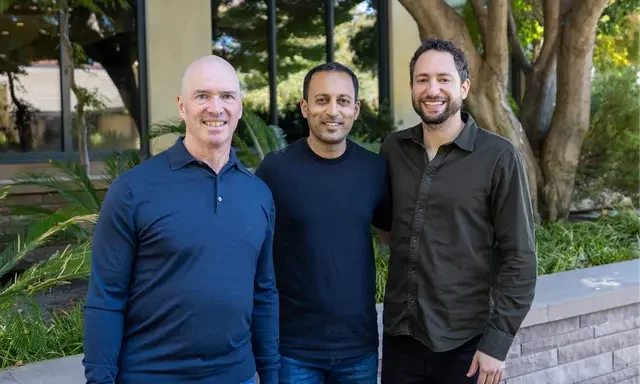
What Citadel just hired
Citadel has named Matt Taddy its new Chief Technology Officer, pulling him from Amazon where he spent eight years, from 2018 to 2026, as a vice president. At Amazon, Taddy led Supply Chain Optimization Technology, the software organization behind the company's global logistics network, a role that put him in charge of the systems that route, price, and sequence Amazon's physical goods movement at a scale few organizations outside Amazon ever operate at. He also ran the company's global private label business, covering product development, manufacturing, and merchandising, and launched its Economic Technology team, a title that hints at exactly the blend of applied economics and software engineering his earlier career suggests.
The move is notable for what it is not: Citadel did not hire a career trading-systems engineer or a Wall Street technology veteran for its top technology seat. It hired someone whose most recent eight years were spent on physical logistics software, and whose formative professional identity was academic economics. For a firm whose entire business model depends on extracting signal from markets faster and more reliably than competitors, recruiting a technologist who has spent his career modeling and optimizing complex systems under real-world constraints, rather than one who has only ever worked inside financial market infrastructure, is a legible bet even without an explicit quote explaining it.
The academic-to-operator pipeline is not a coincidence
Taddy holds a PhD in Applied Mathematics and Statistics from the Baskin School of Engineering at UC Santa Cruz, with research experience alongside NASA and the Sandia, Los Alamos, and Lawrence Livermore national laboratories. He spent roughly ten years as a professor of econometrics and statistics at Chicago Booth, and he authored Business Data Science, a book on applying machine learning and economics to business decisions. Before Amazon, he also held senior research and data science roles at Microsoft. That is a career built almost entirely on quantitative rigor applied to messy, large-scale real-world systems, first in physics and engineering research, then in business economics, then in a trillion-dollar logistics network.
Hedge funds have hired physicists and economists into trading and research roles for decades. What is different here is hiring that profile directly into the CTO seat, the role responsible for the firm's technology platform and infrastructure rather than its trading models. That signals Citadel sees its technology infrastructure problem as fundamentally an optimization and systems problem at the scale of Amazon's logistics network, not a conventional enterprise IT problem. Readers building technology organizations anywhere complex optimization under constraints matters, supply chain, pricing, resource allocation, should take that framing seriously rather than assuming it is finance-specific.
What the hire says about where elite engineering talent is flowing
Taddy's departure from Amazon after eight years in a senior logistics technology role, landing at a hedge fund rather than another retailer, airline, or logistics company, is itself a data point. Quantitative finance firms pay at a different scale than most commerce and retail businesses, and they are increasingly willing to recruit technology executives whose core expertise was built solving physical-world optimization problems rather than financial ones. That widens the competitive set for anyone trying to retain senior supply chain, logistics, or optimization engineering talent: the firm bidding against you for your best people may not be a competitor in your industry at all.
This also reflects a broader convergence in how large organizations think about technology leadership. The skills that run a global logistics network, demand forecasting, constrained optimization, systems reliability at scale, pricing algorithms, are close enough to the skills that run a modern quantitative trading infrastructure that the talent pools are starting to overlap meaningfully. Enterprise technology leaders in retail, commerce, and logistics should expect more of their best optimization and data science talent to field inbound interest from firms well outside their traditional industry boundaries, finance chief among them.
The part of the story without a quote is still a story
Citadel's own announcement of the hire did not include a direct quote from Taddy or from firm leadership explaining the rationale, which is itself worth noting for a firm usually comfortable with public statements about its talent strategy. That absence still leaves the signal value of the hire intact, while leaving outside observers reading strategy from biography rather than stated intent, which should temper how confidently anyone, including this piece, asserts what Citadel plans to do differently under Taddy's technology leadership.
What is verifiable is the shape of the career Citadel chose to bet on: deep applied statistics training, a decade in academia, then eight years running software for one of the most operationally complex logistics networks on the planet. Firms making CTO hires with that little daylight between the technical résumé and the quote-free announcement are usually confident the résumé speaks for itself. Whether that confidence is justified becomes visible only in how Citadel's technology platform performs and scales over the next several quarters, which is the honest limit of what this appointment alone can tell us today.
The talent lesson for enterprise technology leaders
If you lead technology at a retail, commerce, or logistics-heavy enterprise, the practical takeaway is to widen your retention lens past your own industry's usual poachers. Taddy's path from Amazon logistics to a hedge fund CTO seat demonstrates that the market for senior leaders who can run complex, large-scale optimization systems is genuinely cross-industry, and that quantitative finance firms are willing to pay a premium for operators with that exact background regardless of whether they have ever touched a trading desk.
The deeper structural point is that academic rigor in statistics and economics is increasingly treated as a credible substitute for, not just a complement to, conventional enterprise software leadership experience. Technology leaders building their own succession plans and hiring pipelines should ask whether their own candidate slates are too narrowly sourced from people who have only ever worked inside their specific vertical. Citadel just demonstrated, in a single hire, that the better predictor of CTO success may be the complexity of the systems someone has already optimized, not the industry label on their last employer.