An Unexpected Move
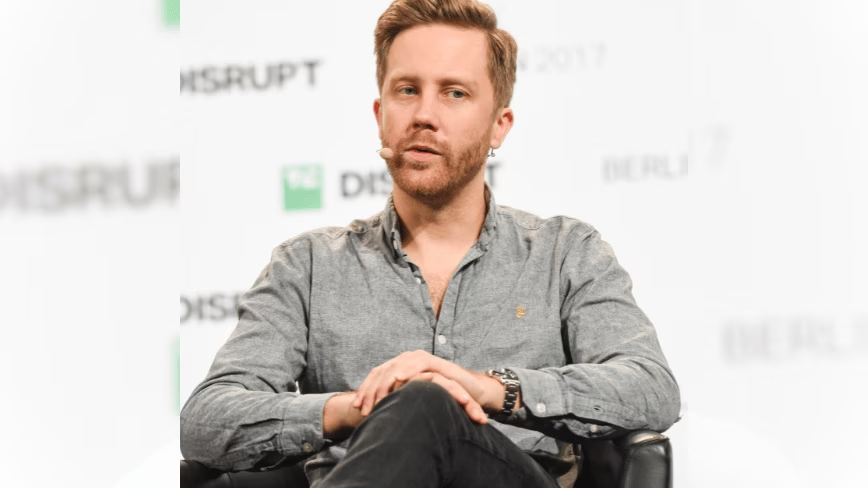
Tom Blomfield, the co-founder of digital bank Monzo and payments company GoCardless, announced that he is taking a leave of absence from Y Combinator to join Anthropic as a member of technical staff on its compute team. He will work alongside Tom Brown, Anthropic's co-founder and chief compute officer, on the infrastructure that underpins the Claude models. Blomfield revealed the move on X, writing that powerful AI has the potential to improve the life of every human on earth, and that as we enter the early stages of recursive self-improvement, availability of compute becomes one of the most important issues to solve.
The surprise is the direction of the move. Blomfield is one of Britain's most successful fintech founders, a former chief executive who built companies to combined peak valuations north of nine billion dollars, and a Y Combinator partner who spent recent years advising startups. Choosing to join a compute team as an individual contributor, rather than take an executive title or found something new, is a statement about where he thinks the important work is. It is also a signal about what Anthropic values enough to attract that caliber of person into a hands-on role.
Compute as the Binding Constraint
Blomfield's stated reasoning cuts to the central bottleneck of the frontier AI industry. The competition among labs is no longer decided purely by algorithmic cleverness. It is increasingly decided by who can secure, deploy and orchestrate enormous quantities of specialized compute. Anthropic is deploying up to one million Google TPUs, with more than a gigawatt of capacity coming online this year, a further 3.5 gigawatts from Google and Broadcom next-generation chips starting in 2027, and more than 220,000 Nvidia GPUs through a cloud arrangement with xAI.
Operating infrastructure at that scale is a systems and logistics problem as much as a machine-learning one. It involves power, supply chains, scheduling, reliability and cost, the kind of operational complexity that a serial company builder is often better equipped to attack than a pure researcher. Blomfield's framing, that compute availability is the issue to solve in an era of recursive self-improvement, reflects a view increasingly shared across the labs: the models will keep improving, but only as fast as the infrastructure beneath them can be built and run. That makes infrastructure the strategic frontier.
A Pattern of Marquee Hires
The Blomfield hire fits a striking run of senior additions at Anthropic in 2026. Andrej Karpathy, an OpenAI co-founder, joined in May to build a team focused on accelerating pre-training research. John Jumper, the Nobel laureate behind DeepMind's protein-folding breakthroughs, joined the research side in June. Eric Boyd left Microsoft Azure in April to lead Anthropic's infrastructure team. Adding a proven fintech operator to the compute group extends the pattern from research stars to operators and builders.
This concentration of talent is itself a competitive weapon. In a field where a handful of people can meaningfully shift a lab's trajectory, the ability to recruit across research, infrastructure and operations compounds. It also reveals Anthropic's read on its own needs. The company is not only hoarding researchers to push model quality. It is deliberately assembling the operational and infrastructure muscle required to turn research advantages into deployed, reliable, cost-effective systems at planetary scale. That balance, research plus operations, is what separates a lab that publishes from a lab that ships.
What It Says About the Talent Market
For technology executives watching the leadership market, the signal is that the definition of scarce AI talent is broadening. For several years the bidding wars centered on research scientists. Blomfield's move, and the parallel hire of an Azure infrastructure leader, show that operators, people who can build and run complex systems and organizations, are now equally prized. The AI race is being won and lost not just in the model but in the messy work of standing up gigawatts of compute and the teams to manage it.
That has implications for how enterprises think about their own AI leadership. The instinct to hire a star researcher or a chief AI officer with an academic pedigree is understandable, but the harder, more decisive capability is often operational: securing capacity, controlling cost, ensuring reliability and integrating AI into production systems. The most sophisticated organizations are learning to value builders and operators alongside researchers. Anthropic, with more resources and information than almost anyone, is voting with its hiring, and it is voting for a blend.
The Recursive Self-Improvement Subtext
Blomfield's phrase, the early stages of recursive self-improvement, is worth pausing on, because it reflects a belief now common inside the frontier labs that AI systems are beginning to accelerate their own development. Whether or not one accepts that framing, the people building these systems increasingly act as though it is true, and they are allocating talent and capital on that assumption. If models can help design better models, then the constraint shifts decisively to the compute available to run the loop.
We would treat the rhetoric with measured caution, because self-improvement claims have a long history of outrunning reality. But the resource allocation is real regardless of the framing. Anthropic is pouring effort into compute because it believes the returns to scale remain steep, and it is recruiting operators like Blomfield to make sure infrastructure is not the thing that caps its progress. For observers, the useful takeaway is not the philosophical claim but the practical one: the labs are betting that whoever controls the most efficiently run compute controls the pace of AI progress.
Our Read
A single hire rarely deserves this much attention, but this one is a clean marker of where the AI contest is being decided. When one of Britain's most accomplished founders concludes that the highest-leverage place to work is a compute team, it says the industry's binding constraint has moved from ideas to infrastructure. Anthropic's willingness to attract that person into a hands-on role, rather than an executive perch, underscores how seriously it takes the problem.
For enterprise leaders, the lesson is to widen the lens on AI talent and to respect the operational layer. The organizations that thrive with AI will not be the ones with the most impressive research hires alone. They will be the ones that also master the unglamorous work of running the systems reliably and affordably. Anthropic is assembling both halves. The companies that copy only the visible half, the research stars, will find that the models are only as good as the infrastructure nobody wrote a headline about.