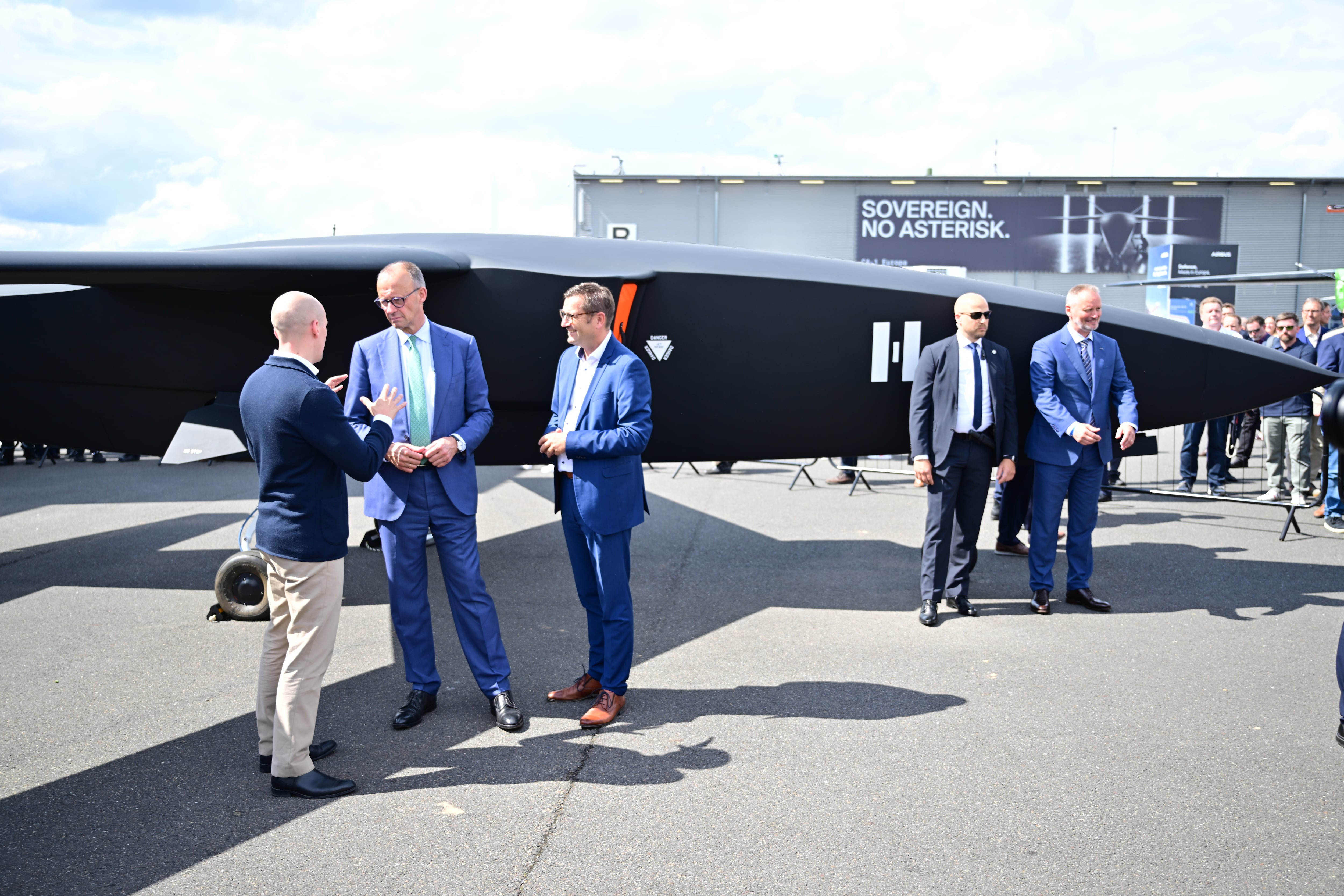
Europe's Biggest Defense Round Ever
Helsing, the Munich-based defense technology company, raised 1.8 billion dollars in a Series E that values it at 18 billion dollars, the largest defense-startup financing in European history. The growth equity arm of Goldman Sachs Alternatives led, joined by Dragoneer Investment Group, Iconiq, the Canada Pension Plan Investment Board and JPMorgan Chase. Existing investors including Lightspeed Venture Partners, General Catalyst and Plural also participated. The company said investor demand significantly exceeded the available allocation, reflecting strong and growing confidence in AI-driven and software-defined defense.
That oversubscription is the headline for anyone tracking capital flows. Defense was, until recently, a sector venture firms avoided on ethical and return grounds. The war in Ukraine, a rearming Europe and a hard pivot toward software-defined systems have rewritten that calculus. When a pension fund and two of Wall Street's largest institutions crowd into a single round and still cannot get their full allocation, the message is that defense AI has become a mainstream growth category, not a fringe bet, and that the appetite now exceeds the supply of credible companies.
A Company That Builds the Whole Stack
Helsing bills itself as a hardware and software platform for defense. It makes AI-powered strike drones designed to operate in GPS-denied and electronically contested environments, and it builds underwater surveillance systems to protect critical infrastructure such as subsea cables and pipelines. Crucially, it develops the autonomous software that powers these systems rather than licensing it from others. The company says the new capital will accelerate its mission to develop and integrate entirely new AI platforms into the defense capabilities of its growing number of partner nations.
Owning both the software and the hardware is a deliberate strategy. In modern conflict, the differentiator is increasingly the autonomy stack, the perception, targeting and coordination software, not the airframe. By controlling both layers, Helsing can iterate the intelligence of its systems on software timelines while retaining the manufacturing base to field them at scale. That vertical integration is what lets it argue it is more than a contractor. It is positioning as a full-stack platform, closer in shape to a technology company than to a traditional European defense supplier.
The Sovereignty Argument
Helsing has leaned hard on its European identity, emphasizing that it remains predominantly European owned. That is not incidental branding. As European governments confront the reality that they cannot indefinitely depend on US primes and US political goodwill for their most sensitive capabilities, a homegrown champion with credible autonomy technology becomes strategically valuable. The sovereignty pitch resonates with procurement officials who now weigh supply-chain independence and data control as heavily as raw performance.
We see this as the same sovereign-technology impulse reshaping cloud and AI infrastructure across the continent, now applied to weapons. Governments want the compute, the models and the systems that matter most to sit under domestic control and domestic law. Helsing is building the defense-sector version of that thesis, and its investor base of European venture firms plus deep-pocketed global institutions is engineered to fund scale while preserving the sovereignty story. For partner nations, buying from Helsing is a way to rearm without deepening dependence on a single foreign supplier.
Why the Capital Markets Changed Their Mind
The scale of this round reflects a structural shift in how investors view defense. Software-defined systems promise the margins, iteration speed and scalability that venture and growth capital understand, unlike the low-margin, long-cycle hardware programs that defined the old industry. An AI drone that improves through software updates looks more like a technology product than a munition, and that reframing is what unlocked institutional money at technology valuations rather than industrial ones.
There is also a demand-side reality. European defense budgets are rising sharply, and governments are actively seeking non-traditional suppliers to inject speed and innovation into procurement. That combination, a growing budget pool and a policy preference for new entrants, gives a company like Helsing a credible path to the revenue that an 18 billion dollar valuation requires. Investors are not betting on a single contract. They are betting that the entire European defense market is being restructured in favor of software-first suppliers, and that Helsing is the clearest leader of that cohort.
The Risks Behind the Valuation
An 18 billion dollar valuation for a company whose revenue depends on government procurement carries real risk. Defense contracts are slow, political and lumpy, and a change in the security environment or a shift in coalition politics could cool the current buying spree. The autonomy technology also raises hard ethical and legal questions about accountability in lethal systems that regulators across Europe have only begun to address, and tighter rules could constrain deployment or slow sales.
There is execution risk too. Building drones and underwater systems at national scale is a manufacturing challenge as much as a software one, and Helsing must now industrialize without losing the iteration speed that makes it attractive. The company is raising at a level that assumes flawless scaling into a market that has never rewarded startups this richly. If it delivers, it becomes Europe's defense technology anchor. If procurement stalls or the ethics debate hardens, the valuation will look stretched. For now, the market has decided the upside justifies the bet.
What This Signals for Enterprise Tech
Helsing's round is a marker of how far the AI capital cycle has traveled. Money is flowing beyond consumer chat and enterprise copilots into physical, high-stakes domains where autonomy meets hardware. Defense, like drug discovery and industrial systems, is a place where AI produces value that is hard to replicate and expensive to build, which is exactly why investors are willing to underwrite it at scale. The pattern of software-defined disruption is now reaching the most conservative industries.
For technology executives, the broader lesson is about the durability of software-defined advantage. Helsing's thesis is that controlling the intelligence layer, and iterating it faster than incumbents can, wins even in markets historically dominated by hardware and relationships. That thesis is being tested with real capital in one of the least forgiving sectors. However it resolves, it confirms that the center of gravity in defense, as in so many industries, is moving toward the companies that own the software and the data, and can improve them on their own schedule.