Showing Up With the Patches
On June 22, 2026, OpenAI and security firm Trail of Bits launched Patch the Planet, an initiative under OpenAI's Daybreak security program aimed at the software almost no one owns and everyone depends on. The pitch is refreshingly concrete. Rather than scanning for vulnerabilities and dumping reports on overwhelmed volunteers, the program pairs frontier AI models with full-time human security engineers who carry findings all the way to merged fixes. Trail of Bits put it bluntly in its announcement: "Anyone can file an issue, flex, and walk away. We showed up with the patches."
We find this framing more interesting than most AI-for-security announcements because it inverts the usual hype. The marketing of AI in cybersecurity has fixated on detection, the thrill of an autonomous agent uncovering a zero-day. Patch the Planet concedes that detection is becoming commoditized and that the genuine bottleneck is remediation. That is a more honest read of where AI actually helps today, and it points enterprise buyers toward the right question: not how many bugs a tool finds, but how many it credibly closes.
The Numbers From Week One
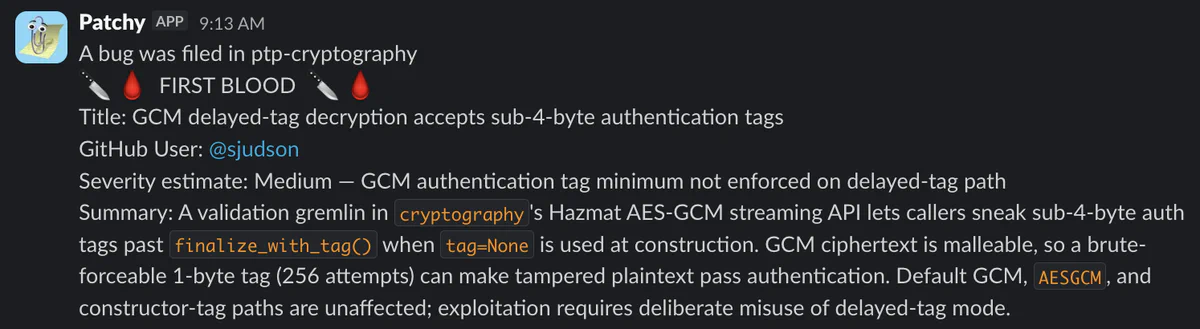
The early results are specific enough to take seriously. In the first week the program reported hundreds of discovered bugs, 64 pull requests, 51 issues filed, and 37 merged patches across 19 open-source projects. Of the issues filed, 19 were already closed with fixes. Trail of Bits dedicated security engineers to work full-time alongside Codex and GPT-5.5-Cyber, OpenAI's most cyber-capable model, and more than 30 additional projects have committed to join. These are modest absolute figures, but the velocity and the merge rate are what matter.
The list of initial projects reads like a map of the internet's load-bearing infrastructure: cURL, Python and python.org, the Go project, aiohttp, Sigstore, pyca/cryptography, NATS, urllib3, PyPI, freenginx, Valkey, and RustCrypto. A vulnerability in any one of these can ripple through millions of downstream systems, including the enterprise stacks our readers run. Concentrating expert attention and model assistance on exactly these chokepoints is a defensible use of resources, and it is the kind of work that rarely gets funded because no single company owns the outcome.
Finding Bugs Is Now the Easy Part
Trail of Bits captured the thesis in a single line: "Finding the bugs is now the easy part." The firm noted that frontier models like GPT-5.5-Cyber are producing a firehose of security findings, which is both the opportunity and the problem. Open-source maintainers, most of them unpaid volunteers, are already drowning in low-quality, AI-generated bug reports that consume time without improving security. An avalanche of machine-found issues with no fixes attached is not help, it is noise.
This is the most important nuance in the announcement, and it should reshape how CISOs think about AI security tooling. The same models that can flood your backlog with findings can, with disciplined human review, also produce tested patches. The differentiator is the workflow around the model, not the model itself. Patch the Planet's design, where engineers vet findings before they ever reach a maintainer and then co-develop the fix and the test, is a template worth studying for any internal vulnerability program drowning in automated alerts.
Funding the Commons, With Strings
Participating projects receive tangible support: access to ChatGPT Pro, conditional access to Codex Security, and API credits for core development, maintainer automation, and release workflows. For chronically under-resourced open-source teams, that is real value, and it begins to address the long-standing complaint that trillion-dollar industries free-ride on the unpaid labor of a handful of maintainers. GPT-5.5-Cyber itself remains restricted, available only to verified government and institutional defenders, which keeps the most capable model out of attackers' hands.
We would be naive not to note the strategic upside for OpenAI. Hardening the open-source ecosystem also seeds dependence on OpenAI's tools inside the projects that everyone else builds on, and it doubles as a high-profile demonstration of GPT-5.5-Cyber's capabilities. That does not make the work less valuable, but it does mean the commons is being improved on a vendor's terms. The healthiest outcome would be multiple labs and security firms running comparable programs, so that critical infrastructure is not quietly tethered to any single provider's roadmap.
The Takeaway for Defenders
For enterprise security leaders, Patch the Planet is both a benefit and a signal. The benefit is direct: if your stack depends on cURL, Python, or any of these projects, their attack surface is being actively reduced by people and models you do not have to pay for. The signal is about your own program. If frontier models are making vulnerability discovery cheap for defenders, they are doing the same for attackers, and the advantage will go to whoever can remediate fastest, not whoever can scan most.
Our practical recommendation is to invest in the patch pipeline, not just the detection layer. That means triage that can absorb a higher volume of findings, testing infrastructure that can validate AI-suggested fixes quickly, and review discipline that keeps a human between the model and production. Patch the Planet works because it pairs model speed with human judgment at the point of merge. Enterprises that copy that pattern internally will be the ones that turn the coming flood of AI-found bugs into closed tickets rather than open risk.