OpenAI Courts Southeast Asia's Builders
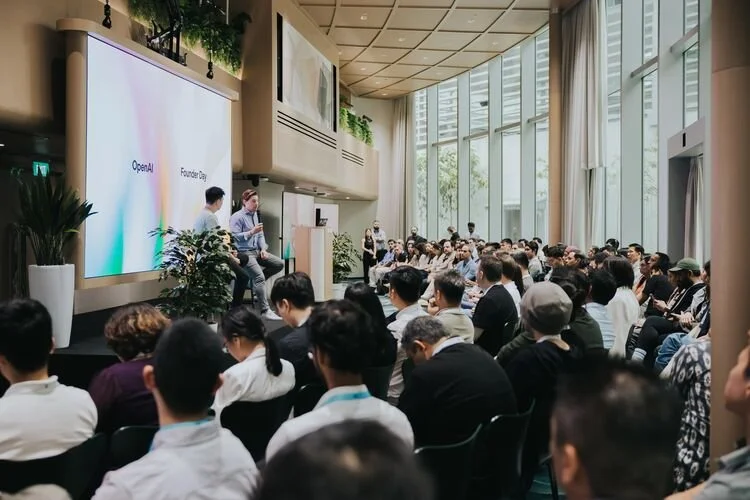
OpenAI has opened applications for Founder Day Singapore, a half day event for startup founders, developers and builders from across Southeast Asia, scheduled for Monday, June 22, 2026, from 2:00 p.m. to 6:30 p.m. Attendance is application based with limited spaces, and the programme is explicitly designed around implementation: product updates, live demonstrations and workshops on agentic workflows, the Codex coding technology and multilingual experiences.
We read this as a workforce and developer education play dressed as an ecosystem event. OpenAI is not running a generic introduction to generative AI; it is teaching builders how to ship products on its models and APIs. That distinction matters. The skills being transferred, agentic orchestration, code generation, multilingual deployment, are precisely the capabilities that separate a prototype from a production system, and they are in short supply across the region's fast growing startup scene.
Implementation Over Introduction
The agenda leans heavily toward hands on learning: opening remarks on the state of the AI ecosystem, product updates and live demonstrations, technical workshops, small group breakout sessions, an ask me anything with OpenAI representatives, startup showcases and a networking reception. The structure deliberately favours depth over breadth, with breakout groups and demonstrations rather than keynote theatre. It is closer to a focused training day than a conference.
This is a smart format for the audience. Founders and senior developers do not need to be sold on AI; they need to be shown how to use the newest capabilities well. By centring the day on agentic workflows and Codex, OpenAI is targeting the exact friction points where teams stall, moving from a chatbot demo to reliable autonomous systems. We see the same pattern across the industry, where the binding constraint on AI adoption is no longer model quality but the scarcity of people who can build with it competently.
The Voices Steering the Room
The listed speakers are Teri Yu of OpenAI's Multimodal API Product team, Thomas Jeng, Head of Startups for Asia-Pacific, and Wulfie Bain, Applied AI Lead for Startups, International. Bain framed the event's intent directly. "We're bringing together a select group of startup founders, developers and builders from across the region," he said. "You'll get an inside look at what we're building on the frontier, and how top startups are building with OpenAI."
That framing reveals the dual purpose. The event is partly education, transferring frontier knowledge to regional builders, and partly cultivation, deepening the dependency of those builders on OpenAI's stack. We do not say that cynically: developers genuinely benefit from direct access to the people who build the products. But enterprises and educators should recognize that vendor run skilling, however useful, optimizes for fluency in one ecosystem rather than portable, vendor neutral competence.
Why Singapore, Why Now
Singapore has positioned itself as the applied AI hub for Asia-Pacific, and OpenAI has been investing accordingly, building a regional presence and applied AI capacity in the city state. Founder Day extends that footprint into community building, putting the company's product teams in front of the founders most likely to become anchor customers and showcases. The Southeast Asia framing widens the net beyond Singapore to a region of more than 600 million people with surging digital adoption.
The geographic strategy is deliberate. As model providers compete globally, the battle is increasingly fought through developer ecosystems in emerging markets where the next wave of AI native companies will form. Whoever trains those builders first tends to win their default loyalty. We expect Singapore to remain a focal point for this competition, with every major provider running its own version of skilling events aimed at the region's startup talent.
What Builders and Buyers Should Take Away
Several practical details are undisclosed: the number of available places and the application deadline. The selectivity signals a curated audience, which concentrates value among already serious builders rather than broadening access to newcomers. For founders who get in, the return is direct exposure to frontier roadmaps and the engineers behind them, which is hard to replicate through documentation alone.
The broader signal for enterprise leaders is that AI capability is now being distributed through vendor cultivated communities, not just universities and bootcamps. That shifts where talent forms and which ecosystems it forms around. We would advise teams to take the learning while staying clear eyed about lock in, pairing vendor specific skilling with the vendor neutral fundamentals that keep an organization's AI strategy portable. The demand for builders who can ship is real, and events like this are one answer to it.