A Guidance Cut Becomes a Sector Reckoning
When Accenture trimmed the top end of its annual revenue forecast on June 18, the reaction was not a polite repricing. It was a rout. Accenture itself fell as much as 17 percent in New York, the steepest single-session drop the consultancy has seen since 2016, wiping out roughly a year of patient gains in a single afternoon. The narrowing looked modest on paper: full-year growth guidance moved from 3 to 5 percent down to 3 to 4 percent in local currency. Markets do not trade on the midpoint, they trade on the direction, and the direction was unmistakably down.
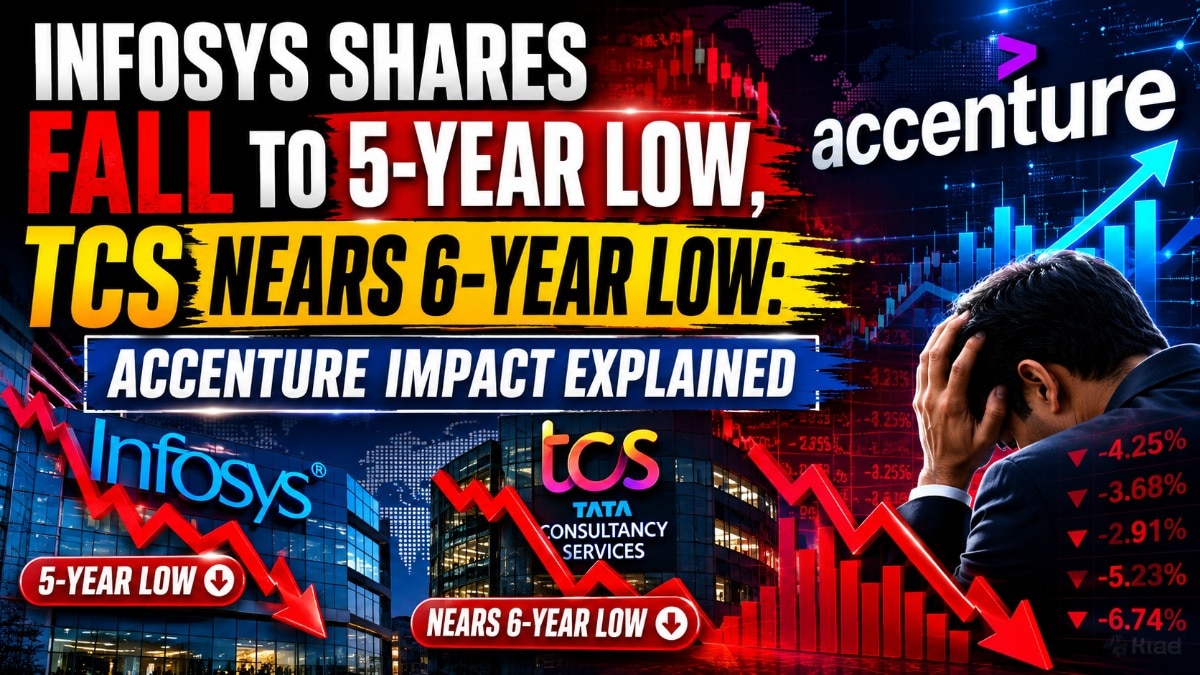
By the time trading opened in Mumbai on June 19, the contagion had crossed the ocean. The Nifty IT index cracked roughly 6 percent to around 27,012, a level it had not seen in more than three years. Infosys led the decline, sliding about 8 percent to 1,035 rupees, a five-year low and the worst performer on the Nifty 50. TCS sank about 6.5 percent to near 2,060 rupees, closing in on a six-year low. Mphasis, Tech Mahindra, HCLTech and Persistent all bled in sympathy. The market had decided that Accenture's caution was a leading indicator for everyone.
Why Accenture Sneezes and Bengaluru Catches Cold
The reflex is well established, and it is not irrational. Accenture is the largest player in the same enterprise services market that Indian firms compete in, and its quarter ends on May 31, ahead of the Indian majors who report on calendar quarters. That timing makes Accenture's print a real-time read on demand that Infosys and TCS will only confirm weeks later. When Accenture says enterprise clients are slowing discretionary spend, the read-across is that the same clients are slowing spend with everyone, including the Indian vendors that frequently sit on the execution side of Accenture-led programs.
The numbers underneath the guidance cut justified the nervousness. Accenture's new bookings came in at 19.32 billion dollars, down 2 percent in dollar terms, the first decline in recent memory and the metric the Street watches most closely as a forward signal. Revenue of 18.7 billion dollars missed slightly even as adjusted earnings per share of 3.80 dollars beat. Profitability is intact, in other words, but the order machine is sputtering. For a sector that sells future delivery capacity, a softening backlog is more damaging than a soft quarter.
Geopolitics Meets Discretionary Caution
Management pinned part of the weakness on the Middle East, citing roughly 400 million dollars knocked off the quarter by the Iran conflict, with more pressure expected into the fourth quarter. That is a clean, exogenous explanation, and it is partly comforting because conflicts eventually de-escalate. But it is also a convenient one. The more structural worry buried in the commentary is the slow conversion of AI bookings into recognized revenue, and a broader pattern of enterprise clients elongating deal cycles and deferring the discretionary projects that carry the best margins.
Nomura captured the lingering doubt, warning that the indirect impacts could continue into the September quarter because it is not clear how quickly spending behavior will normalize, particularly in challenged sectors like automotive. That is the sentence that matters for the Indian names. A one-off war premium is survivable. A multi-quarter freeze in discretionary technology spending across automotive, manufacturing and consumer is a demand problem that no amount of cost discipline fully offsets.
Not All Exposure Is Equal
The selloff treated the Indian majors as a bloc, but the underlying exposure is uneven. Goldman Sachs singled out Wipro as the most vulnerable, flagging the risk of a fourth consecutive year of revenue decline. That is a sobering assessment for a company that has spent the past year chasing large transformation mandates to reset its growth trajectory. Infosys, despite leading Thursday's fall, enters this window from a position of relative operational strength, though its shares have now retraced more than a third from their December 2025 high near 1,655 rupees.
TCS occupies the steadiest ground of the three, with the deepest banking and retail relationships and a more diversified geographic mix, yet even it could not escape a 6.5 percent haircut. The lesson for investors is that in a demand-led drawdown, correlation spikes and differentiation disappears for a session or two, only to reassert itself as the dust settles. We would expect the next round of company-specific bookings disclosures to begin separating the resilient from the exposed, with deal pipeline quality, not headline growth, doing the sorting.
The AI Paradox at the Heart of the Slump
There is an uncomfortable irony in this episode. The same generative and agentic AI wave that the entire sector has positioned as its growth engine is, for now, suppressing the very revenue it is meant to expand. Clients are signing AI bookings, but conversion into billed work is lagging, and in parallel AI-driven productivity is compressing the labor-arbitrage model that built these firms. With roughly three-quarters of Accenture's workforce sitting in low-cost locations, including around 325,000 staff in India, the efficiency that AI promises clients is also a threat to the headcount-linked revenue these companies have historically banked.
This is the strategic tension digital-transformation leaders should sit with. The pitch to enterprise buyers is that AI lets you do more with less, faster. If that pitch is true, the services providers selling it must reinvent how they price and staff engagements before the productivity dividend lands entirely with the client. The market's June 19 verdict was, in part, an early bet that the integrators have not yet solved that pricing puzzle, and that revenue per program is heading down even as ambition heads up.
What CIOs Should Take From the Tape
For the enterprise buyer watching this volatility, the practical signal is leverage. A services market where the largest player is cutting guidance and the Indian challengers are at multi-year lows is a buyer's market. Deal cycles that vendors describe as elongated are, from the client side, simply more deliberate, and that deliberation is being rewarded with sharper pricing and more outcome-based terms. CIOs renegotiating master services agreements or scoping AI modernization programs in the second half of 2026 will rarely find a more favorable negotiating posture than this one.
The caution, of course, cuts both ways. A vendor under revenue pressure is a vendor tempted to overpromise on AI delivery to win the logo, and the gap between booked AI ambition and delivered AI value is exactly what is unsettling the market. Our advice is to treat the discount as real but the delivery risk as equally real: tie payments to milestones, insist on demonstrable conversion of pilots into production, and do not confuse a depressed share price with a derisked engagement. The firms that emerge strongest from this window will be the ones that prove conversion, not the ones that simply promise it.