A Transparency Tool Becomes a Disinformation Channel
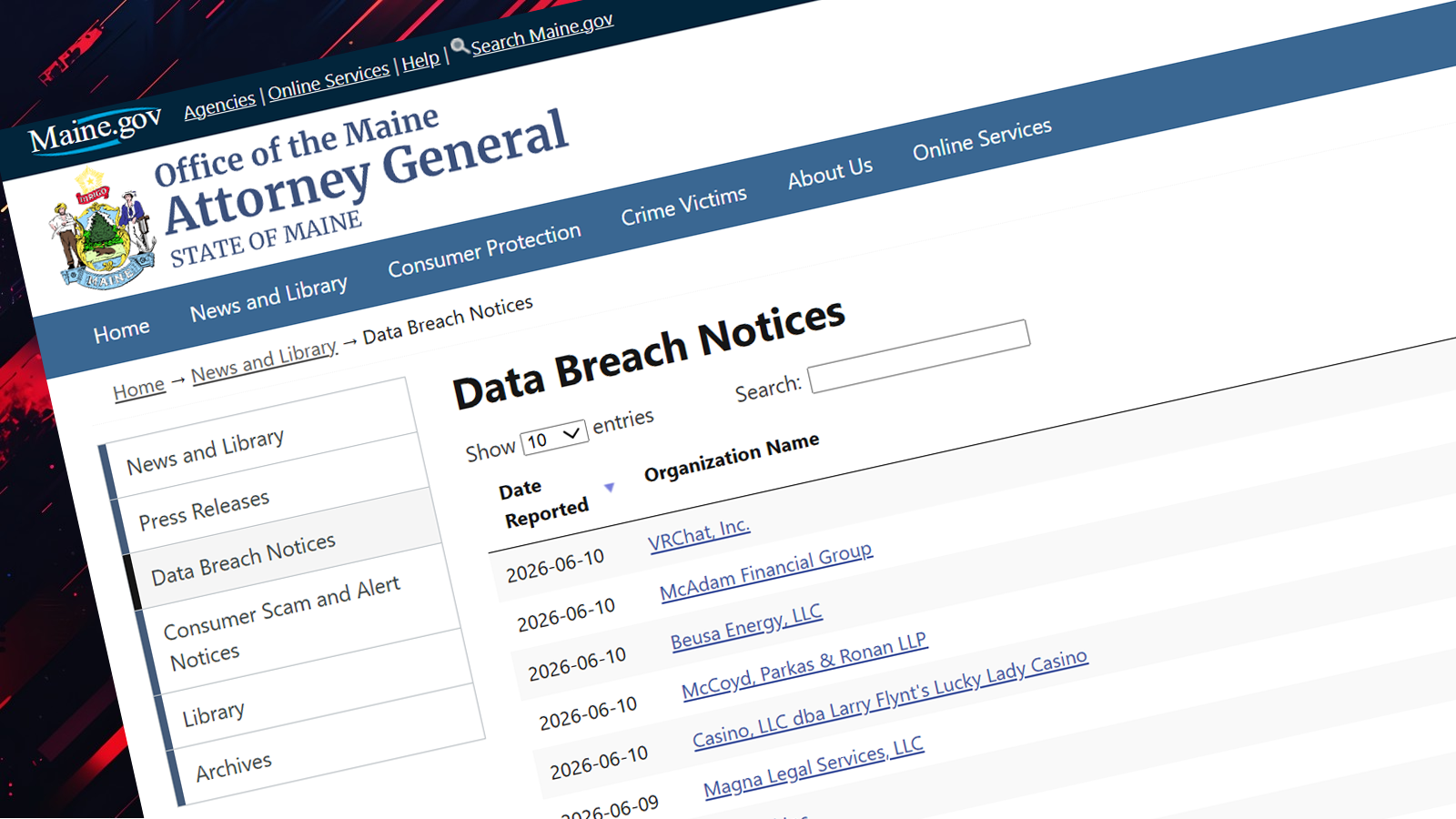
Maine's Office of the Attorney General took its public data breach reporting portal offline this week after discovering that someone had used it to publish entirely fabricated breach notices. On June 12, 2026, the office confirmed that two high-profile disclosures, one claiming a breach at VRChat affecting 2.4 million people and another alleging that insider wrongdoing at Discord had exposed more than 10 million, were hoaxes filed by an unknown entity with no connection to either company. The VRChat filing even named a fabricated employee as the corporate contact, an attempt to lend the fake notice an air of authenticity that briefly succeeded.
For those of us who treat regulatory breach databases as ground truth, this is an uncomfortable moment. Maine's portal is one of the most widely watched breach registries in the United States, mined daily by journalists, threat intelligence analysts, and security researchers precisely because it aggregates disclosures in a clean, searchable feed. The incident did not involve a hack of Maine's systems at all. It exploited a design decision: submissions from the online reporting form flowed directly onto the public site without any human in the loop to verify them. The integrity gap was procedural, not technical, and that makes it both easier to fix and harder to excuse.
How the Hoax Worked
The mechanics were almost trivially simple. Maine, like most US states, requires organizations to notify the attorney general when residents' personal information is exposed. To make that process frictionless, the state built a web form that accepts a submission and pushes it straight to the public database. As the AG's office candidly admitted, the system carried no independent confirmation step: the submitting party fills in the details and they appear online. An attacker, or simply a mischief-maker, needed only to fill out the form with a convincing company name, a plausible victim count, and a fake contact to manufacture a breach that never happened.
That this had not happened sooner is the surprising part. Breach notification portals across the country share the same architecture, optimized for speed and transparency rather than authentication. The Maine episode is a proof of concept that anyone now has, and it lands at a time when threat actors routinely fabricate breach claims on dark web forums to extort companies or manipulate stock prices. Moving a fake claim from an obscure cybercrime channel onto an official government website is a meaningful escalation in credibility, and that is exactly the leverage a disinformation actor would want.
Why VRChat and Discord Were Plausible Targets
The choice of impersonated victims was shrewd. Both VRChat and Discord are consumer platforms with enormous user bases and genuine histories of security scrutiny, which made the fabricated claims land as believable rather than absurd. A notice asserting that Discord had suffered an insider-driven exposure of 10 million records does not strain credulity in 2026, when insider threats and third-party compromises are routine headlines. The attacker leaned on that ambient plausibility, knowing that an official-looking filing would propagate through breach trackers and news aggregators before anyone called the companies to confirm.
It took direct conversations between Maine officials and VRChat to establish that the reports were false. As the attorney general's office put it, after talking with VRChat it became clear the reported breaches were hoaxes submitted by an unknown entity. Discord, for its part, did not respond to requests for comment, which only underscores the problem: verification depends on the impersonated company being reachable and willing to engage, and there is no guarantee of either. For the window between publication and rebuttal, the fake notices were, for all practical purposes, real.
The Verification Gap in Public Breach Registries
This incident exposes a structural weakness that extends well beyond Maine. State breach registries were designed in an era when the assumption was that companies would underreport, not that bad actors would overreport on others' behalf. The entire trust model rests on the idea that no organization would falsely confess to a breach. That assumption is now broken. Once you accept that submissions can be adversarial, the open-publish design looks less like transparency and more like an unauthenticated content management system pointed at the public internet.
Maine's interim response is reasonable but blunt: companies can still file notices, but the public database is dark and anyone seeking breach information must contact the attorney general's office directly. That restores integrity at the cost of the very transparency the portal was built to provide. The durable fix is a verification layer, some combination of domain-validated contacts, callbacks to known corporate security addresses, or a short hold-and-review queue before publication. None of that is technically hard. It simply requires treating the submission pipeline as an attack surface, which until this week it apparently was not.
What Security Leaders Should Take From This
For CISOs, the immediate lesson is about monitoring your own name. If your organization relies on threat intelligence feeds that ingest state breach registries, you should assume those feeds can now carry fabricated entries about your company. A false notice claiming you suffered a breach could trigger customer panic, regulatory inquiries, and reputational damage long before you can prove it never happened. Building a process to watch for impersonation on official portals, and a fast-response playbook to rebut it, belongs on the same shelf as your dark web monitoring.
The broader takeaway is that data integrity is now a security property of public infrastructure, not just a feature of internal systems. We spend enormous effort defending the confidentiality of breach data and almost none on the authenticity of breach disclosures. Maine has handed every state a free lesson in why that imbalance is a mistake. Expect copycat filings to surface elsewhere, and expect other attorneys general to quietly audit whether their own portals publish first and verify never. The transparency mission is worth preserving, but only if the channel carrying it can be trusted.