A Layer Above the Agents
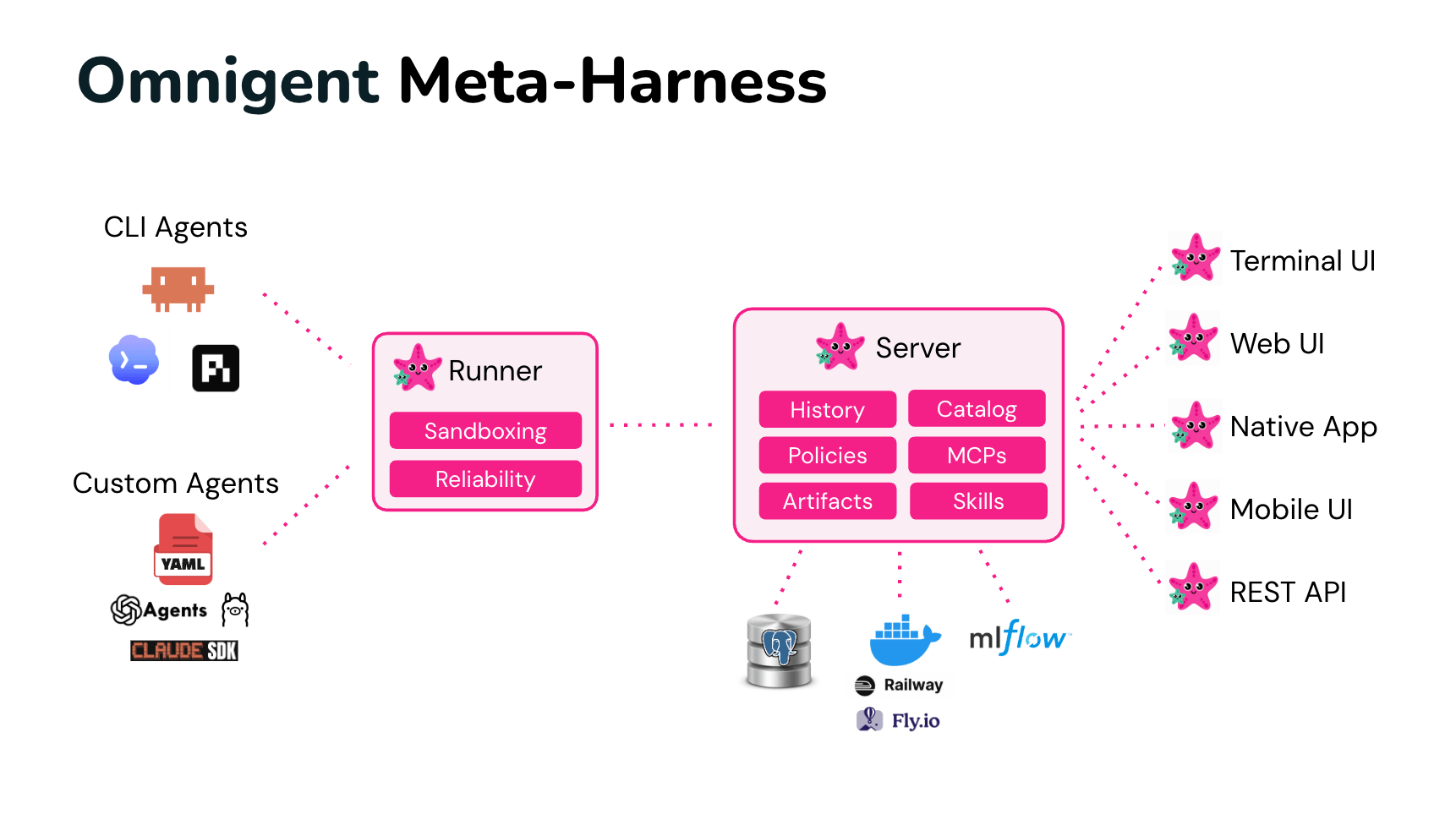
Databricks has released Omnigent, an open-source meta-harness under the Apache 2.0 license that sits one layer above individual agent harnesses, giving engineers a single interface to combine, govern, and share AI coding agents such as Anthropic's Claude Code, OpenAI's Codex, and Pi. The framing is the strategy. Rather than competing to build the best single agent, Databricks is building the layer that orchestrates whichever agents an organization chooses to run, a deliberately neutral position in an increasingly crowded field.
The company articulated the thesis plainly in its announcement, authored by co-founder and Chief Technology Officer Matei Zaharia and product lead Kasey Uhlenhuth. "Agent harnesses made models swappable," they wrote. "We believe the next layer of abstraction is the meta-harness, the layer above every harness where composition, control, and collaboration live." That sentence is a bet about where durable value will accrue, and it is worth taking seriously given Databricks' track record of reading platform shifts early.
Composition, Control, and Collaboration
Omnigent organizes its value around three enterprise problems that no single agent tool solves well. The first is composition: the ability to mix harnesses and models, even swapping them mid-session, so teams are not locked into one vendor's capabilities or pricing. The second is control: policy-based governance and cost budgeting enforced by the platform rather than improvised through prompts. The third is collaboration: live session sharing across terminal, web, desktop, and mobile, so agent work becomes a shared activity rather than a solitary one.
Each of these maps to a real pain point that enterprises hit the moment they move agents beyond experimentation. Composition addresses lock-in. Control addresses the governance vacuum that makes security and finance teams nervous about autonomous agents. Collaboration addresses the reality that software is built by teams, not individuals. By targeting the gaps between tools rather than competing inside them, Databricks is staking out territory that becomes more valuable precisely as the number of agent options proliferates.
Governance as the Real Product
The control dimension is, in our reading, the most consequential. Omnigent enforces stateful, contextual policy and cost budgeting at the platform level, which directly answers the question that stalls most enterprise agent deployments: how do you let an autonomous system act without ceding oversight of what it does and what it costs? Prompt-based guardrails are brittle and unauditable. Policy enforced by an external layer is the kind of control that security and compliance functions can actually sign off on.
This is the unglamorous work that determines whether agentic AI graduates from pilots to production. The technology to make agents capable already exists; what has been missing is the scaffolding to make them governable. Cost budgeting deserves particular attention, because long-running agent sessions consume real and sometimes surprising amounts of inference compute. A platform that lets an organization cap and attribute that spend addresses a problem that has caught more than a few finance teams off guard this year.
The Vendor-Neutral Gambit
By open-sourcing Omnigent and supporting the OpenAI Agents SDK, the Claude Agents SDK, and custom agents alongside an OS-level sandbox called Omnibox, Databricks is positioning itself as a Switzerland in the agent platform wars. It is not asking customers to abandon their preferred models or tools; it is offering to manage all of them. For enterprises wary of placing a large bet on any single AI vendor at a moment of rapid change, that neutrality is genuinely appealing.
The strategic logic is familiar from earlier platform eras. When the underlying components are commoditizing and changing fast, the orchestration and governance layer often captures more durable value than any individual component. Databricks is wagering that models and harnesses will keep churning, while the need to compose, control, and collaborate across them will persist. If that thesis holds, Omnigent positions the company at a choke point that grows more important as the ecosystem fragments.
What Enterprises Should Watch
For technology leaders, Omnigent is worth evaluating less as a finished product, it ships as an open-source alpha, and more as a statement about how to architect agent adoption. The principle it embodies, that organizations should retain a neutral, governable layer above the agents they deploy rather than hard-wiring themselves to one vendor's stack, is sound regardless of whether they ultimately adopt this specific tool. Optionality and oversight are the right defaults in a fast-moving market.
We would temper enthusiasm with realism about maturity. An alpha release requiring specific runtimes and sandboxes is not a turnkey enterprise platform, and serious deployment will demand hardening, integration, and operational investment. But the direction is the signal that matters. As agentic AI moves from novelty to infrastructure, the winners will be those who treat governance and composability as first-class requirements from the start, and Omnigent is a credible articulation of what that looks like in practice.