Who just left, and for where
Bikash Koley spent more than 16 years at Google across two separate stints, most recently as vice president of global infrastructure and capacity, before leaving this week to join Crux AI as its chief technology and product officer. Before Google, Koley was CTO and EVP of Juniper Networks, founder and CTO of Qstreams Networks, and a lead engineer at Ciena, giving him a career entirely spent on network and infrastructure engineering at scale rather than product or research roles. That background is precisely the skill set a young neocloud needs most when it is trying to go from announced capacity to energized megawatts on a tight timeline.
Koley marked the move on LinkedIn with language about pushing the envelope on modern consumable infrastructure and continuing the pursuit to engineer and scale next-generation infrastructure. Whatever the exact framing, the substance is straightforward: one of the people most directly responsible for how Google's own global data center fleet is built and run has chosen to build the same kind of infrastructure for a Google-backed competitor instead. Google remains both his former employer and, through its Blackstone joint venture, an investor in the company he just joined, which makes this less a clean departure than an internal transfer across a corporate boundary that happens to be a different legal entity.
What Crux AI actually is
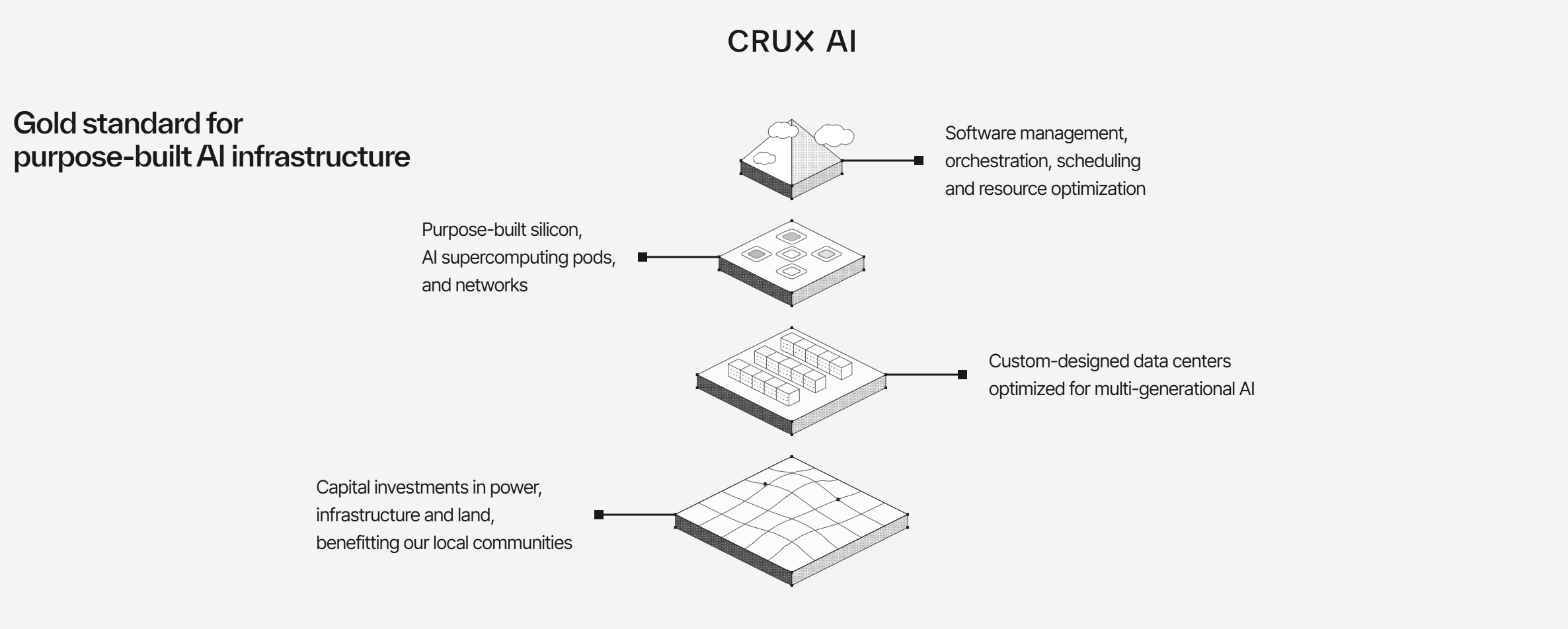
Crux AI is a neocloud, meaning a cloud provider focused specifically on AI compute, built around Google's TPU chips rather than Nvidia GPUs. It operates as a joint venture between Google and Blackstone, with Blackstone providing an initial $5 billion equity commitment and Google supplying TPUs, software, and services. The venture is run by Benjamin Treynor Sloss, a former Google vice president of engineering, which means Crux AI's two most senior technical leaders, Treynor Sloss and now Koley, both came directly from Google's own infrastructure organization, carrying institutional knowledge of how Google actually operates a TPU fleet at global scale into a nominally independent competitor.
The company has publicly stated a target of bringing 500 megawatts of capacity online in 2027, with a plan to scale to 2 gigawatts after that. Those are serious numbers for a company still in its first year of public operation, and they put Crux AI in direct competition with the much larger bench of Nvidia GPU-focused neoclouds that have dominated AI infrastructure headlines for the past two years. Hitting even the 2027 figure would make Crux AI one of the larger single AI capacity additions announced by any operator this year, TPU-based or not.
Why Koley's hire matters more than a normal executive move
Executive poaching between competitors is routine in any fast-growing sector, but this particular hire carries extra signal because of timing and sequence. Last month, Crux AI hired Alan Duong away from Meta, where he was vice president and head of data center engineering and construction, with responsibility for end-to-end delivery of multiple gigawatts of capacity, including power procurement, design, construction, and handover. His experience included leading a 2023 data center redesign at Meta specifically for AI workloads.
Pulling two senior infrastructure executives from two different hyperscalers within a matter of weeks is a deliberate signal, not a coincidence. Crux AI appears to be assembling a leadership team that has personally built gigawatt-scale infrastructure before, rather than hiring executives with AI credentials but no track record of actually delivering power and construction at this scale. That is the right team to build if you genuinely intend to hit a 2 gigawatt target, which is itself a tell about how seriously Google and Blackstone are taking this bet.
The part that should make you skeptical
None of this hiring activity has yet translated into confirmed delivery. Bloomberg has reported delays at major Crux AI sites, including a Cheyenne, Wyoming project involving Crusoe that Google reportedly abandoned. Crux AI has not published a full site list or a revised delivery plan, which means the 500 megawatt target for 2027 remains a stated goal rather than a verified trajectory, and the gap between announced targets and delivered capacity has become a recurring theme across the entire neocloud sector this year.
Hiring a credible construction and infrastructure team is a necessary condition for hitting an aggressive capacity target, but it is not a sufficient one. Power procurement, grid interconnection, equipment supply chains, and local permitting all sit outside any individual executive's direct control, and plenty of well-staffed infrastructure projects have slipped regardless of who was running them. The honest read on this week's hire is that Crux AI just improved its odds of execution, not that it has solved the execution problem.
What a credible TPU alternative would actually change
If Crux AI does deliver anywhere close to its stated targets, it would represent something genuinely new in the market: a large-scale, publicly available AI cloud built on an architecture other than Nvidia GPUs, backed by both a hyperscaler's chip supply and a major institutional investor's balance sheet. That combination does not currently exist anywhere else at this scale, and it would give enterprise AI buyers a real pricing and architecture alternative to the Nvidia-centric capacity crunch that has defined the last two years of AI infrastructure procurement.
It would also create an unusual competitive dynamic for Google itself, which would be backing a TPU-based cloud provider that competes for the same AI workload customers as its own Google Cloud Platform, under a different brand and ownership structure. That overlap looks presumably intentional, a hedge that lets Google capture TPU-based AI infrastructure revenue even from customers who prefer to avoid buying directly from a hyperscaler. It remains a structure worth watching for how Google manages the internal conflict it creates between its own cloud sales team and a venture it co-owns.
What this means for your own infrastructure planning
If your AI roadmap currently assumes Nvidia GPU capacity as the only realistic option, Crux AI's hiring pattern is a signal to at least start tracking TPU-based alternatives as a live possibility for 2027 planning, even if you do not act on it yet. A credible second architecture, backed by serious capital and serious construction talent, changes the negotiating leverage every AI infrastructure buyer has with their current Nvidia-dependent suppliers, whether or not you ever actually switch.
The more immediate lesson is procedural: treat executive hiring announcements from any neocloud, TPU-based or GPU-based, as a leading indicator worth noting, not as confirmation that capacity is coming. Put a specific milestone on your calendar, Crux AI's first confirmed megawatts actually energized in 2027, and revisit your own vendor diversification plans against that milestone rather than against this week's hiring headline. The executives are a genuine signal of intent. The energized capacity is the only signal that actually changes what you can buy.