The numbers behind the headline
Equinix reported $533 million in annualized gross bookings for the third quarter of 2026, a record for the company, up 35 percent year over year and 26 percent from the second quarter alone. New-deal pricing rose 12 percent year over year in the same period, a figure that matters more than the bookings total itself: Equinix is signing substantially more deals at meaningfully better rates than a year ago, in a business where pricing power had been relatively flat for years before this cycle began.
Revenue for the quarter came in at $2.57 billion, up 11 percent year over year even though it dipped slightly from the second quarter's $2.63 billion. Net income reached $489 million, and funds from operations hit $858 million. Utilization across stabilized data centers stood at 83 percent, a level that leaves comparatively little room for Equinix to absorb new demand without bringing additional capacity online, which is precisely the constraint driving the pricing dynamics described above.
A third consecutive raise is the real signal
Equinix raised its full-year 2026 revenue guidance to a range of $10.33 to $10.37 billion, up from a prior range of $10.21 to $10.29 billion, and this is the third straight quarter the company has raised its outlook. A single beat-and-raise quarter can reflect a one-time deal or favorable timing. Three consecutive raises reflect a demand environment that has been consistently underestimated by the company's own forecasting, quarter after quarter, which is a stronger signal than any single quarter's results on their own.
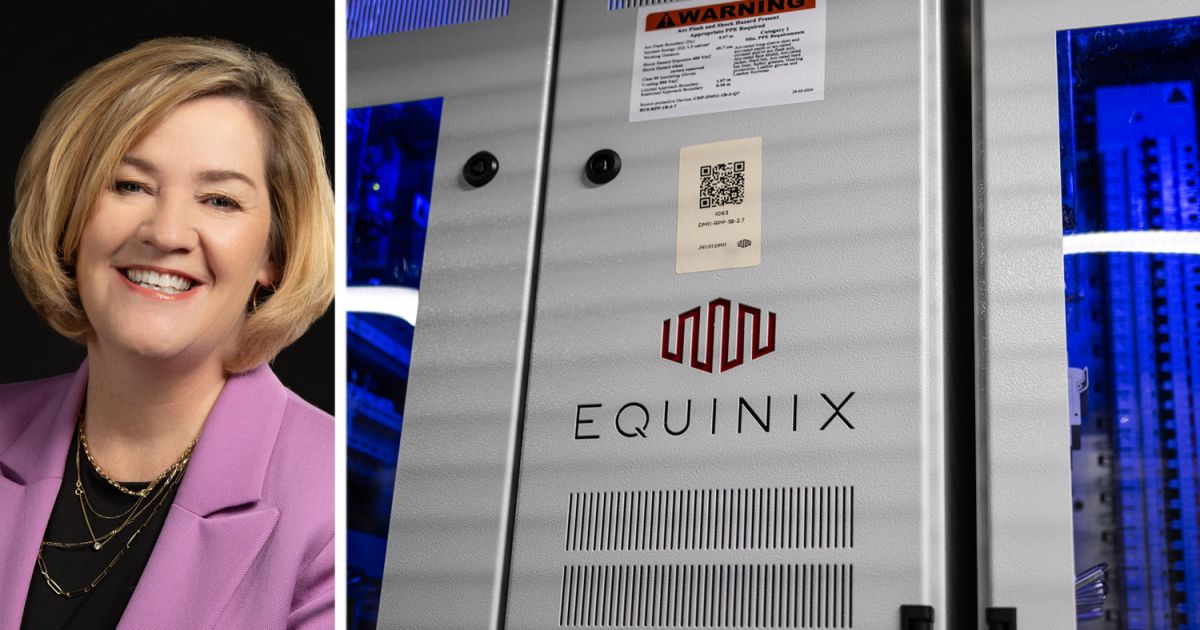
CEO Adaire Fox-Martin's own framing removes any ambiguity about what is driving this: "There isn't enough capacity to satisfy the demand that we see in the market," and on pricing specifically, "we believe that we are at the very early stage of durable pricing strength going forward." Read together, those two statements describe a seller's market that Equinix expects to persist, not a temporary spike the company anticipates normalizing soon.
Why this is bigger than one colocation company
Equinix's business model, selling colocation space, interconnection, and data center capacity to enterprises and cloud providers rather than running its own cloud platform, makes it a useful independent read on demand because its customers include the very hyperscalers whose own capacity announcements can be harder to parse for true underlying scarcity. When a colocation provider with Equinix's scale says capacity cannot keep up with demand and reports record pricing power, that is a demand signal coming from outside the hyperscalers' own self-reported growth numbers, which makes it harder to dismiss as marketing framing around a single company's capital expenditure plans.
The company's exposure to pure AI cloud providers remains under 2 percent of monthly recurring revenue, and Fox-Martin flagged genuine uncertainty in that specific segment even while describing overall demand as outstripping supply across the business broadly. That distinction matters for how you read this result: the shortage Equinix describes is broader than the AI infrastructure boom alone, spanning the enterprise and cloud workloads that make up the overwhelming majority of its revenue base today and will likely continue to do so.
The capacity Equinix is bringing online, and its limits
Equinix expects to deliver more than 13,000 new cabinets in the fourth quarter of 2026 alone, a company record, with more than 20 percent already pre-sold before the capacity even comes online, a pre-sale rate that itself demonstrates how far ahead of supply demand is currently running. The company also reports roughly 15 percent of its 2027 scheduled capacity is already committed, and now expects to deliver nearly 40 percent more cabinets in 2026 than it originally planned for the year.
Even this aggressive build-out has run into the same constraints affecting every data center operator right now. The earnings disclosure specifically references project delays tied to power constraints, regulatory friction, and local community opposition, including one project in Dubai. The lesson for any enterprise watching Equinix's results is that even a well-capitalized, publicly traded colocation leader cannot simply out-build the current supply constraint; capacity is gated by grid connections and permitting timelines that capital alone cannot accelerate.
What this means for your own hosting and colocation contracts
If your organization has colocation, interconnection, or data center capacity contracts coming up for renewal in the next twelve to eighteen months, this earnings result is a strong signal to begin that renegotiation earlier than you otherwise would, rather than waiting until closer to the renewal date assuming today's pricing will hold. A provider reporting 12 percent year-over-year pricing gains and describing itself as in the early stages of durable pricing strength is not a provider likely to offer favorable renewal terms as scarcity persists into next year.
More broadly, treat Equinix's results as independent confirmation that the capacity shortage driving cloud and AI infrastructure pricing is not confined to hyperscaler GPU allocation; it extends into conventional enterprise colocation and interconnection as well. Any budget planning that assumes data center and colocation costs will moderate in 2027 should be revisited against a provider that is, by its own CEO's account, still in the early stages of a pricing cycle it expects to continue.