What CoreWeave actually reported
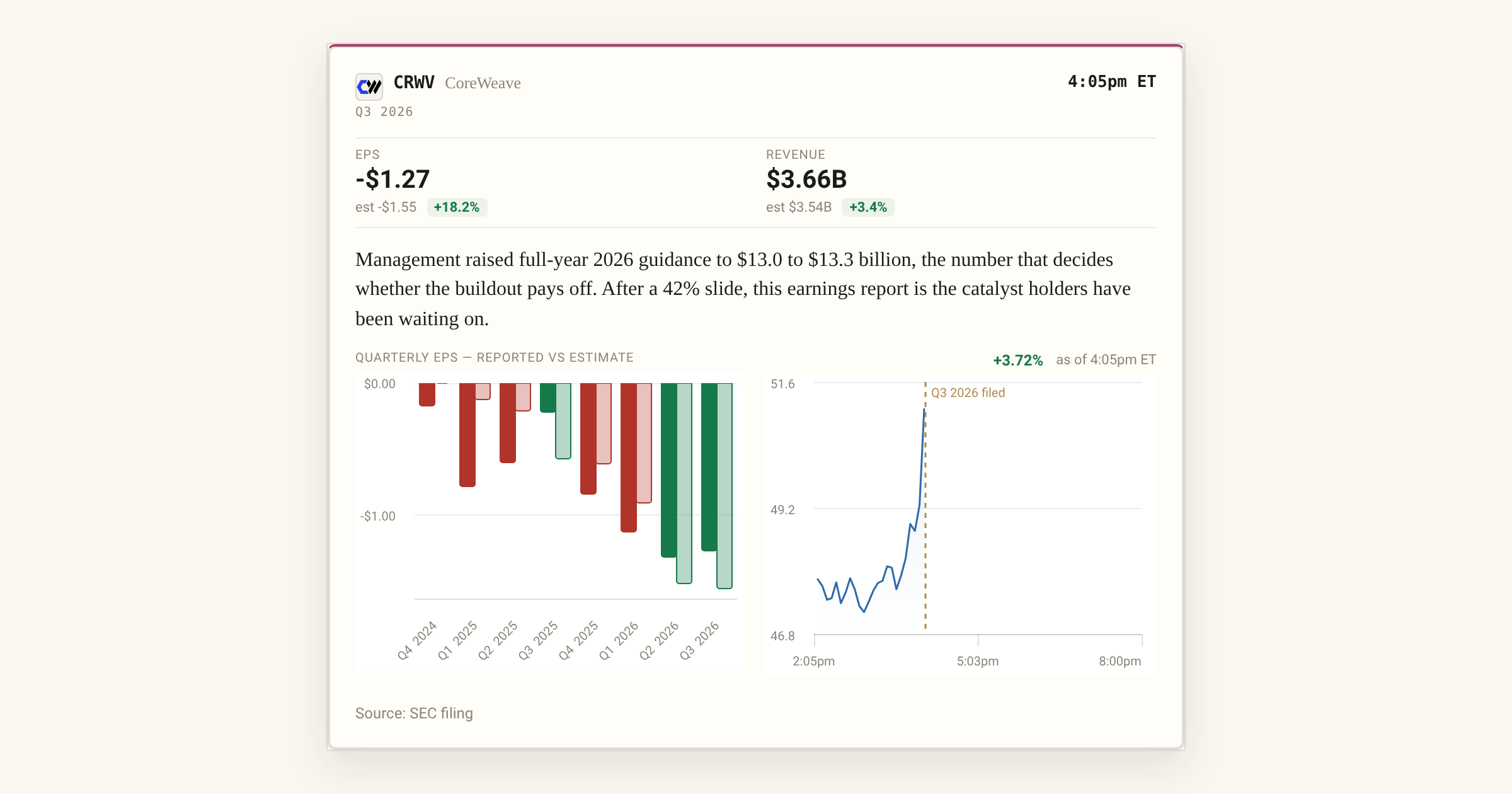
CoreWeave's third-quarter 2026 revenue reached $3.66 billion, up 168 percent year over year and roughly 3.4 percent ahead of the $3.54 billion analysts had expected. The company raised its full-year 2026 revenue guidance to a range of $13.0 to $13.3 billion, and set an exit-year annualized run-rate revenue target of $20 to $21 billion, a figure that implies the growth rate accelerating further into the final stretch of the year rather than plateauing.
Revenue backlog, the contracted future revenue not yet recognized, reached approximately $132.5 billion, up 27 percent from the prior quarter. New or expanded customer relationships disclosed alongside the results include Canva, OpenAI, Perplexity, Wayve, and the Chan Zuckerberg Initiative, a customer list that spans design software, foundation model labs, autonomous vehicle research, and philanthropic science funding, evidence that CoreWeave's customer base extends well beyond the handful of frontier AI labs most commonly associated with GPU cloud demand.
The loss, and why it isn't the headline
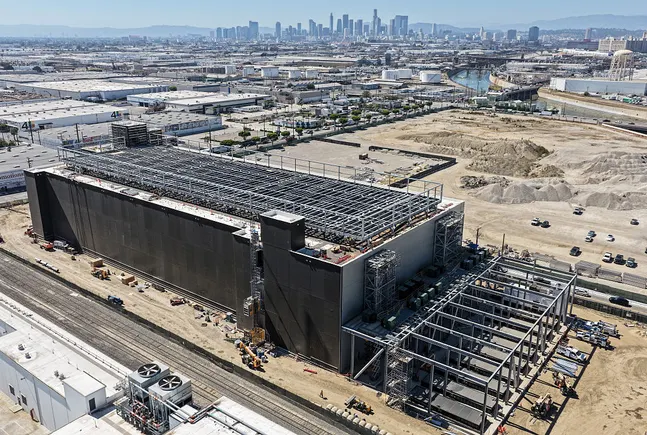
CoreWeave's GAAP net loss widened to $709 million for the quarter, with earnings per share of negative $1.27, though that beat the negative $1.55 analysts had modeled going into the report. A widening headline loss alongside raised guidance is a pattern specific to capital-intensive infrastructure buildouts of this scale: the company added more than 200 megawatts of active power during the quarter, bringing its total above 1.7 gigawatts, and depreciation and financing costs on that buildout show up in GAAP earnings well before the associated contracted revenue fully ramps into recognized results.
CoreWeave's full-year 2026 capital expenditure guidance moved to $37 to $39 billion, with the low end of that range raised specifically because infrastructure is reaching paying customers faster than originally planned, a detail the company frames as validation of its build-ahead-of-demand strategy rather than as a cost overrun. Whether that framing holds depends entirely on contracted demand continuing to absorb the capacity at the pace management is now projecting.
The disconnect that matters more than the quarter
CoreWeave's stock had already fallen 42 percent before this earnings report landed, a decline that occurred despite the company's trajectory of raising guidance and growing revenue at triple-digit rates throughout the year. That gap between operating momentum and market valuation is the detail worth sitting with longer than any single quarter's beat, because it reflects investor skepticism about something the earnings report itself does not fully resolve: the durability of GPU-cloud economics once the current capacity shortage eases and renewal pricing is tested against a less desperate market.
CEO Michael Intrator addressed part of that skepticism directly when explaining his decision to raise $4.2 billion in convertible senior notes and establish an at-the-market program for up to 35 million Class A shares, financing moves that add dilution risk, rather than using available capital to buy back CoreWeave's own discounted bonds. His stated reasoning, that he can deploy the capital at a higher rate of return elsewhere, is a bet that growth capacity remains more valuable than balance sheet optimization right now, a bet the stock's pre-earnings slide suggests the market is not yet fully willing to make alongside him.
Why the 2027 and 2028 renewal numbers are the ones to track
More than 130,000 GPUs come off their current contracts in 2027, and roughly 170,000 more in 2028, according to figures Intrator shared alongside the earnings release. Those renewal volumes, not the current $132.5 billion backlog, are the number that will actually test whether CoreWeave's current pricing power survives contact with a market where GPU supply has caught up with demand, since a backlog measures commitments made under today's scarcity-driven pricing, not the terms customers will accept when those specific contracts come up for renewal.
Intrator's own comment on this pipeline, that CoreWeave already has "a robust pipeline of customers competing for this capacity" for the 2027 renewals, is the company's confident answer to that exact question. It is also, notably, an answer that cannot be verified until those renewals actually happen, which is precisely the kind of forward-looking claim a 42 percent pre-earnings stock decline suggests the market is treating with real skepticism rather than taking at face value.
What this means if you're evaluating GPU cloud vendors
CoreWeave's results confirm that near-term GPU cloud demand remains strong enough to support triple-digit revenue growth and raised guidance, which is useful validation if your organization is evaluating specialized GPU cloud providers against hyperscaler alternatives for AI workloads. It does not resolve the longer-term question of vendor financial stability that a 42 percent stock decline alongside strong operating results should put on your vendor risk checklist regardless of how this specific quarter looked.
Ask any GPU cloud vendor you are evaluating, CoreWeave included, directly about their 2027 and 2028 contract renewal pipeline and pricing assumptions, not just their current backlog and growth rate. A vendor whose growth story depends on renewal pricing holding at today's scarcity-driven levels carries a different risk profile than one with diversified, renewal-independent revenue, and that distinction will matter more to your own long-term planning than this quarter's headline beat.