What AWS shipped
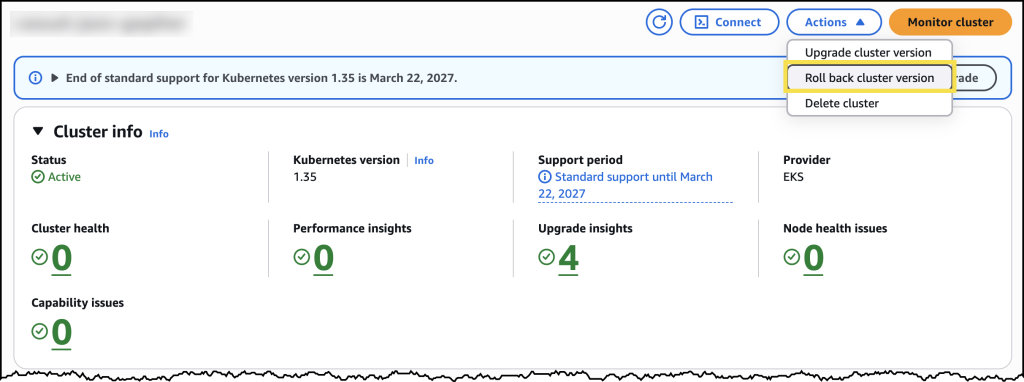
Amazon EKS now supports Kubernetes version rollbacks, a feature that reached general availability on July 1, 2026, with an InfoQ recap following on July 26. The capability lets an administrator reverse a minor-version upgrade of a cluster within seven days of completing it, returning the control plane to its previous working state. Crucially, AWS is offering this at no additional charge, which removes the usual friction of a paid safety net that teams hesitate to budget for. It is a small feature in scope and a large one in operational consequence.
In the words of Micah Walter, a Senior Solutions Architect who authored the AWS News Blog post, with version rollbacks you can reverse a Kubernetes version upgrade within seven days if you encounter issues after upgrading, returning your cluster to its previous working state. That single sentence captures why this matters. Kubernetes upgrades have always been one-way doors in practice, and the fear of an irreversible break is what keeps many fleets running old versions long past their supported window.
The mechanics and the guardrails
The feature is deliberately constrained. A rollback moves the cluster back exactly one minor version, for example from 1.33 to 1.32, and it cannot skip versions or unwind multiple upgrade hops in a single operation. That limitation is a direct consequence of how Kubernetes handles version skew and API deprecation between releases, and it is better to accept the constraint than to promise a rollback the underlying system cannot safely deliver. The seven-day window similarly reflects how long the previous state can be reliably preserved.
Around the core capability AWS has built a set of safety checks called Rollback Readiness Insights. These pre-check API compatibility, version skew, add-on compatibility, and overall cluster health before a rollback proceeds, so an administrator learns whether the operation is safe before committing to it. A force flag can override these checks for teams that know their situation better than the automation does, and pod disruption budgets are respected during node rollbacks. That combination of default caution with an explicit escape hatch is the right shape for a production control.
Node rollbacks and Auto Mode
The rollback story extends beyond the control plane. Node rollbacks are available for EKS Auto Mode, the managed compute option where AWS handles node provisioning and lifecycle, so a version reversal can carry through to the data plane rather than leaving nodes stranded on the newer release. This matters because a control-plane rollback alone would leave operators with a version mismatch to reconcile by hand, which is exactly the kind of manual toil that erodes confidence in the feature.
AWS also exposes a cancel API that can stop a node rollback mid-process. That is a meaningful detail for anyone who has watched a large rolling operation go sideways and wished for a stop button. Combined with pod disruption budget enforcement, it gives platform teams graduated control: begin a node rollback, watch its effect on workloads, and halt it if the cluster is not behaving as expected. The design assumes operators will want to supervise these operations rather than fire and forget.
Why reversibility changes the risk math
The deeper significance is not any single mechanic but what reversibility does to decision-making. Every upgrade decision is a bet on limited pre-production testing predicting production behavior, and the downside of a bad bet has always been severe: a broken cluster with no clean way back. When the downside is a seven-day undo, the same team can rationally choose to upgrade sooner and more often. The cost of being wrong drops, so the threshold for acting falls with it.
This reframes a governance conversation that platform teams have repeatedly with their leadership. The pressure to stay on supported Kubernetes versions, for security patches and vendor support, has always collided with the fear of upgrade breakage. A reversible upgrade path lets a team commit to a more aggressive currency policy without asking the business to absorb unbounded risk. The undo button is really a policy enabler dressed as a feature.
What platform teams should reconsider
Teams that have been deferring upgrades to batch them into rare, high-ceremony maintenance windows should revisit that posture. The economics that justified waiting, chiefly the cost and risk of a failed one-way upgrade, have shifted. A more frequent cadence of single-version upgrades, each with a rollback available for a week, spreads risk into smaller and recoverable increments. It also keeps clusters closer to the versions AWS actively supports, which reduces the compounding pain of eventually jumping several versions at once.
There is still homework to do before leaning on this. The one-version limit means a fleet that has drifted far behind cannot use rollback as a blanket safety net across a multi-hop catch-up. The seven-day window demands that validation of a new version happen promptly rather than weeks later. Teams should update their upgrade runbooks to include Rollback Readiness Insights as a gate, define who is authorized to use the force flag, and schedule post-upgrade validation inside the seven-day window so the option stays open when it is needed.
The competitive signal for managed Kubernetes
For engineering leaders comparing managed Kubernetes offerings, this raises the bar on what operational safety looks like. Reversible control-plane upgrades are the kind of feature that is easy to overlook in a procurement checklist and painful to live without during an incident. Buyers evaluating EKS against other managed platforms now have a concrete capability to weigh, and providers without an equivalent will feel pressure to answer it. The direction of travel is toward treating upgrades as routine rather than as rare high-stakes events.
The broader lesson for anyone running infrastructure at scale is that reducing the blast radius of a change is often more valuable than making the change itself faster. AWS did not make Kubernetes upgrades quicker here; it made them recoverable. That is the pattern platform teams should internalize when they build their own systems: invest in the undo path, not only the forward path, because reversibility is what turns a risky operation into an ordinary one that people are willing to perform often.