A six-week timeline is the metric that should get executives' attention
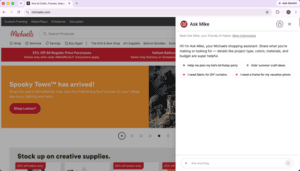
Michaels launched Ask Mike, a conversational AI shopping assistant built on Google Cloud's Gemini Enterprise for Customer Experience, across michaels.com and its iOS and Android apps. The headline engagement number is nearly 75,000 customer conversations since the May launch, but the figure that should reset planning assumptions is the delivery timeline. Michaels moved from concept to a production-grade AI experience in roughly six weeks. For any retailer that has watched conversational commerce projects stretch across quarters, that compression is the real news.
Paul Tepfenhart, Global Director for Retail Industry Strategy and Solutions at Google Cloud, framed it plainly: "Seeing a retailer move from concept to a production-grade AI in just six weeks is a signal of where the industry is heading." A CTO should read that as a statement about the maturity of managed AI platforms, not just one retailer's execution. When the underlying model, retrieval, and orchestration are delivered as a configurable service, the bottleneck moves from engineering capacity to data readiness and product decisions.
Natural-language discovery replaces the category filter as the entry point
The functional shift in Ask Mike is how shoppers navigate the assortment. Instead of drilling through categories and applying filters, a customer describes a project or a goal in plain language and receives recommendations. That is a meaningful change for a craft and hobby retailer whose catalog spans thousands of loosely related components that a first-time buyer would struggle to assemble on their own. The assistant absorbs the intent and maps it onto the product set, which is exactly the kind of problem generative models handle better than faceted search.
Heather Bennett, President and Chief Customer Officer at Michaels, described the range of use: "In just a few weeks, Ask Mike has fueled nearly 75,000 conversations, with our community using the tool for everything from party planning to finding the right materials for their first punch-needle pillow." That breadth is the point. A shopper who cannot name the products they need can still describe the outcome they want, and the assistant closes the gap that traditional navigation leaves open for exactly the customers a retailer most wants to convert.
More than 60% of interactions are product discovery, and that is a real signal
Engagement volume alone can flatter a launch, so the composition of that volume matters more. More than 60% of Ask Mike interactions centered on product discovery across the online assortment, which tells a technology leader the tool is being used for a commercially load-bearing job rather than novelty or support deflection. Discovery sits directly on the path to purchase, so a majority of conversations pointed at it suggests the assistant is doing work that correlates with revenue rather than absorbing idle curiosity.
That distinction should shape how any retailer instruments its own pilot. The 75,000 conversation count is the vanity metric; the 60% discovery share is the one that justifies continued investment. Before greenlighting a conversational assistant, a CTO should define upfront which interaction types count as valuable, then measure the mix rather than the total. A tool that generates high volume but drifts toward low-value queries is a cost center, while one that concentrates on discovery and consideration earns its place in the funnel.
The build-versus-buy calculus has quietly shifted
For years the default assumption was that a differentiated conversational experience required a substantial in-house build across model selection, retrieval, orchestration, and safety tooling. The Michaels case argues that the balance has moved. Building on Gemini Enterprise for Customer Experience let the team compress that stack into a six-week configuration effort rather than a multi-quarter engineering program. The managed platform absorbs the hardest and least differentiated parts, leaving the retailer to focus on catalog data, prompt design, and the interaction model.
Buying does not automatically beat building here, yet this case clearly shifts where the burden of proof sits. A CTO now has to justify why a bespoke stack would outperform a managed platform that a peer stood up in six weeks. The credible reasons to build are proprietary data advantages, unusual latency or cost constraints at scale, or a need to avoid platform lock-in. Absent one of those, the faster path to a working assistant, with real customers generating real signal, is usually the one that compounds into an advantage.
Managed speed comes with dependencies worth pricing in
The six-week story has a cost side that a disciplined buyer should surface. Building on a managed platform means accepting a dependency on Google Cloud's roadmap, pricing, and model behavior, and it concentrates a growing share of the customer experience on a single vendor's stack. None of that is disqualifying, and for most retailers the tradeoff is worth it, but it should be a deliberate decision with an exit path considered rather than a default that hardens over successive releases.
The other dependency is data. A conversational assistant is only as good as the product information, availability, and attributes it can reason over, so the six-week timeline assumes the underlying catalog data is clean enough to serve. Retailers whose product data is fragmented or inconsistent will find that the model surfaces those gaps quickly and visibly to customers. The lesson for a technology leader is that the platform compresses the AI work, which raises the return on getting the unglamorous data foundation right first.
What this means for a conversational commerce roadmap
Michaels ranks #93 in the Top 1000 database and #575 in the new AI Rankings, so this is a substantial but not top-tier digital operator demonstrating a fast, measurable launch. That profile makes the case more transferable, because it shows the approach does not require the resources of the largest retailers. A mid-to-large retailer can now point to a concrete reference, a real timeline, and disclosed engagement metrics when it argues internally for a similar pilot rather than relying on vendor projections.
The roadmap implication is to run a tightly scoped conversational discovery pilot, instrument it for interaction quality rather than raw volume, and get the catalog data ready before the model touches it. Treat the six-week figure as a planning benchmark to test against your own constraints, not a guarantee. The strategic risk now is not moving too fast on conversational commerce; it is letting a competitor stand up a working assistant, learn from live customers, and iterate while your organization is still debating whether to build or buy.