Remote Management Is the Crown Jewel
Few categories of software offer attackers more leverage than remote monitoring and management tools. By design, RMM platforms hold privileged, persistent access to the endpoints they manage, which is exactly why a flaw in one is so dangerous. The disclosure of CVE-2026-48558, a critical authentication-bypass vulnerability in SimpleHelp, lands squarely in this high-stakes territory, and researchers warn that roughly 14,000 internet-facing SimpleHelp servers are exposed.
We treat RMM compromises as a distinct class of incident because they are force multipliers. An attacker who breaks into a single workstation has one foothold. An attacker who compromises the RMM server that manages thousands of workstations has a distribution channel. This is the mechanism behind some of the most damaging supply-chain intrusions of recent years, and it is why a single authentication flaw in a management platform deserves more attention than a more severe-looking bug in an isolated application.
How the Bypass Works
The root cause is a failure of basic verification. When the affected SimpleHelp servers are configured to use OpenID Connect authentication, including Azure Active Directory integrations, the identity tokens submitted during login are accepted without verifying their cryptographic signature. That single omission collapses the entire trust model. A remote, unauthenticated attacker can submit a forged token, and the server treats it as legitimate.
The consequence is not subtle. Using a forged token, an attacker can create a new Technician account, the privileged role in SimpleHelp, then remote into managed endpoints and execute scripts. About 7.2 percent of the exposed servers are configured with the vulnerable OIDC setting, which sounds small until you multiply it against 14,000 instances and remember that each one may manage many downstream clients. The blast radius of a single compromised RMM server extends to every endpoint it touches.
Defeating Multi-Factor Authentication
The most alarming property of this flaw is that it sidesteps the control most organizations rely on as their backstop. Because the attacker can create a brand-new Technician account, and because SimpleHelp lets a technician self-register their own MFA method on first login, the attacker simply enrolls their own second factor. Multi-factor authentication, configured precisely to stop unauthorized access, becomes irrelevant.
Horizon3.ai's researchers were direct about this. "Even when the SimpleHelp server is configured to enforce MFA for technicians, this issue allows the attacker to bypass this mechanism," they wrote. We highlight this because it punctures a dangerous assumption baked into many security programs, that MFA is a near-absolute defense. MFA protects existing accounts from credential theft. It does nothing when the flaw lets an attacker create a fresh account and define the second factor themselves. The control is only as strong as the account-provisioning logic beneath it.
An AI Found It First
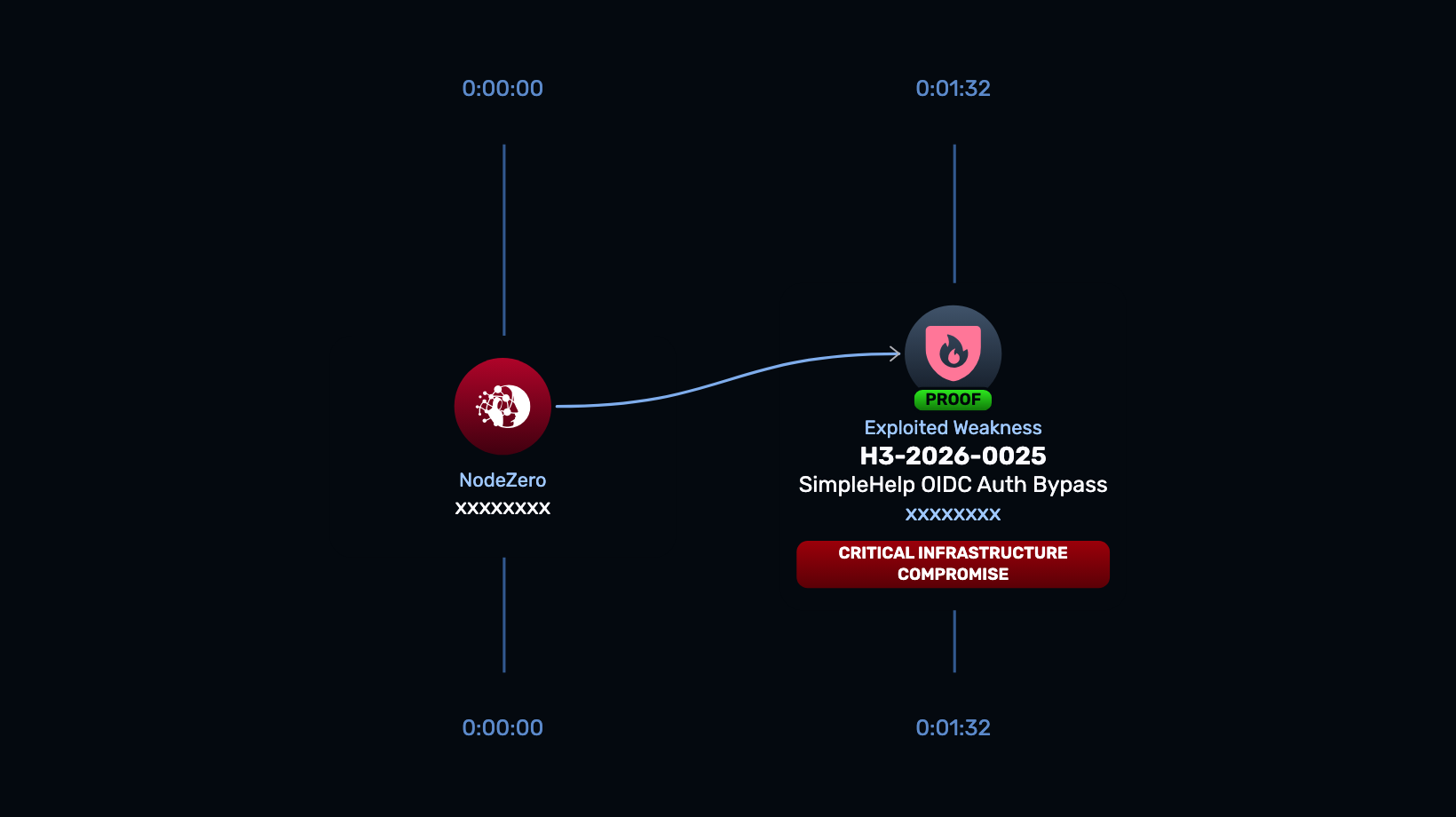
There is a notable wrinkle in how this vulnerability surfaced. Horizon3.ai discovered the flaw through its autonomous, AI-driven research initiative known as Sua Sponte, which probes software for weaknesses without a human driving each step. The discovery, assignment, and reporting moved quickly: the issue was identified and assigned on May 21, reported to SimpleHelp on May 22, and patched on May 26, with public technical disclosure following on June 12.
This is the double-edged story of AI in security that we keep encountering. The same automated capability that helped a defender-aligned firm find this bug responsibly is, in other hands, generating exploit code at scale. The encouraging read is that AI-assisted research compressed the disclosure timeline and got a fix shipped in days. The sobering read is that adversaries are running the same playbook, and defenders should assume that internet-exposed software is being continuously and automatically probed for exactly this kind of verification lapse.
Patch, Then Hunt
Remediation is available and should be applied without delay. The flaw affects SimpleHelp versions 5.5.15 and earlier and pre-RC2 6.0 builds, with fixes shipped in the stable 5.5.16 release and 6.0 RC2. Given that technical details are now public, every exposed server should be considered a live target. SimpleHelp noted that "servers accessible only from local networks or recognised and trusted IP ranges are at much lower risk," which reinforces the broader lesson about not exposing management planes to the open internet.
Patching alone is insufficient here. Because the flaw enables silent creation of privileged Technician accounts, organizations must also hunt for indicators of prior compromise: unexpected technician accounts, unfamiliar MFA enrollments, and anomalous script execution on managed endpoints. An RMM breach can be invisible precisely because the attacker operates through legitimate-looking administrative tooling. Closing the vulnerability stops new abuse, but only a deliberate review of accounts and activity will reveal whether the door was already opened.