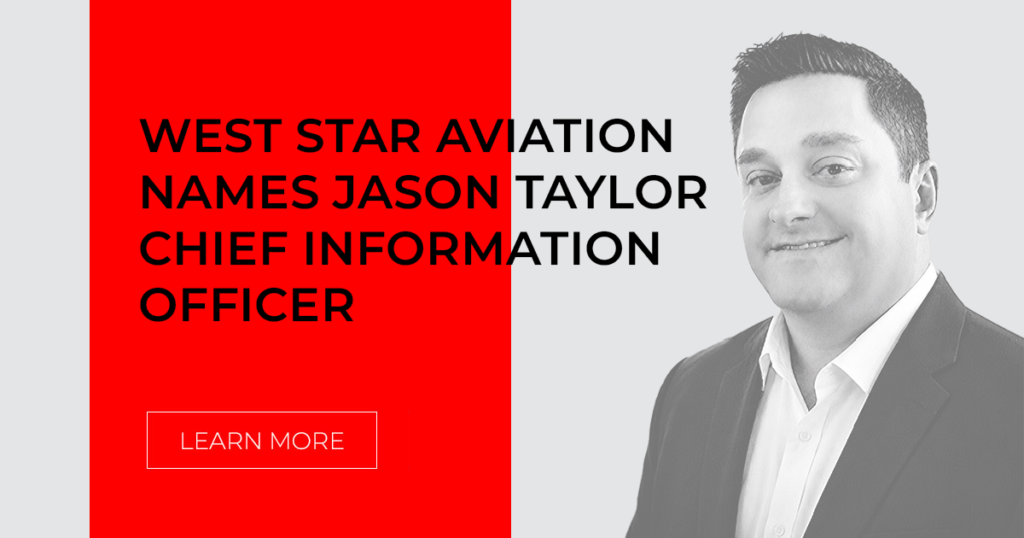
West Star hires a CIO built for consolidation, not maintenance
West Star Aviation named Jason Taylor its Chief Information Officer on July 20, 2026, and the reason we notice a maintenance-and-overhaul company's CIO pick is the resume behind it. Taylor most recently served as CIO and Global CTO at RS Americas, and before that as Vice President of Global Digital and Innovation at Gates Corporation, with earlier leadership roles at Mohawk Industries and Eaton. That is a manufacturing and industrial-distribution pedigree, not an aviation one. West Star reached outside its sector for someone who has run technology inside asset-heavy, plant-floor businesses where uptime and throughput are the whole game.
The company is not a startup experimenting with its first systems. West Star has operated for more than 79 years, employs over 3,000 professionals, and runs six full-service facilities across Illinois, Colorado, Tennessee, New Jersey, Missouri, and North Carolina, plus the nation's largest Aircraft On Ground network. Hiring a CIO with a consolidation background into an organization that size is a decision about where the next efficiency comes from. It says leadership believes the constraint is now internal systems and data, and it wants an operator who has fixed exactly that problem elsewhere.
The mandate reads like an operations brief
Taylor's charter covers enterprise technology strategy, data and analytics, and cybersecurity, with an explicit focus on system reliability, data accessibility, and scalable operations. Read that alongside the CEO's framing. Stephen Maiden, West Star's chief executive, said that information and technology sit at the heart of aviation today and that the company intends to lead the industry in leveraging technology to drive efficiency, improve turn times, and elevate the customer experience. Turn time is an MRO's revenue metric. When a CEO ties a technology hire directly to turn times, the CIO is being measured on operational output, not on a project portfolio.
This is the version of the CIO role that survives contact with a P&L. The mandate puts data accessibility next to reliability and security, which is the correct ordering for a business where a mechanic waiting on a part or a record is lost margin. For technology leaders in services businesses, the lesson is in how the job was scoped. West Star did not frame the role around a shiny transformation program. It framed it around getting information to the people doing physical work faster and more reliably, which is where the money actually is.
Application rationalization is the unglamorous work that scales
The most telling line in Taylor's background is his experience consolidating more than 1,000 applications into core platforms and leading SAP S/4HANA programs. That is the least glamorous work in enterprise IT and the most consequential. Every merged tool is a data model reconciled, a license retired, an integration deleted, and a team retrained. Companies that grow through acquisition or across many sites accumulate application sprawl the way a hangar accumulates tools, and the cost shows up as slow reporting, brittle integrations, and staff who cannot get a straight answer from their own systems.
For West Star, which runs distinct facilities that each accreted their own tooling over decades, this is the foundational job. You cannot get trustworthy cross-site analytics, and you certainly cannot get useful AI, on top of a thousand disconnected applications. Hiring a proven consolidator says the company understands the sequence. Standardize the platforms and the data first, then the analytics and automation become tractable. Technology leaders who skip that step and buy an AI layer over a fragmented estate end up automating the confusion.
Cybersecurity moves from checkbox to operating requirement
Taylor's history includes establishing cybersecurity programs aligned to NIST and ISO 27001, and West Star put security in the headline mandate rather than burying it. That placement is appropriate for the sector. Aviation maintenance sits inside a regulated environment and a deep supply chain, touching aircraft records, customer data, and operational systems that keep planes flyable. A ransomware event at an MRO grounds aircraft and breaks customer commitments, which is why security belongs in the same sentence as reliability.
The framing choice matters for peers. Naming NIST and ISO 27001 alignment as part of a CIO's remit signals that the board wants a defensible, auditable security posture anchored to recognized frameworks and treated as core infrastructure. For any services business handling regulated data across multiple physical sites, this is the model to copy. Put security in the CIO's operating mandate, tie it to recognized frameworks, and treat it as a precondition for scaling rather than a cost imposed after growth.
AI belongs on the shop floor, measured in turn times
Taylor's prior work reportedly introduced practical AI and automation to reduce delivery times and costs, and that is the right altitude for AI in a business like this. The valuable applications are unglamorous: predicting parts demand across the Aircraft On Ground network, surfacing the right maintenance record instantly, scheduling technicians, and flagging quality issues before they cause rework. None of that requires a frontier model. It requires clean data, integrated systems, and a leader who measures AI by whether an aircraft leaves the hangar sooner.
This is why the consolidation work has to come first, and why the sequencing in Taylor's mandate is credible. West Star is not promising a headline AI product. It is putting a CIO in place who has used automation to move operational metrics, then giving him the data foundation to do it again. Enterprise leaders chasing AI wins should note the discipline. The teams that get durable value point automation at a measurable operational bottleneck and own the number, rather than launching a pilot in search of a use case.
What the hire signals for services-business technology leaders
West Star is an independent MRO, and its choice reflects a broader pattern in asset-heavy, multi-site services businesses that are professionalizing their technology function. The profile it hired for is specific: an operator from industrial and manufacturing environments who has consolidated sprawling application estates, run a major ERP program, and stood up framework-aligned security. That is the resume of someone brought in to reduce complexity and make data usable, which is the precondition for everything else a modern services business wants to do.
If you run technology at a company like this, the decision you own is whether to keep buying point solutions for each new problem or to invest in the harder work of platform consolidation that pays off across every site. West Star bet on the consolidator. For a 3,000-person business measured on turn times and customer trust, that bet is defensible, and it is a useful signal for peers deciding what kind of technology leader their next chapter actually requires.