A gigawatt of training with no Nvidia inside
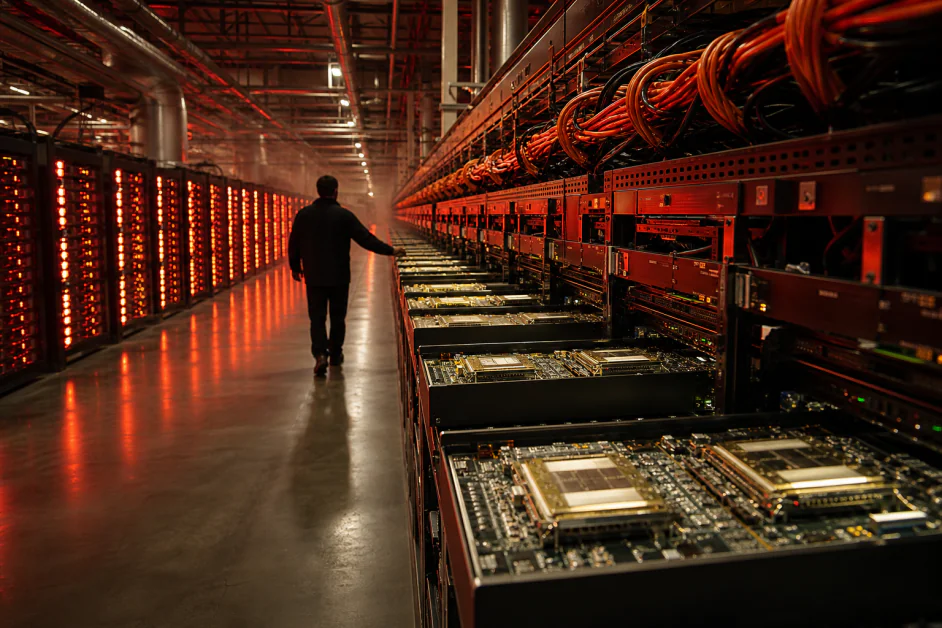
Z.AI, the Chinese model developer formerly known as Zhipu, has started partial operations at a data center hub with power capacity near 1 gigawatt, roughly what 750,000 homes draw at any moment. The detail that matters is the silicon. The facility runs entirely on Chinese-made accelerators, drawing on Huawei, Cambricon, and Alibaba supply rather than the Nvidia parts that US export rules keep out of the country. For two years the working assumption in the West was that frontier training at this scale needed Nvidia. A gigawatt campus running without it moves that assumption from theory to an operating fact.
Scale is the proof point. Z.AI runs multiple computing clusters that each hold more than 10,000 chips, the configuration a lab needs to train and serve large models rather than to run inference on someone else's weights. The company builds the GLM family of models, and this hub is the compute base under that roadmap. A single large cluster is a demonstration. Several of them wired into a gigawatt of power is an industrial capability, and it changes the calculus for anyone who assumed Chinese labs would stay compute constrained while controls held Nvidia hardware at the border.
The chips filling the Nvidia gap
The supply base here is domestic by necessity and increasingly by design. Huawei's Ascend line anchors the accelerator side, Cambricon supplies a homegrown alternative that has drawn heavy state support, and Alibaba contributes chips from its own silicon effort. None matches Nvidia's top part on raw performance or on the software maturity of CUDA. The bet Z.AI is making is that enough domestic capacity, wired together at scale and paired with a stack tuned to that hardware, closes enough of the gap to train competitive models. The gigawatt footprint is partly an answer to lower per chip efficiency, more silicon compensating for weaker parts.
That trade carries costs the campus itself makes visible. Running a decoupled stack means building around a software ecosystem younger than CUDA, accepting lower efficiency per watt, and spending more power and capital to reach a given training run. Z.AI appears willing to pay that tax because the alternative, dependence on hardware it cannot reliably buy, is worse. For the industry, the signal is that Nvidia's moat is real but not absolute. A national effort with enough capital and grid access can stand up frontier scale compute on other silicon, and China has now shown it at the level of a working plant.
What $295 billion is buying
This campus is one node in a much larger program. China has laid out roughly $295 billion, near 2 trillion yuan, in planned data center spending over five years, and projects like Z.AI's are where that money lands. The strategic aim is self sufficiency in AI compute, insulating the country's leading labs from the export controls that have shaped the last two years. Z.AI itself targets around $1 billion in annual recurring revenue for 2026, a figure that signals it intends to run a business on this infrastructure rather than treat it as a research showpiece.
For a Western technology leader, the scale of that spend reframes a question many treated as settled. The assumption that export controls would keep Chinese AI a generation behind rested on a hardware bottleneck. Spending at this level, directed at domestic silicon and the plants to house it, attacks the bottleneck directly. It will not close the gap overnight, and the efficiency penalty is real. Over a multi year horizon, though, a rival compute base funded at national scale changes the competitive map for foundation models and for the products built on them.
Why GLM models now deserve a second look
The practical link to Western enterprises runs through the models this compute produces. Z.AI's GLM family ships as open weights, and open weight models from Chinese labs have already earned real usage in the West on cost and capability. A common objection was supply chain fragility, the worry that a model dependent on hardware the developer cannot reliably source would stall. A gigawatt training base on domestic silicon weakens that objection. The lab now has a compute foundation it controls end to end, which makes its roadmap more credible to a buyer weighing whether to build on those weights.
That credibility cuts against a governance concern many enterprises hold. Deploying a Chinese trained open weight model raises questions about provenance, data handling, and regulatory posture, and some jurisdictions are moving toward restrictions on exactly these models. The compute story does not resolve those questions. It does mean the models will keep improving on a stable base, so a decision to exclude them on supply chain grounds looks weaker while a decision to exclude them on governance grounds needs its own clear rationale. Buyers should separate the two and decide each on its merits.
The efficiency tax of a decoupled stack
It would be a mistake to read this campus as parity. A gigawatt spent on domestic accelerators buys less effective training than a gigawatt of the latest Nvidia systems, because the parts are less efficient and the software extracts less from them. Z.AI absorbs that penalty in power, capital, and engineering effort. The reason the campus works is scale and state backed capital, which let the company throw more silicon and more watts at the problem than a Western lab facing market cost of power and hardware would choose to. That is a durable structural difference, and it shapes how fast the gap actually closes.
The read for infrastructure leaders is to watch efficiency, not just headline capacity. A gigawatt of Chinese compute and a gigawatt of frontier Nvidia compute are not equivalent training capacity, and the ratio between them is the number that determines the real competitive distance. That ratio is improving as domestic parts mature and as the software stack around them fills in. Tracking it gives a cleaner signal of where Chinese labs actually stand than any single facility announcement, and it should inform how seriously you weigh their models in your own build versus buy decisions.
What to put on your roadmap
Plan for a compute landscape with two stacks rather than one. If your business touches China, or if you evaluate open weight models with Chinese origins, the accelerator underneath those models increasingly sits outside the Nvidia ecosystem. That has practical consequences for portability. A model tuned on Ascend or Cambricon hardware may behave differently when you serve it on your own Nvidia or cloud TPU fleet, and quantization and kernel support vary across families. Test portability early rather than assuming a set of weights runs identically everywhere, and budget for the tuning that a cross family move requires.
The larger point is strategic. A working gigawatt campus on non Nvidia silicon tells you the hardware monoculture that shaped the last two years is loosening at the edges. That is healthy for buyers over time, since more credible accelerator paths eventually mean more pricing pressure and more sourcing options. In the near term it means more complexity, since the stack you standardize on is now one of several the market supports. Leaders who track the alternative silicon seriously, rather than dismissing it, will make better calls on where to commit their own training and inference spend.