Augmodo raises $21M to instrument the store worker
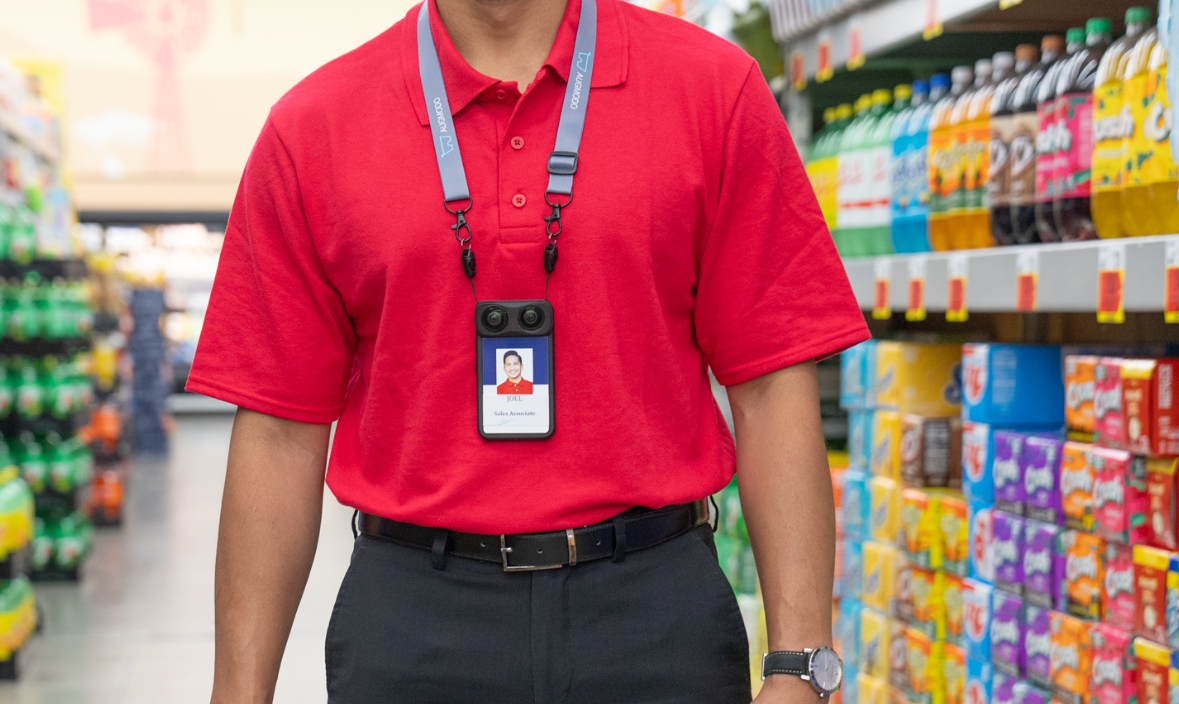
Augmodo raised $21 million at a $350 million valuation, in a round led by TQ Ventures with Lerer Hippeau, Arena Holdings, Jefferson River Capital, and strategic backers including the pharmacy chain Chemist Warehouse, SiliconANGLE reported on July 13. The company sells a Smartbadge, a wearable that store associates clip on and forget, which continuously scans the aisles around them as they work and feeds a real-time store map the company calls a Realogram. The pitch is inventory accuracy and stock-out prevention captured as a byproduct of work the staff are already doing.
The traction numbers explain the valuation. Augmodo says revenue grew roughly tenfold over the past year, that it now maps about 186 million square feet of retail floor a month, and that it expects to reach a billion by year-end while adding 50 to 100 store locations monthly. CEO Ross Finman describes the mission as 'AI system for the physical workforce.' The enhanced badge adds a walkie-talkie, a digital identity display, and an optional panic button, which turns a data-capture device into something a worker has a reason to want to wear.
The wearable bet is a fresh answer to shelf data
Every retailer wants a live, accurate picture of what is actually on the shelf, and the industry has tried several routes to get it: fixed ceiling cameras, shelf-edge sensors, robots that roam the aisles at night, and phone apps that ask staff to scan. Augmodo's answer is to attach the sensor to the person who is already walking every aisle. The badge captures shelf state passively, without adding a task to a shift that is already full. That design choice is the whole thesis, because the common failure mode of store-execution technology is that it depends on someone reliably doing extra work.
The economics of passive capture are attractive if the accuracy holds. A wearable that maps the store as a side effect of normal work spreads sensing across every associate on the floor and every hour they work. Set against a nightly robot pass or a fixed-camera install, it scales with headcount instead of capital expenditure, and it captures the store in the state customers actually see it during the day. The open question is data quality: passive scans from a moving badge are messier than a fixed camera's, and the value depends entirely on whether the models clean that signal into a reliable Realogram.
Store execution is suddenly a fundable category
Investors are writing checks against store execution because the payoff is finally legible. Out-of-stocks are a direct, measurable revenue leak, and a live shelf map plugs straight into replenishment, ecommerce availability, and the fulfillment promises retailers now make for same-day pickup and delivery. When a retailer offers 30-minute pickup, the accuracy of its shelf data becomes the thing that determines whether the order can be fulfilled at all. That is why a company selling badges to store staff can command a $350 million valuation in 2026.
The agentic layer sharpens the case further. AI agents that reorder inventory, rebalance stock, or quote availability to a shopping bot are only as good as the ground-truth data underneath them, and store shelves are the noisiest, least-instrumented part of the whole chain. Whoever owns accurate, real-time shelf data owns an input that every downstream agent needs. Augmodo is betting that the cheapest way to capture that data at scale is to clip a sensor to the workforce already in motion, and the early revenue curve suggests the bet is landing.
The build-versus-buy and labor questions
For a retail technology leader, this is a clean build-versus-buy decision, and the buy case is strong. Instrumenting store execution in-house means hardware, computer vision, and a mapping pipeline, none of which is a retailer's core competency and all of which a specialist is iterating on faster. Buying the capability as a wearable service lets you get shelf data without standing up a hardware and ML team. The trade is dependence on a young vendor for a data feed that could become load-bearing across replenishment and fulfillment, which argues for a contract that guarantees data portability from the start.
The labor dimension deserves honest attention. A badge that continuously scans the floor also, by construction, records where associates go and how they move. Augmodo softens this with genuinely worker-useful features like the walkie-talkie and panic button, and that is smart product design. It leaves the surveillance question intact. Any retailer deploying this should be explicit with staff and, where relevant, with works councils and unions about what the badge captures and how it is used, because a store-execution tool the workforce distrusts will be quietly defeated on the floor.
The horizontal thesis and what to watch
Augmodo is already positioning beyond retail. Finman argues the underlying problem is universal, that 'someone grabbing a wrench in an automotive factory isn't that different from someone grabbing a Cheerios box,' and the company names warehouses, manufacturing, hospitals, and automotive as expansion targets. The addressable market for a spatial AI system aimed at the roughly 80 percent of the workforce that works with their hands is enormous, and it is the story that justifies a $350 million price on early revenue. Horizontal ambition of that kind is also where young hardware companies most often overreach.
For retail leaders, the near-term signal is what matters. A well-funded, fast-growing vendor is making shelf data cheaper and more current, and that lowers the barrier to the availability-dependent services retail is racing to offer. We would pilot it against a hard metric, out-of-stock reduction or fulfillment accuracy on same-day orders, and insist on exporting the raw Realogram data into your own systems. The capability is worth adopting. The dependency on a Series A vendor for a load-bearing data feed is worth structuring carefully before it becomes hard to unwind.