What actually launched this week
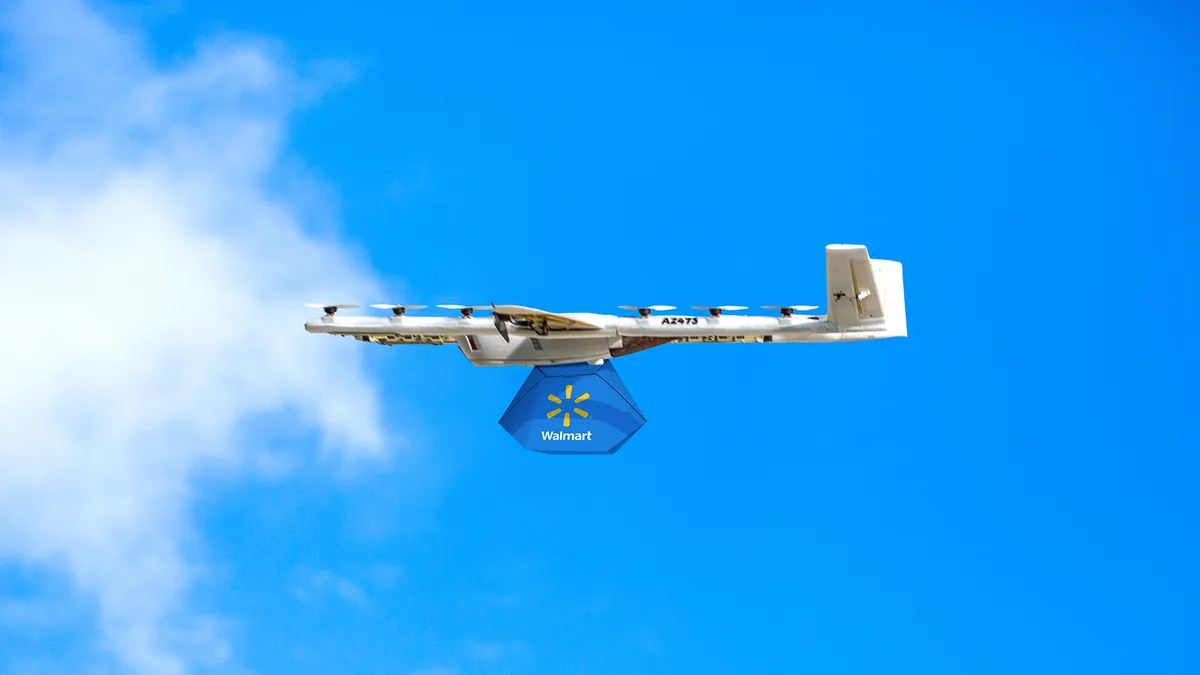
Walmart and Wing, the drone delivery operator owned by Alphabet, launched service across Greater Orlando, Florida, giving more than 50,000 homes, businesses, and apartment buildings access to drone delivery in as fast as 30 minutes. The service is live from two Walmart Supercenters in Apopka and Clermont, with three more stores in Ocoee, Clermont, and Haines City coming online soon. Wing's drones cruise at 150 to 200 feet and up to 60 miles per hour, then descend to roughly 20 feet to lower packages by tether rather than landing.
Current payload capacity sits at 2.5 pounds per flight, with Wing planning to raise that to 5 pounds. That ceiling is worth sitting with: at 2.5 pounds, this is a service for school supplies, small electronics, and daily essentials, not a general-purpose delivery channel. Greg Cathey, Walmart's senior vice president of ecommerce fulfillment transformation, said the goal is to give Orlando customers access to 'a wide assortment of everyday items through one of the fastest and most innovative delivery options available,' language that is honest about scope even if the marketing leans toward breadth.
The part of the story that should give you pause
Walmart has done this before in Florida, and it did not stick. The retailer partnered with DroneUp for drone delivery in Tampa and Orlando starting in 2022, and DroneUp wound down those operations by the end of 2024 as the unit economics of drone delivery failed to pencil out at scale. Two of the store locations formerly served by DroneUp are now, or will be, served by Wing. Walmart is not entering a new market so much as it is re-entering one where a previous vendor already gave up.
A CTO or operations leader should discount the announcement's framing of Florida as fresh territory and instead ask what changed since DroneUp folded. Wing is a different company with different unit economics, backed by Alphabet's balance sheet rather than a standalone drone delivery startup, and that capital durability is arguably the single biggest reason this attempt has better odds than the last one. Vendor solvency is an underrated diligence criterion in logistics partnerships, and this is a clean real-world example of why.
Why Walmart keeps betting on drones despite the history
The strategic logic has not changed since DroneUp: last-mile delivery cost is the single largest unsolved line item in ecommerce fulfillment, and Walmart's store footprint, with a Supercenter within ten miles of the vast majority of the US population, is a genuine structural advantage for drone delivery specifically. A drone launched from a store rather than a warehouse cuts the delivery radius dramatically, which is the entire economic argument for using stores as fulfillment nodes in the first place. Walmart has invested years and multiple vendor relationships in proving this out, alongside a parallel bet on Wing for ground-based delivery-adjacent logistics across other parts of its network.
The target of more than 270 Walmart locations by 2027, spanning nearly 20 US metros including New Orleans, Philadelphia, Phoenix, San Diego, the San Francisco Bay Area, Salt Lake City, and Memphis, is an aggressive number given the DroneUp precedent. It signals Walmart believes the Wing partnership has solved the cost problem that killed the last one, but that belief has not yet been tested at anywhere near that scale, and Orlando is effectively the live test case the rest of the rollout depends on.
The payload ceiling is the real constraint
A 2.5 pound payload limit, even with a planned increase to 5 pounds, rules out most of what makes up a typical Walmart basket: groceries, bulk household goods, anything beyond a narrow band of lightweight essentials. That constraint is why drone delivery has stayed a niche channel rather than a Walmart delivery default in every market it has touched, DroneUp included. The technology is genuinely fast and genuinely novel, but the addressable basket is small enough that it functions more as a convenience layer on top of existing delivery options than a replacement for them.
For a retail technology leader evaluating drone delivery as a category, the payload ceiling should be the first number you interrogate, not the delivery speed. Speed is the marketable metric, but payload capacity determines whether the unit economics work at scale, because it directly caps average order value against a fixed cost per flight. Wing and Walmart both know this, which is presumably why the 5-pound capacity increase is already on the roadmap rather than a someday feature.
What this means for retail logistics planning
Drone delivery only makes sense today layered on top of store-based fulfillment infrastructure a retailer already has, which is exactly why Amazon, Walmart, and a handful of grocery chains are the primary players testing it seriously. The Wing and Walmart partnership works as a capability specific to retailers with Walmart's real estate density, functioning as de facto micro-fulfillment centers, and it stops being a template the moment your organization lacks that dense a store footprint to launch from.
The more transferable lesson is about vendor risk in logistics technology partnerships generally. Walmart's willingness to re-enter a market after its first drone vendor failed there, this time with a capital-backed operator instead of a startup, is a reasonable response to a real failure. Any retailer building a multi-year logistics technology roadmap should be asking the same question Walmart clearly asked after DroneUp: does this vendor have the balance sheet to survive the years it takes for unit economics to actually work. That question applies just as well to warehouse robotics, in-store AI, and computer vision vendors as it does to drone operators, and it is worth writing into procurement criteria rather than leaving to instinct.