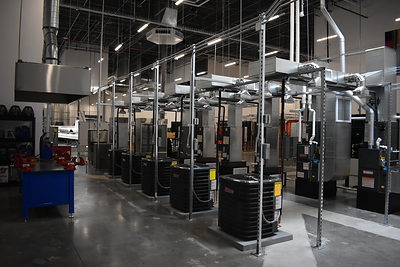
A new campus built for a very physical part of the AI economy
Universal Technical Institute opened UTI-Atlanta on August 4, its first campus in Georgia and second new facility of 2026. The 117,000 square foot building in Smyrna will train up to 1,500 students at full capacity across programs in automotive, diesel, aviation, electrical, robotics, HVACR, and welding. It is a straightforward vocational training expansion on paper, the kind of announcement that rarely lands on a CTO's radar, filed under local business news rather than technology news, and easy to skip past on the way to the next AI model release.
It should land there anyway. Every one of those trades sits directly on the critical path for building and operating the physical infrastructure that AI workloads run on: data centers need electricians to wire them, HVACR technicians to keep server rooms within tolerance, and increasingly robotics technicians to maintain the automated systems inside them. A skilled trades campus opening in a fast-growing metro is not adjacent to the AI infrastructure story. It is part of it, and it is arriving at a moment when regional power and construction capacity, not chip supply, is emerging as the tighter constraint on how fast new AI infrastructure can actually get built.
Executives are naming the connection out loud
UTI is not being subtle about the link. Todd Hitchcock, the company's executive vice president for strategy, growth, and operations, framed the expansion in explicitly AI-driven terms: 'Meeting the growing demand for skilled collar workers who build, operate and maintain our infrastructure is critical to prosperity.' The announcement itself notes that 'as AI reshapes economies across the U.S., meeting demand for skilled workers who build and maintain infrastructure is critical,' language that reads less like a training company's marketing copy and more like a labor market forecast.
Local business leadership echoed the framing. Sharon Mason, president and CEO of the Cobb Chamber, said UTI's 'hands-on training model' prepares students 'for real careers in industries our local businesses depend on.' Smyrna sits inside metro Atlanta's fast-expanding data center corridor, where hyperscalers and colocation providers have been competing for buildable land and grid capacity for several years now. A new pipeline of electricians and HVACR technicians is not a coincidence next to that geography.
The scale of the bet UTI is making
This is not a one-off campus opening. UTI now operates 35 campuses nationwide and has committed to opening multiple new locations annually through 2029, alongside 10 to 20 new programs added at existing campuses each year. That is an aggressive expansion schedule for a company betting on sustained demand for skilled trades labor, and it is a bet that stands in sharp contrast to the enrollment anxiety gripping much of traditional higher education right now.
While four-year institutions worry about declining computer science enrollment and AI's effect on the value of a college degree, UTI is scaling in the opposite direction, on the theory that AI's economic disruption increases rather than decreases demand for hands-on infrastructure skills. Whether that theory holds depends heavily on how fast data center, energy, and manufacturing buildouts continue, but the early signal is that UTI's leadership is confident enough to put real capital behind it.
Why this belongs on an enterprise talent roadmap
Most enterprise AI strategy conversations focus on model selection, data pipelines, and governance for software. Very few include a line item for the electricians, HVACR technicians, and facilities engineers needed to physically stand up the infrastructure that software runs on. That gap is manageable when you are renting cloud capacity from a hyperscaler. It becomes a direct operational risk the moment your organization builds, colocates, or heavily customizes its own infrastructure footprint.
Organizations investing in on-premise AI infrastructure, private data centers, or edge deployments should treat the regional skilled trades labor market the same way they treat cloud vendor capacity: a constraint to model and plan around, not an assumption to leave unexamined. A metro area adding 1,500 new trades graduates a year is a different infrastructure build environment than one without that pipeline, and procurement and facilities teams should be factoring that into site selection and timeline planning now.
The broader signal for workforce strategy
UTI's expansion is also a useful counterweight to the AI narrative that dominates most workforce conversations, which tends to focus almost entirely on knowledge work displacement. The physical buildout required to support AI at scale, power infrastructure, cooling, networking, robotics maintenance, is creating durable demand for trades that are much harder to automate than white collar tasks and that traditional talent pipelines have underinvested in for years, even as billions of dollars in AI infrastructure capital chase a limited pool of workers qualified to build and run it.
For enterprise leaders building long-term workforce strategy around AI, that is a signal worth acting on rather than dismissing as someone else's labor market problem. Partnerships with regional trades schools, apprenticeship pipelines tied to facilities and infrastructure teams, and realistic timeline planning that accounts for skilled labor scarcity all belong in the same conversation as model governance and data strategy. The companies that plan for both sides of the AI buildout, the software and the physical infrastructure underneath it, will be the ones that actually ship on schedule, while competitors who treated trades labor as someone else's problem sit on delayed data center timelines waiting for a crew that was never coming.