The size of the deal is the headline
Virtus Data Centres has closed a 2.45 billion pound financing package, and the company is calling it one of the largest data center bank financings completed in the UK to date. The package includes a 1.2 billion pound green capex facility structured across both term and revolving tranches, giving Virtus flexibility to draw capital as construction milestones are hit rather than all at once. Thirteen banks participated in the consortium, though only four were named publicly as coordinators, senior mandated lead arrangers, and bookrunners: BNP Paribas, Credit Agricole CIB, Societe Generale, and Standard Chartered Bank.
Virtus CEO Adam Eaton called the financing a milestone that gives the company capital flexibility to keep investing in data center infrastructure. That is a modest way to describe a nine-figure-sterling bank syndicate forming around a single operator's growth plan. The scale of the lending group, 13 banks for one company's expansion capital, says more about how banks are underwriting data center risk right now than any press statement could.
Where the money is actually going
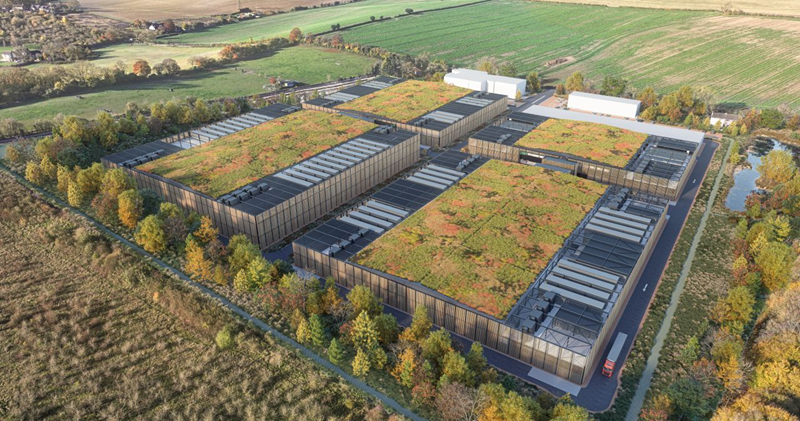
The capital funds continued development at Virtus's Saunderton campus in Buckinghamshire, a 78 megawatt site, and future investment at London19 in Slough. Virtus already operates 14 data centers across four campuses in Greater London plus the Buckinghamshire site, and the company has additional projects in development in Germany and Italy. That geographic spread matters: it signals Virtus is positioning itself as a pan-European operator, not just a London specialist, at exactly the moment continental capacity has become scarce.
Virtus has an institutional backing structure that helps explain why 13 banks were comfortable writing checks. ST Telemedia Global Data Centres made Virtus a wholly-owned subsidiary in 2017, and Macquarie Asset Management acquired a stake in 2023. That combination of an established data center group and a deep-pocketed infrastructure investor gives lenders a credit story beyond the data center assets themselves, which is increasingly what large-scale debt financing in this sector requires.
Why 13 banks underwrote one operator's growth plan
Bank financing at this scale for a single data center operator is not business as usual. It reflects a broader pattern across the sector in 2026: traditional project finance and corporate balance sheets are no longer sufficient to fund the pace of data center construction European demand requires, so operators are assembling larger, more complex lending syndicates to get there. A green capex facility specifically, rather than a general-purpose loan, also signals that sustainability-linked financing terms are now a standard feature of how this capital gets priced and structured.
For an enterprise buyer, the relevant fact is not the financing mechanics themselves but what they imply about supply. Lenders do not assemble 13-bank consortia to fund speculative capacity nobody wants. They do it when an operator has visible, contracted demand that justifies the debt load. Virtus's financing is a proxy indicator that European colocation and data center demand remains strong enough to support aggressive, debt-funded expansion well into this decade.
What this means for capacity planning
If you are negotiating colocation or cloud capacity in London, Frankfurt, or Milan right now, this financing is a data point worth having in your back pocket going into that conversation. It confirms that even well-capitalized operators backed by institutional owners like Macquarie need large syndicated bank facilities to keep pace with demand, which means lead times for new capacity in Europe are unlikely to shorten soon. Expansion funded this way takes years to convert into usable racks, not quarters, so any procurement plan built on an assumption of near-term easing in European data center supply should be revisited before you commit to a timeline you cannot actually hit.
The practical implication is to lock in capacity commitments earlier than you might in a US market with comparatively looser supply, and to treat multi-year European colocation contracts as a scarce resource to be secured rather than a commodity purchase to be shopped at renewal. Operators financing growth at this scale have real pricing power, and that power typically shows up first in renewal terms and expansion clauses rather than in the headline rate card you see during initial negotiations, which is exactly where most procurement teams are not paying close enough attention.
The bigger picture for hyperscaler-adjacent capacity
Virtus sits a tier below the hyperscalers in brand recognition, yet its financing competes directly in the same capital stack for the same construction resources, skilled labor, and grid connections that AWS, Microsoft, and Google need for their own European regions. Every billion pounds of bank debt chasing colocation capacity adds a billion pounds of competition for the substations, cooling equipment, and construction crews hyperscalers also need to build out their own regions on schedule. That physical-input competition, running alongside the capital competition, is a meaningful part of why European cloud capacity has stayed tight even as financing keeps flowing in from every direction imaginable.
Enterprises building multi-year European cloud strategies should read financings like this one as confirmation that the binding constraint is physical rather than financial. Capital is clearly available for data center construction across Europe, as a 13-bank syndicate backing one operator demonstrates. Grid capacity, planning approvals, and construction build time remain the scarce resources, and no amount of bank lending shortens a grid connection queue or a local planning process. Procurement teams should plan their European capacity timelines around those physical bottlenecks, not around the apparent abundance of financing chasing the sector right now.