A satellite campus bigger than most companies' entire footprint
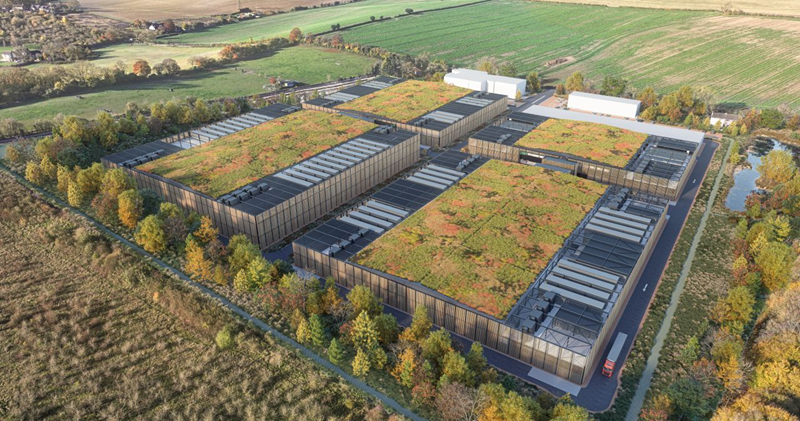
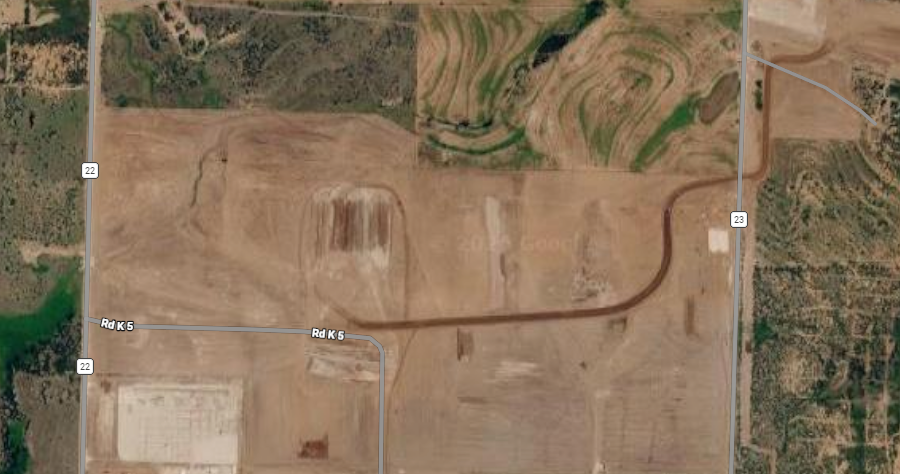
Crusoe has filed plans with the Texas Department of Licensing and Regulation for two data center buildings in Jayton, Kent County, each roughly 759,260 square feet, for a combined investment of about 4.8 billion dollars. The filings describe these as spur buildings of Project Hyper, meaning Jayton exists to extend capacity from Crusoe's primary Childress development rather than to stand on its own. Construction is expected to begin at the end of January 2027, with the two buildings going live in May and July of 2029.
To put the scale in perspective, 4.8 billion dollars and 1.5 million combined square feet is what Crusoe is spending on a secondary, supporting site. The primary Childress campus, Project Hyper, consists of three buildings totaling over 806,000 square feet, with Crusoe expected to invest roughly 2.4 billion dollars in each, or about 12 billion dollars across both sites currently under construction, all targeted for completion in the first half of 2028.
Childress is the anchor, and it is enormous
Crusoe announced the Childress campus in July 2026 as a 1.4 gigawatt development built with Lancium on 270 acres Lancium owns. The site includes behind-the-meter solar and storage and closed-loop cooling, design choices aimed at reducing dependence on the regional grid for a facility of this power draw. A gigawatt-scale campus with its own generation and storage is effectively a small power utility bolted onto a data center, and that combination is becoming standard for sites expected to run continuous AI training and inference workloads at this scale.
The tenant list around Childress and its surrounding Texas sites reads like a who's who of AI compute demand. Iren's adjacent Childress campus is leased to Microsoft. Crusoe's Abilene site, built for and used by OpenAI, serves Oracle and the Stargate project, with more Abilene capacity reportedly being leased to Microsoft. Crusoe is separately developing a campus in Armstrong County for Google. Meta is reportedly set to lease capacity at the Childress site as well.
Why this matters more than another big number
What should get a CTO's attention is not the dollar figure, which has become almost routine in 2026 AI infrastructure coverage, but the concentration. Microsoft, Google, Meta, and the OpenAI-Oracle Stargate partnership are all drawing capacity from Crusoe sites within roughly the same stretch of West Texas. That is efficient for Crusoe's construction and power procurement, but it also means several of the largest cloud and AI workloads in the world now share overlapping exposure to the same regional grid, weather patterns, and water availability.
This is the kind of tail risk that does not show up in a vendor's SLA until it matters. A severe West Texas grid event, an extended heat wave straining cooling systems, or a water availability dispute would not just affect one hyperscaler's regional capacity. It would touch Microsoft's Azure AI workloads, Google Cloud's capacity, Meta's training runs, and the Stargate project simultaneously, because they are increasingly drawing from the same physical neighborhood of data centers.
What it means to lease from a neocloud at this scale
Crusoe operates as a developer and operator building capacity specifically to lease to hyperscalers and AI labs, a category of vendor enterprise buyers rarely interact with directly but increasingly depend on indirectly through their actual cloud contracts. If your AI workloads run on Azure, Google Cloud, or through OpenAI's infrastructure, there is a reasonable chance some portion of that capacity traces back to a Crusoe-built site, even though your contract sits with Microsoft, Google, or OpenAI rather than with Crusoe itself. That layer of indirection is new enough that most procurement and vendor-risk processes have not caught up to it yet.
That indirection matters for how you run risk assessment going forward. Due diligence on cloud vendor resilience has traditionally stopped at the named provider's own regions and published SLAs, treating everything upstream of that as the provider's problem to manage. The Crusoe buildout across Jayton, Childress, Abilene, and Armstrong County is a reminder that the physical layer underneath those SLAs is increasingly concentrated in a small number of specialized developers, whose own financial health, construction timelines, and geographic concentration are now effectively part of your risk surface too, whether your contract names them or not.
The roadmap implication
None of this is a reason to avoid Azure, Google Cloud, or OpenAI's platforms, which remain the right default for most enterprise AI workloads today. It is a reason to change what you ask your account team when negotiating capacity-heavy, multi-year AI compute commitments. Ask where the underlying capacity is physically located, whether it concentrates in a specific region or a specific developer's portfolio, and what contractual protections exist if a regional disruption affects your provider's ability to deliver committed capacity, beyond the standard uptime language covering a single data center.
The broader signal worth taking from this filing is that AI compute capacity is being built further ahead of demand, and further out geographically, than most procurement teams are currently tracking. Crusoe locking in 2029 delivery dates for a satellite campus today tells you the largest buyers in the market believe demand will still be growing by then, at a scale that justifies planning five years out. Build your own capacity planning horizon to match that timeline rather than assuming today's scarcity resolves on a shorter cycle than the people building the actual infrastructure are betting on.