A Capital Budget That Says the Quiet Part Out Loud
Urban Outfitters just told investors it will spend $475 million in capital this fiscal year, up from an earlier estimate of $385 million. That is not a rounding change. The company also moved the share going to logistics from 40% of the budget to 50%, which puts roughly $237.5 million behind warehouses and fulfillment infrastructure alone. For a specialty apparel holding company with three storefront brands, that ratio is unusual. Most retailers still weight capital toward stores and digital storefronts. Urban Outfitters is weighting it toward the plumbing behind Nuuly, its clothing rental subscription business.
That shift matters because Nuuly has stopped behaving like a side project. Subscription segment net sales rose 28.6% year over year and average active subscribers climbed 30.4%, growth rates most retail chief financial officers would take from any channel, let alone a five-year-old one. When a business unit grows that fast, the capital follows it. What is worth watching is not that Urban Outfitters is investing in Nuuly. It is how much of the company's entire capital plan that one unit now commands.
Rental Logistics Is a Different Engineering Problem
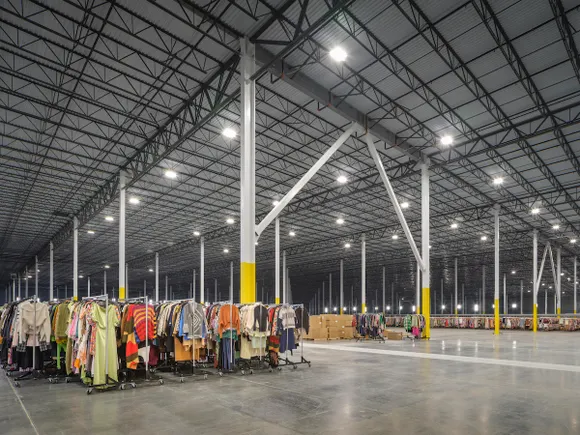
A standard ecommerce fulfillment center moves inventory in one direction: warehouse to customer, with returns as the exception path. Nuuly runs the opposite loop as the default. Every garment ships out, comes back, gets inspected for damage, goes through commercial laundering, and gets restocked for the next subscriber, on a recurring monthly cycle across roughly 500,000 active subscribers today. Nuuly president David Hayne put it plainly: shipping, receiving, laundering, and inspecting wardrobes at that scale requires significant investment, deep focus, and continuous optimization. That is a fair description of a logistics operation that looks more like a industrial laundry service crossed with a distribution center than a typical apparel warehouse.
That is precisely why the automation targets are storage, sortation, and picking, in that order, rather than the customer-facing layer retailers usually automate first. Garment storage automation went live this August. An automated order sortation system follows in the fourth quarter of 2026. An automated picking solution is planned for mid-2027. The sequencing tells you where the actual bottleneck sits: getting used garments back into a sellable, trackable state fast enough to keep pace with subscriber growth, not getting orders out the door.
The Subscriber Math Forcing the Buildout
The Kansas City facility has already been expanded to 1 million square feet, taking its capacity to 600,000 subscribers. A second facility in Philadelphia is set to open in late 2028, growing from 300,000 to 1 million square feet and lifting regional capacity from 200,000 to 600,000 subscribers. Add those together and Nuuly is building toward supporting roughly 1.2 million subscribers, more than double its current base. That is not incremental capacity planning. It is a bet that the growth rate holds for years, not quarters.
Committing hundreds of millions of dollars to physical capacity years ahead of the subscriber base arriving is a real balance sheet risk if rental fashion demand cools. But it also reflects a lesson enterprise operators have learned the hard way in other subscription categories: physical fulfillment capacity cannot be spun up on short notice the way cloud compute can. If Nuuly's growth curve is real, Urban Outfitters would rather be building warehouses now than explaining stockouts and shipping delays to subscribers in 2027.
What CIOs Running Subscription or Resale Models Should Take From This
Nuuly is a useful proxy for any enterprise building a circular or subscription commerce model, resale platforms, equipment-as-a-service, medical device rental, tool libraries, anything where the product comes back. The lesson is that reverse logistics does not scale on the same automation stack as forward fulfillment. Storage, inspection, and reconditioning are the constraint, and they need purpose-built systems rather than a retrofit of a standard warehouse management system built for one-way flow.
It is also a reminder that finance and operations leaders evaluating a subscription pivot need to model the logistics capex curve before the growth curve, not after. Urban Outfitters had years of runway to observe Nuuly's trajectory before committing at this scale, and it still needed a mid-year capex revision to keep pace. Any enterprise entering a similar model without that lead time on infrastructure planning is more likely to be capacity-constrained exactly when the business finally proves itself.
The Bigger Signal for Retail Capital Allocation
Retail capital budgets have spent the last two years shifting toward AI-driven personalization and in-store technology, and most retail earnings calls now frame capex almost entirely around that theme. Urban Outfitters offers a useful counterweight to that narrative. The highest-conviction capital project inside the company right now sits in warehouse automation for a subscription unit with fundamentally different unit economics than the rest of the business, funded ahead of a shopping assistant or a recommendation engine. That ordering of priorities deserves attention precisely because it runs against the current industry pattern.
For enterprise technology leaders benchmarking capital plans against peers, Urban Outfitters' 50% logistics allocation is a data point worth citing directly in board conversations. It shows a public retailer treating physical fulfillment infrastructure as the real constraint on its fastest-growing business line, funding that infrastructure accordingly, and letting the more visible customer-facing AI spend take a secondary seat in the same budget cycle. Boards evaluating their own retail technology roadmaps should ask whether their capital allocation reflects a similarly honest read of where the actual bottleneck sits.