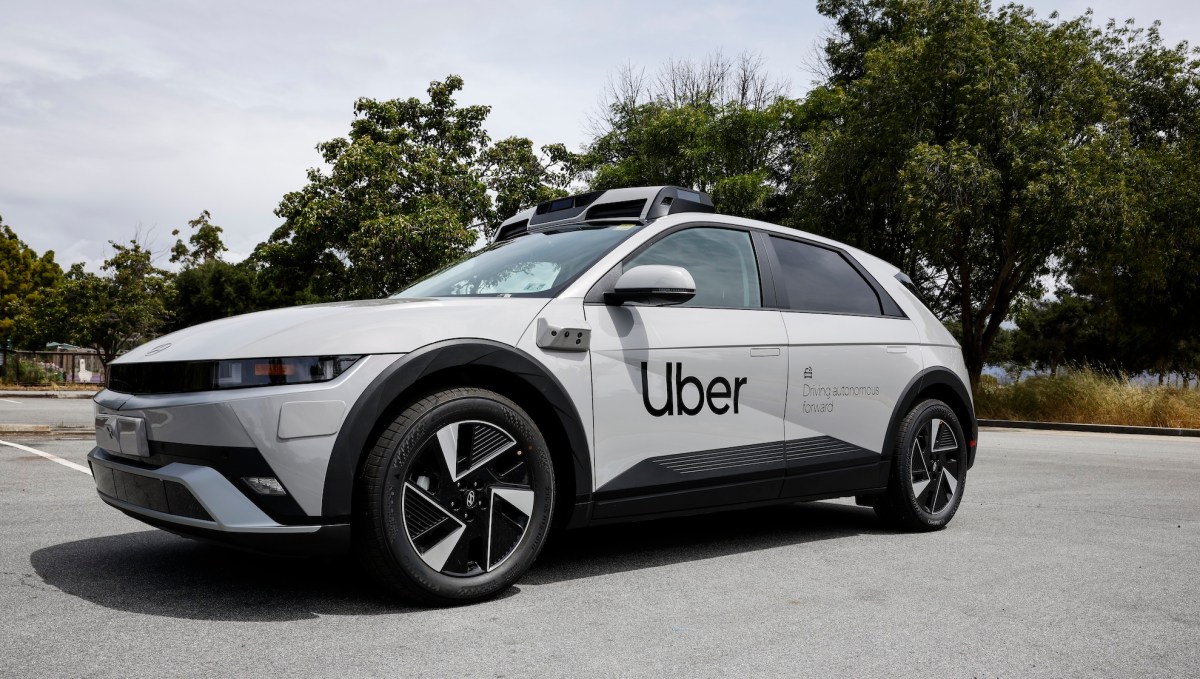
Uber pulled the cover off a retrofitted Hyundai Ioniq 5 on June 3 and used the reveal to announce a far more ambitious plan than a single prototype suggested. The company intends to put 500 of these vehicles on roads around the world this year, with the first 50 operating by summer, and to use them as a shared sensing platform for the autonomous vehicle developers that already run on its network. The stated production target is two million miles per month of high fidelity, time synchronized data, which would make Uber one of the largest non operator data sources in the autonomy industry within a single calendar year.
The sensor stack on the Ioniq 5 is deliberately heavy. Each car carries 14 cameras, 8 solid state lidar units, and 9 radars, all wired into an Nvidia Drive Thor compute module. Roush Performance, the Michigan engineering shop best known for motorsports work, is handling the physical retrofits. Uber says the suite will evolve as partners ask for different sensor placements and modalities, suggesting the long term plan is closer to a configurable rolling test bed than a fixed reference design. Output to partners includes a 360 degree, time synchronized stitched view, which is the kind of pre processed data that AV teams normally have to build themselves.
What the sensor car actually does
The strategic context matters more than the spec sheet. Uber sold its in house autonomy effort, Advanced Technologies Group, to Aurora in late 2020 after burning through capital and reputational equity on a program that never produced a commercial product. The Ioniq 5 reveal is the first vehicle Uber has built or assembled itself since that exit, and leadership is careful to frame the work as data engineering rather than a return to building drivers. The new Uber AV Labs division owns the program, sitting alongside Uber Autonomous Solutions, the operations arm that runs day to day robotaxi, autonomous trucking, and sidewalk delivery deployments.
Uber already has a head start that is easy to miss. The company has been pulling outward facing camera data from thousands of fleet partner vehicles across dozens of cities for years, and over the past two years it has collected data from hundreds of Lucid Air vehicles operated by fleet partners in the United States and Europe. The Ioniq 5 program upgrades that camera only feed into a multi modal dataset with lidar returns and radar tracks, which is what most modern perception stacks actually need to train robust models.
Why Uber is rebuilding AV after Aurora
For us at the CTO level, the move reframes Uber from a demand aggregator into a data utility. The robotaxi market is rapidly bifurcating. On one side sit the autonomy stack builders, including Waymo, Wayve, Tesla, and a long tail of Chinese players. On the other sit the operators and capital allocators that own real estate in cities, payment rails, and rider relationships. Uber is now positioning itself in a third layer, the training data and operations layer, that both sides need. If the company can lock in exclusivity on certain geographies or sensor configurations, it can extract rent from every robotaxi mile driven on its platform, regardless of which autonomy vendor wins.
The competitive read is also worth our attention. Waymo, a stated Uber partner, has its own enormous data flywheel from years of public road driving. WeRide and Avride are smaller and lean more heavily on partnerships. By offering all three the same dataset, Uber is implicitly betting that data parity will not eliminate differentiation, because the actual neural network designs, simulation environments, and safety cases still matter. That is a defensible bet, but it also pressures pure data plays that have tried to sell driving corpora as a standalone product.
What this means for AV-stack buyers and data partners
Two follow on questions are worth tracking. The first is regulatory. As regulators in Europe and California tighten rules on connected vehicle data, Uber will need to prove that the Ioniq 5 fleet is a controlled research program rather than a surveillance asset. The second is commercial. Uber has not disclosed pricing, exclusivity terms, or data residency commitments. Those details will determine whether the company captures durable margin or simply subsidizes its partners.
For technology leaders inside our portfolio companies and customer base, the practical takeaway is to start treating driving data, and by extension any physical world sensor data we touch, with the same rigor we apply to model training corpora. That means provenance, licensing, retention windows, and contractual exclusivity language. Uber just made it clear that whoever controls the sensors controls part of the autonomy economy, and the same logic will apply in warehouse robotics, agriculture, and field service within the next 24 months.
We covered Uber's per-engineer AI spending cap last month in our earlier piece on the $1,500 per month limit, and the sensor car program reads as the operational counterpart to that cost discipline: rather than buy synthetic AV training data from a vendor, Uber is generating proprietary data at scale and selling access to thirty-plus partners, turning a cost center into a moat. For technology leaders watching the AV stack, the read is that data ownership remains the durable advantage even as the model layer commoditizes.