A ground-up rewrite finally reaches production
Microsoft published TypeScript 7.0 on July 8, closing out the work it started in March 2025 under the name Project Corsa. The compiler and language service, previously written in TypeScript and run on Node.js, have been reimplemented in Go. Principal product manager Daniel Rosenwasser framed the release plainly: "Today we are proud to announce the availability of TypeScript 7, a 10x faster native port of TypeScript." This is the same language and the same type system engineering teams already use, running on a fundamentally different engine. The install path stays familiar too, since 7.0 ships under the standard latest tag on npm.
The reason this matters to engineering leaders is time. Type-checking sits in the inner loop of every developer and every CI run, and for large TypeScript monorepos it had become a measurable tax on velocity. A compiler that runs an order of magnitude faster changes what teams can afford to check on every commit, how quickly editors respond, and how much compute the build fleet burns. The Go rewrite also unlocks native multithreading through new flags for parallel checkers and builders, which the old single-threaded JavaScript implementation could never offer. For once, a major version bump is about raw throughput rather than new syntax.
The benchmark numbers that actually matter
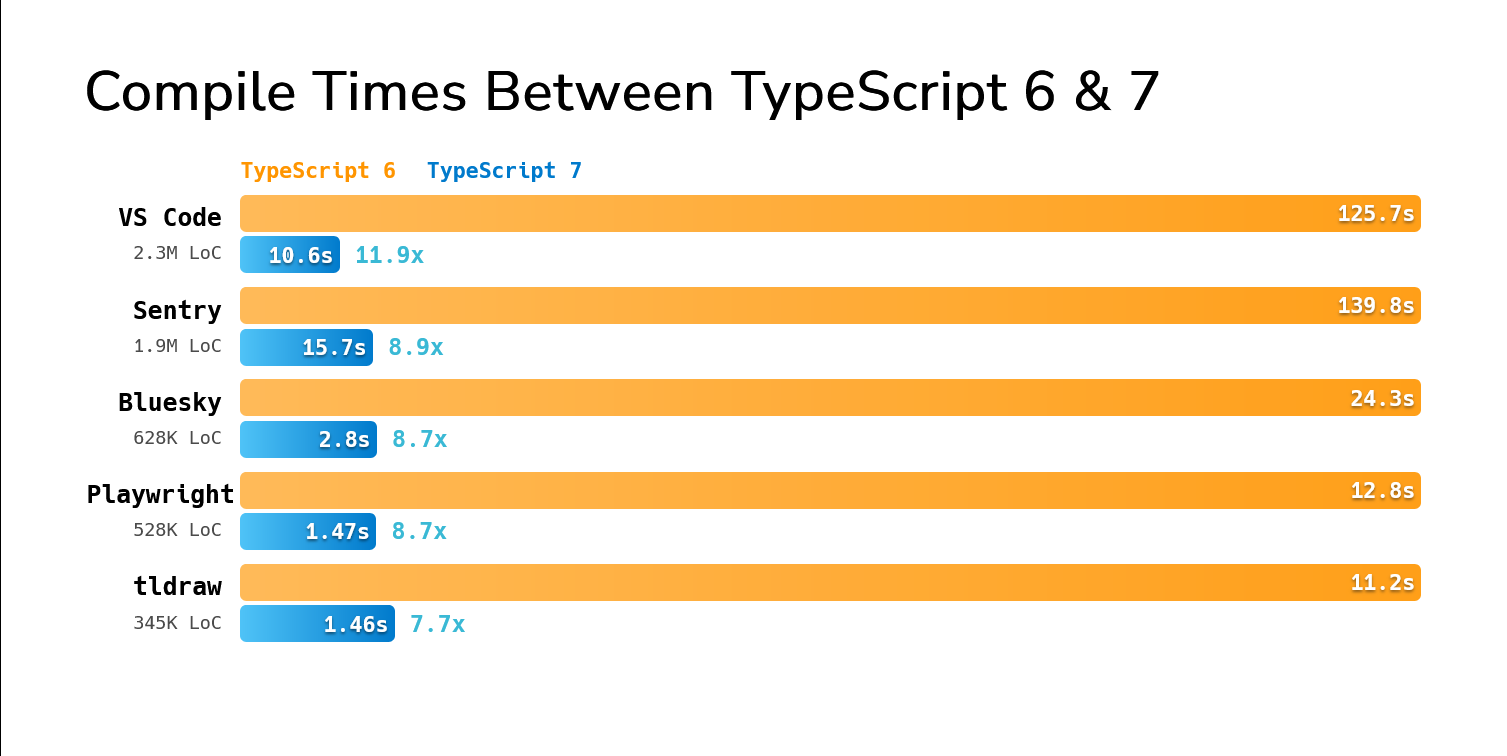
Microsoft published head-to-head figures across well-known open-source projects. VS Code went from 125.7 seconds to 10.6 seconds, an 11.9x gain. Sentry improved 8.9x, Bluesky 8.7x, Playwright 8.7x, and tldraw 7.7x. Memory consumption dropped between 6 and 26 percent depending on the project. Editor responsiveness saw an even sharper jump: opening a file with errors in VS Code fell from 17.5 seconds to 1.3 seconds, roughly 13x faster. These are not synthetic microbenchmarks, they are full type-checks of real codebases that many teams recognize, which makes them a reasonable proxy for what your own repository will see.
The CI story is where the money shows up. Slack engineers, quoted by Microsoft, said TypeScript 7 brought their CI type-check from about 7.5 minutes to 1.25 minutes and removed 40 percent of merge-queue time. Merge-queue latency is a direct constraint on how fast a large team can land changes, so a cut of that size compounds across hundreds of daily pull requests. For a platform team measuring developer productivity, the release is a rare lever that improves both wall-clock feedback and cloud spend at the same time, without asking engineers to change how they write code.
What breaks and what has to wait
The catch sits in the ecosystem. TypeScript 7.0 ships without a stable programmatic API, and Microsoft has deferred that to 7.1. Any tool that reaches into the compiler through the API, and that includes large parts of the linting and build-tooling world, cannot move yet. Framework template type-checking for Vue, MDX, Astro, Svelte, and Angular still depends on the TypeScript 6.0 implementation. Teams that rely on those integrations will run 7.0 for command-line and editor checking while keeping 6.0 in the loop for template validation, a split that adds coordination overhead until the surrounding tools catch up.
There is a second gate. Strict mode and the deprecations introduced in 6.0 are now hard defaults rather than opt-in settings, and several older configuration options have been removed. For a codebase that has been coasting on loose settings, the upgrade doubles as a cleanup project that surfaces latent type errors. That is healthy in the long run, and it is also work that has to be scheduled and staffed. Leaders should treat 7.0 as a migration with a real backlog attached, not a drop-in dependency bump that lands cleanly on the first try.
Reading the migration realistically for large orgs
The pragmatic path for most enterprises is a phased rollout. Start by running 7.0 in a non-blocking CI lane alongside the existing 6.0 pipeline, so the faster checker can flag new strict-mode failures without gating merges. That surfaces the true size of the cleanup before anyone commits to a cutover date. Teams with heavy framework template usage should map which repositories depend on the missing programmatic API and plan to keep those on 6.0 until 7.1 arrives. The goal is to capture the CI speedup where it is safe today while isolating the parts of the estate that genuinely need to wait.
This is also a governance moment. A build toolchain that runs 10x faster invites teams to add checks they previously skipped for cost reasons, from broader type coverage to stricter lint gates. That is an opportunity to raise the quality bar, and it needs an owner so the newly cheap compute does not simply get spent on more of the same. Platform teams should decide deliberately what to do with the reclaimed minutes, whether that is faster feedback, tighter gates, or a smaller CI bill, rather than letting each team make the call in isolation.
The competitive backdrop for JavaScript tooling
TypeScript 7.0 lands in a JavaScript ecosystem that has spent two years porting hot paths to native code. Bundlers, linters, and runtimes have moved into Rust and Go to escape the performance ceiling of tools written in JavaScript itself. Microsoft rewriting its own flagship compiler in Go is the clearest signal yet that the language of the toolchain and the language of the application no longer need to match. For engineering leaders, the takeaway is that native-speed developer tooling is becoming the baseline expectation rather than a differentiator reserved for a few well-resourced teams.
That shift has a hiring and maintenance dimension worth naming. As core tools move to Go and Rust, the pool of engineers who can contribute to or debug them changes, and internal tooling teams may need skills beyond JavaScript to stay effective. The upside is stability: native compilers tend to have more predictable performance profiles under load than their interpreted predecessors. Leaders evaluating their platform investments should factor in that the tools underpinning their frontend and Node.js estates are quietly becoming systems software, with the reliability expectations that label implies.
What it means for your roadmap
For any organization running a large TypeScript codebase, 7.0 is worth putting on the near-term roadmap, with eyes open about the 7.1 dependency for tooling integrations. The CI and editor gains are large enough to justify the migration work for teams that feel the pain of slow type-checking today. Teams with lighter TypeScript footprints or heavy framework-template dependencies can reasonably wait a cycle, tracking the 7.1 API milestone as the trigger to move. The decision hinges on how much your feedback loops and merge queues currently cost you, which is a number your platform team can measure directly.
The broader lesson is about where developer-productivity gains now come from. This release delivered a step change without a single new language feature, purely by rebuilding the engine. Leaders should watch for similar native rewrites across their toolchain and budget for the migration effort each one carries, because the pattern of order-of-magnitude speedups from native ports is likely to repeat. TypeScript 7.0 is a concrete, measurable win available now, and it is also a preview of how the next few years of toolchain improvement are going to be won.