Schnucks launches an agentic nutrition shopping assistant
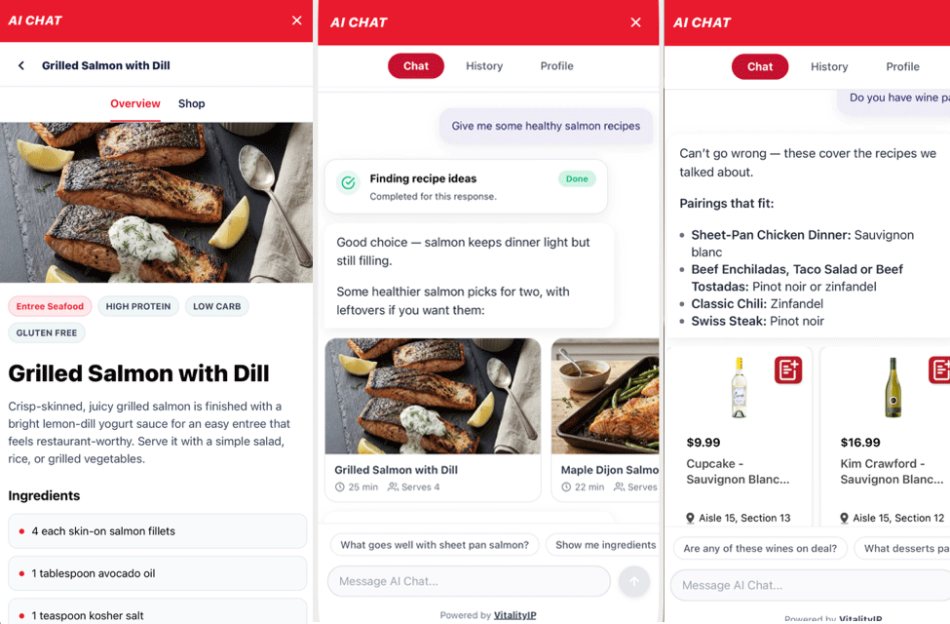
On July 22, 2026, regional grocer Schnuck Markets and startup VitalityIP announced an AI-powered agentic shopping assistant that will bring personalized nutrition guidance, meal ideas, and product recommendations into Schnucks' digital storefront. Set to launch in late summer 2026, the assistant will live inside the Schnucks Rewards app and schnucks.com, and it is built on more than 6 billion lines of shopping, health, and nutrition data. Schnucks runs 112 stores across Missouri, Illinois, and Indiana with more than 11,000 employees, giving the deployment real scale in a regional footprint. For grocery technology leaders, it is a concrete test of agentic commerce grounded in health.
Sarah Hoit, co-founder and chief executive of VitalityIP, tied the launch to a gap in where nutrition advice reaches people. "Food is medicine, but personalized nutrition options haven't been available where people make food decisions," she said, pointing to the grocery cart as the moment of truth. Tom Henry, chief data and information officer at Schnucks, described the goal as a shopping experience that is more personal, more helpful, and more rewarding for customers. The pairing puts a health-aware recommendation engine at the exact point of purchase, where a suggestion can change what actually lands in the basket rather than living in a separate wellness app users forget to open.
Six billion data points and real store inventory ground the agent
The assistant's credibility rests on its data. VitalityIP brings more than 6 billion lines of shopping, health, and nutrition data plus what it describes as medical-grade health databases, and the system was co-developed using real customer journeys and Schnucks' actual store inventory. That grounding matters because a nutrition agent that recommends products a store does not carry, or that ignores what a shopper actually buys, fails on first contact. Tying recommendations to live inventory means the agent suggests items a customer can add to the cart immediately, which is the difference between useful guidance and generic advice detached from the shelf.
Grounding an agent in real inventory and purchase history is also the technical guard against the failure mode that undermines most retail chatbots: confident recommendations that do not match reality. By constraining the model to Schnucks' catalog and a customer's genuine behavior, the design keeps the assistant tethered to products that exist and preferences that are real. For technology leaders, this is the pattern worth copying from the announcement. An agentic experience is only as trustworthy as the data boundaries around it, and pairing a proprietary health dataset with live commerce inventory is a deliberate architecture for keeping suggestions both safe and actionable.
Food as medicine moves from slogan to shopping cart
The strategic framing is food as medicine, and the assistant operationalizes it by targeting specific health goals: weight management, healthy aging, recovery, and family wellness. Instead of offering flat product listings, the agent is meant to interpret a shopper's stated objective and translate it into meal ideas, product choices, and dietary adjustments that fit real needs. That positions Schnucks to compete on a dimension beyond price and convenience, offering personalized health value that a pure marketplace cannot easily replicate. For a regional grocer facing national delivery giants, differentiating on nutrition and trusted local relationships is a defensible strategy worth investing in.
The commercial logic is that healthier, goal-oriented shopping tends to be higher-consideration and higher-loyalty. A customer who relies on the assistant to plan meals around a wellness goal returns more often and consolidates more of their basket with the retailer that helps them succeed. Embedding the guidance inside the rewards app also strengthens the loyalty loop, connecting health outcomes to points, savings, and repeat visits. For commerce leaders, the takeaway is that agentic experiences can do more than speed checkout; they can create switching costs by becoming genuinely useful to how a customer manages an ongoing part of their life.
The retailer keeps the customer, the vendor supplies the brain
The deal's structure is as instructive as its features. VitalityIP retains its proprietary AI and medical-grade health databases, while Schnucks retains its customer relationships, shopper data, and brand experience. That clean division lets the grocer add a sophisticated capability without surrendering the asset that matters most, the direct connection to its shoppers. The assistant appears as a Schnucks experience inside Schnucks-owned channels, powered by a specialist's technology in the background. For any retailer weighing an AI partnership, this arrangement is the one to study, because it captures vendor innovation while keeping the customer relationship and first-party data on the retailer's side of the line.
That balance is harder to strike than it sounds. Many AI vendors want to sit between the retailer and the customer, accumulating the behavioral data that makes their models better and their position stickier. A structure where the retailer owns the relationship and the interface, and the vendor owns the model and its specialized data, aligns incentives without ceding strategic ground. VitalityIP is also positioning the system as white-label software for other retailers, health systems, and employers, so commerce leaders negotiating similar deals should define who owns the customer data, who controls the branded experience, and what happens to both if the partnership ends, before a single recommendation ships.
Health recommendations raise the governance bar
Putting a health-aware agent between a grocer and its customers introduces obligations that ordinary product recommendations do not carry. Nutrition guidance tied to conditions like recovery or healthy aging edges toward advice people may treat as medical, which raises questions of accuracy, liability, and appropriate disclaimers. VitalityIP's use of medical-grade databases and grounding in real inventory are meant to keep the assistant reliable, and the responsibility for how that guidance is framed and bounded still sits squarely with both partners. A wrong or overconfident health suggestion damages trust far more than a bad product recommendation ever could.
For technology and data leaders, this is where the unglamorous work concentrates. Deploying the assistant responsibly means clear boundaries on what it will and will not claim, monitoring for recommendations that drift into medical territory, and consent controls over the sensitive health and dietary data the system collects. Those guardrails are mandatory in a health context, and they are the difference between an assistant customers trust with their wellness goals and one they abandon after a single misfire. The Schnucks launch is a useful reminder that the more valuable an agent's domain, the higher the governance investment required to run it safely.
What the Schnucks launch means for grocery roadmaps
The immediate signal is that agentic commerce is moving into specialized, high-value domains where grounding and trusted data create real differentiation. A regional grocer is deploying a health-aware assistant tied to live inventory and loyalty, which is a more defensible use of AI than a generic chatbot bolted onto a catalog. Grocery leaders should look at where their own first-party data, whether nutrition, purchase history, or loyalty signal, could power an assistant that customers find genuinely useful, and treat that grounding as the core of the build rather than an afterthought bolted on late.
The structural lessons travel beyond grocery. Partner with a specialist for the model and the domain data, keep the customer relationship and brand on the retailer's side, ground the agent in real inventory and real behavior, and invest in governance proportional to the sensitivity of the domain. Schnucks and VitalityIP have packaged those principles into a single deployment launching this summer, and its results will tell the industry whether food-as-medicine agentic commerce drives measurable loyalty and basket growth. For commerce leaders, it is a live case study in building AI that is useful, trusted, and still owned by the retailer.