The governance gap Draco is built to close
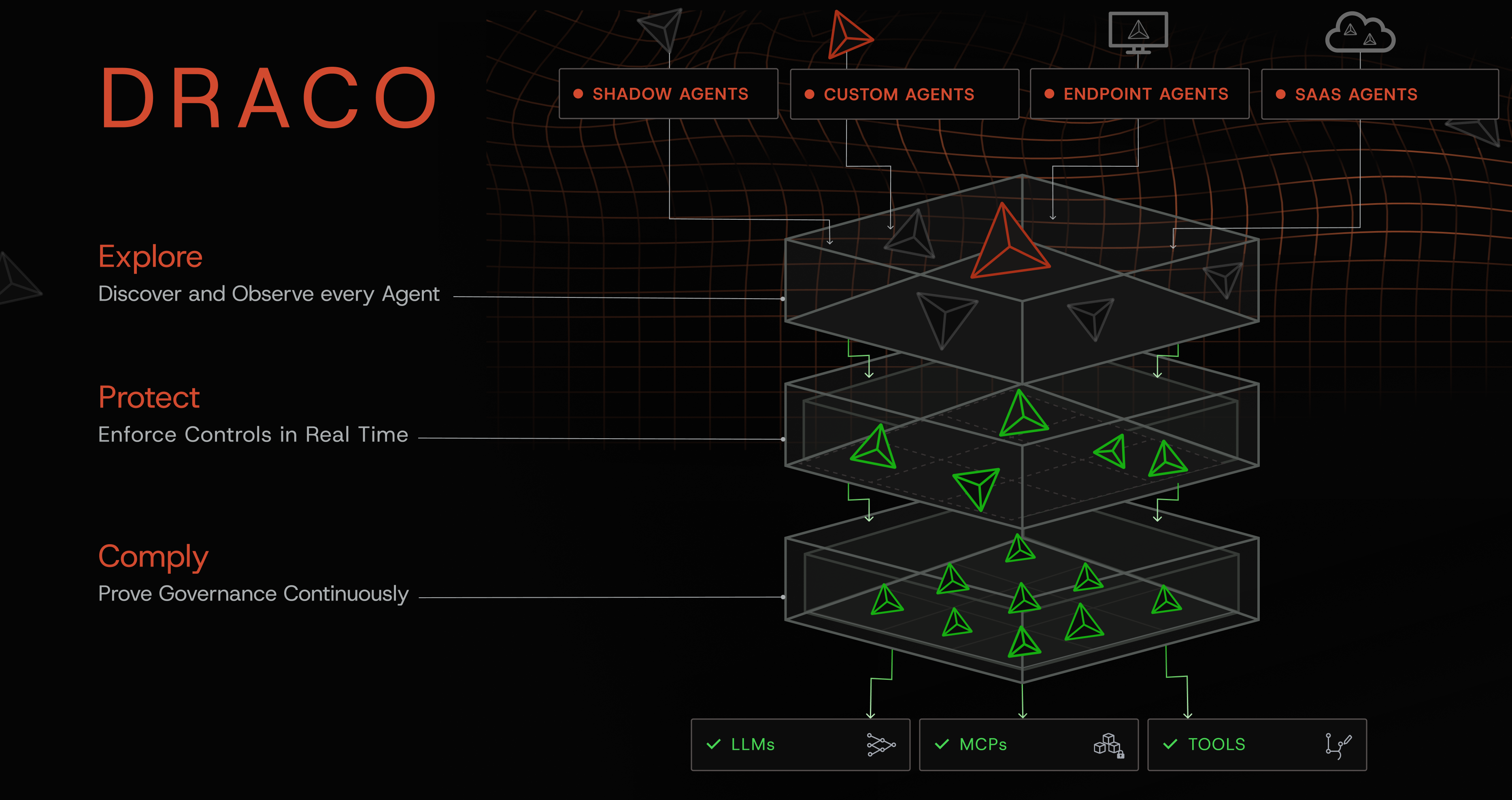
Alterion introduced Draco on July 16 as what it calls a runtime control plane for enterprise AI agents. The pitch targets a specific failure mode that leaders are now hitting in production: agents that were reviewed and approved at design time behave unpredictably once they are live, calling tools and touching systems in combinations no one modeled in advance. Draco inserts itself between the agents and the infrastructure they act on, observing prompts, actions, and payloads as they happen and enforcing policy in the moment. The company frames this as governance that operates while agents run, rather than a set of rules configured once and trusted thereafter.
The timing tracks with where enterprise AI actually sits in mid-2026. Many organizations have moved past pilots and now have agents wired into real workflows, often across several vendors and clouds at once. That sprawl is exactly what makes after-the-fact review inadequate, because the risky behavior appears at runtime and the blast radius includes production data and systems. Co-founder Asim Husain summarized the pattern bluntly: "Every enterprise we talk to has the same situation: agents in production, and no real visibility into what they're doing." Draco is an attempt to sell that visibility and control as infrastructure rather than as a policy document.
Why runtime enforcement differs from design-time rules
The conceptual claim behind Draco is that most existing agent governance tools work before deployment, configuring permissions and rules and then hoping the agent stays inside them. Co-founder Alharith Hussin put it sharply: "Most governance tools work at design time: configure rules before deployment and hope agents behave. That's not governance, that's guessing." Draco instead profiles each agent's normal runtime behavior, builds a baseline, and applies programmable guardrails that can stop a high-risk action before it executes. The distinction matters because agent behavior is emergent, and a static allow-list cannot anticipate every tool-call sequence a capable model will invent under real conditions.
For engineering leaders, the practical difference is where the enforcement point lives. A design-time approach depends on developers correctly scoping permissions and on the agent respecting them. A runtime control plane moves the decision to the moment of action, where it can weigh live context that was unavailable at configuration time. That is a stronger guarantee, and it also introduces a new component in the critical path that must be low-latency and highly available, since it now stands between agents and the work they are meant to do. Evaluating Draco means evaluating that trade between control and added dependency.
Shadow agents and the inventory problem
A recurring theme in Alterion's description is discovery. Draco claims to find shadow agents, SaaS-embedded agents, endpoint agents, and custom-built agents without code changes, then inventory every prompt, tool call, and token expenditure they generate. That framing acknowledges a reality many security and platform teams already feel: agents are proliferating faster than any central registry can track, arriving through SaaS features and individual developer experiments rather than through a governed procurement path. You cannot enforce policy on an agent you do not know exists, so discovery is the precondition for everything else the platform promises.
This is the part of the story that should resonate with CIOs wrestling with visibility. The token-spend inventory in particular doubles as a cost-governance signal, since agent runs translate directly into model API bills that are often opaque at the department level. A control plane that already sees every tool call is positioned to answer both the security question and the FinOps question with the same telemetry. For leaders, the discovery claim is also the one to test hardest in a proof of concept, because a governance layer is only as good as the fraction of the agent estate it can actually see.
Compliance mapping and audit evidence
Draco leans heavily on compliance framing, mapping its controls to SOC 2, ISO 42001, and the NIST AI RMF, and generating audit-ready evidence packages on demand that integrate with existing GRC systems. Alterion also states that the platform covers the full OWASP Top 10 for Agentic Applications, a nod to the emerging shared vocabulary for agent-specific threats. For regulated enterprises, that mapping is the difference between a promising tool and one that can actually be adopted, because auditors and risk committees want controls expressed in frameworks they already recognize rather than in a vendor's private taxonomy.
The evidence-generation piece deserves attention because it targets a real operational cost. Producing audit trails for autonomous systems by hand is slow and error-prone, and the burden grows as agents multiply. A control plane that continuously records prompts and actions can turn that telemetry into compliance artifacts without a separate reporting project. Integration with SIEM, SOAR, and SOC systems extends the same data into the security operations stack. Leaders should probe how faithfully these packages map to their specific audit requirements, but the underlying idea, treating runtime telemetry as the raw material for compliance, is directionally correct.
Who is building it and why that matters
Alterion pairs enterprise and engineering pedigrees at the top. Alharith Hussin is a former McKinsey partner, and Asim Husain is a long-time Google engineering VP, a combination the company presents as bridging the boardroom framing of risk with the technical depth needed to build a low-latency control plane. That mix matters in this category because the buyer is often a security, risk, or compliance leader while the deployment lands on a platform team. A vendor that can speak credibly to both sides has a real advantage in a market where the technology is young and trust is the scarce resource.
It is worth being clear-eyed about maturity. Draco launched on July 16 as a first commercial availability, and the agent-governance category itself is still forming, with standards like the OWASP agentic list only recently taking shape. The claims of days-to-deploy and full threat coverage are the vendor's, and they warrant validation against a real agent fleet before anyone treats them as settled. This is an early product in an early market, which means the reference customers and independent results that would normally anchor a buying decision are still being written.
The build-versus-buy call for agent governance
For engineering leaders, Draco crystallizes a decision that is arriving whether or not this specific product wins: how to govern agents at runtime, and whether to build that capability in-house or buy it. Teams with heavy agent deployments and strict regulatory exposure will feel pressure to have some enforcement point between their agents and production soon, because the risk of an unsupervised agent taking a costly action is concrete rather than theoretical. The question is whether a dedicated control plane earns its place in the critical path or whether existing policy engines and API gateways can be stretched to cover the need.
The pragmatic move is to run a scoped evaluation against your riskiest live agents and measure two things: how much of your actual agent estate the tool discovers, and what latency it adds to real actions. Those numbers, more than any framework mapping, will tell you whether runtime control is ready to sit in your production path today. Regardless of vendor choice, the launch is a useful prompt to inventory where your agents already run unsupervised, because that inventory is the work you will have to do before any governance layer, bought or built, can help.