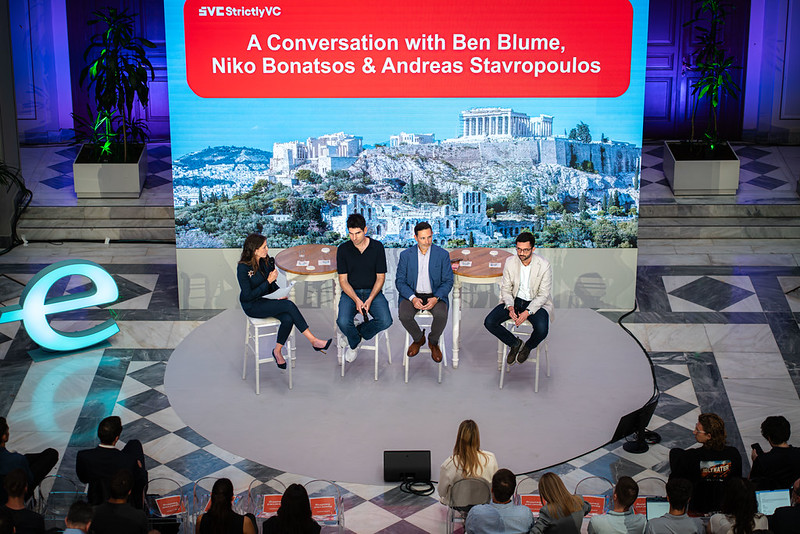
A panel at StrictlyVC Athens this afternoon delivered the bluntest framing yet of what AI money is actually doing inside the venture industry. Niko Bonatsos of Verdict Capital, Andreas Stavropoulos of Threshold Ventures, and Ben Blume of Atomico told Connie Loizos that roughly three quarters of all venture capital raised over the past year has been concentrated in five companies. Bonatsos, who has worked in Silicon Valley for 17 years, called it the most extreme groupthink he has ever seen, and said that a tenured Stanford professor in their 40s who is not building an AI startup currently struggles to get a meeting. That is the climate engineering vendor maps for the next 24 months.
The headline number matters less than the structural mechanics behind it. Stavropoulos pointed out that the coming wave of mega IPOs (SpaceX at a reported $1.75 trillion, with OpenAI and Anthropic queued behind) is the first credible chance since Google's 2004 listing to reopen the public market for technology issuers. If those filings land cleanly, the secondary effects are immediate: pension funds and sovereign allocators get a defensible reason to expand technology exposure, late-stage rounds get repriced upward, and the M&A premium that hyperscalers must pay to take competitors off the board climbs again. For a CTO evaluating a multi-year platform commitment, the relevant question is not whether SpaceX prices well; it is whether your incumbent vendor's acquirer pool is about to triple in size, and what that does to roadmap stability.
The compression of company stages is the second structural change the panel surfaced. Bonatsos described seed term sheets arriving for 22 year olds and Series A offers for 19 year olds, made possible because two-founder teams now ship in two months what previously required a ten-person team and a year. From a buyer's perspective that means the typical signals we used to triangulate vendor maturity (headcount, time since founding, named customers) are no longer reliable proxies for delivery capacity. Several of our portfolio operators are already adjusting their vendor scorecards to add explicit questions about runway, contracted ARR composition, and dependency on a single hyperscaler's credit program. We expect that to become standard practice by the end of the year.
The ARR question is where it gets uncomfortable. Blume noted publicly what most operators already know privately: people are being liberal with how they define the A, the R, and the R. Token-based pricing, free tokens recognized as revenue, three-month annualizations, and pilot revenue counted as production are all in active circulation. Bonatsos shared an anecdote about a portfolio company that reported a number representing one day's revenue multiplied by 365 after a launch spike. The implication for enterprise procurement is concrete. If your finance team is benchmarking a vendor's burn-to-revenue ratio off published ARR, the denominator may not survive the next quarter, and the renewal conversation may arrive earlier than the contract suggests. We have moved to requesting trailing twelve month GAAP revenue, not headline ARR, for any AI vendor we plan to standardize on.
The third theme worth carrying into Monday's leadership meeting is where the panel sees actual white space. Bonatsos believes consumer internet is rebuilding under the cover of ChatGPT, with only a handful of remaining specialist investors, which means founders in that lane can raise on better terms but with thinner syndicates. Blume's argument that robotics and the physical world represent an order of magnitude larger opportunity than digital workflow automation is the one we find most directly relevant. The teams winning enterprise robotics pilots over the next 18 months are likely to come from companies that today look unfundable by the same logic Bonatsos described, because they sit outside the five-company gravity well. For organizations with warehouse, field service, or manufacturing operations, the planning horizon for evaluating physical AI providers should be brought forward.
Finally, the panel underscored that correction is coming. Stavropoulos was explicit that short and medium term results will not match current promise, and that not every 19 year old is the next big thing. That is the polite Silicon Valley way of saying valuations are wrong somewhere in the stack. We are not in the business of forecasting market timing, but we are in the business of advising clients on counterparty risk. The operational implications are straightforward: tighten exit clauses, avoid single-vendor lock-in on agentic platforms, demand portable data formats, and treat any AI provider's published growth metrics as a starting point for diligence rather than an answer. The capital concentration that Bonatsos described will produce both extraordinary winners and a long tail of stranded customers. The job, for now, is to make sure none of the latter category are ours.
One last operational point from the panel deserves emphasis. Blume noted that Atomico's $500 million fund competes for the same deals as $10 to 15 billion funds, which distorts round sizes upward because the marginal dollar means something very different to each side. The downstream effect for buyers is that companies are now raising 18 to 24 months of runway in a single round, which means a vendor's behavior in year two of a contract is decoupled from any near-term funding pressure. That is good news for stability and bad news for negotiating leverage at renewal. We are advising operators to negotiate price protection clauses into multi-year AI contracts now, while the vendor still has incentive to close, rather than at renewal when the vendor has cash and the customer has integration debt. The capital cycle Bonatsos described will end the way every concentrated capital cycle ends; the only question is who has written the right clauses into the right contracts before it does.