A Health System Builds the Floor Before the House
On June 24 Sentara, one of the largest not-for-profit health systems in the US Mid-Atlantic and Southeast, said it had entered a strategic collaboration with Infosys to scale enterprise AI adoption across its operations. What stands out is not the ambition but the order of operations. Rather than announcing a flashy clinical tool or a chatbot for patients, Sentara is describing a foundation: a scalable framework, governance, and a disciplined path for taking AI from experimentation into production across IT, hospital operations and clinical support. For a system with twelve hospitals and around thirty-four thousand employees, that sequencing is a tell about how seriously it takes the risk side of the ledger.
We have watched a lot of healthcare AI announcements over the past two years, and the recurring failure mode is the pilot that never scales. A promising model works in one department, impresses a committee and then stalls because the surrounding plumbing, the data access, the governance, the integration, was never built. Sentara appears to be addressing that gap directly by funding the unglamorous scaffolding first. That is a less exciting story to tell, but it is the one that determines whether AI ever touches a patient outcome or a clinician's day in a meaningful, repeatable way.
Governance as the Starting Point, Not the Brake
In many enterprises, governance shows up late and is experienced as a brake on momentum. In healthcare the calculus is different, because a model that misfires can affect care, privacy and regulatory standing all at once. Sentara's framing puts responsible AI design, enterprise guardrails and operational readiness at the front of the effort. The intent is to prioritize high-value use cases, validate them, then scale the ones that work, with the governance layer present from the first step rather than retrofitted after something goes wrong. That is the correct order for an industry where the cost of a bad deployment is measured in trust and safety, not just dollars.
Jamisson Fowler, Senior Vice President and Chief Digital Officer at Sentara, said that as the system continues to advance its digital strategy, working with Infosys enables it to take a thoughtful and scalable approach to AI adoption across the enterprise. The word thoughtful is doing real work in that sentence. It signals a deliberate posture in a market that has rewarded speed and spectacle. For a health system, thoughtful and scalable are not hedges. They are the requirements that keep an AI program from becoming a liability the moment it leaves the lab.
What Topaz Fabric Is Supposed to Do
The technical backbone of the engagement is Infosys Topaz Fabric, which the company positions as an agentic services suite that unifies infrastructure, models, data, applications and workflows into a composable, agent-ready ecosystem. Stripped of the marketing, the promise is integration. The reason so many healthcare AI projects stall is that the underlying environment is fragmented, with data trapped in silos and workflows that do not talk to one another. A fabric layer is meant to knit those pieces together so that agents have something coherent to act on, rather than a patchwork they have to fight.
Whether the technology lives up to the framing is the open question, and we would not take it on faith. The value of any unifying layer in healthcare depends on how well it respects clinical context, consent, and the messy reality of legacy systems that hospitals cannot simply rip out. The right test is not whether the platform demos cleanly but whether it lets Sentara move a validated use case from one hospital to twelve without rebuilding it each time. That portability, more than any single feature, is the practical measure of whether the foundation is real.
Why Healthcare Forces a Different Discipline
Venky Ananth, EVP and Global Head of Healthcare at Infosys, said healthcare organizations are at a pivotal moment where AI can meaningfully enhance clinical and operational outcomes when it is adopted responsibly and at scale. The two conditions in that statement, responsibly and at scale, are usually in tension. Moving fast tends to mean cutting corners on governance, and being rigorous tends to mean moving slowly. The bet here is that building the framework up front lets a system have both, by making the safe path also the fast path once the scaffolding exists.
Sentara's profile sharpens the stakes. It runs twelve hospitals across Virginia and northeastern North Carolina, most carrying Magnet recognition for nursing excellence, and its health plan covers more than a million members. That breadth means an AI capability that works has a large surface to improve, from care management to back-office productivity to the digital front door patients use. It also means a capability that fails has a large surface to harm. The size that makes the upside attractive is the same size that makes governance non-negotiable, which is precisely why the foundation-first approach reads as the disciplined choice.
The Pattern CIOs Should Notice
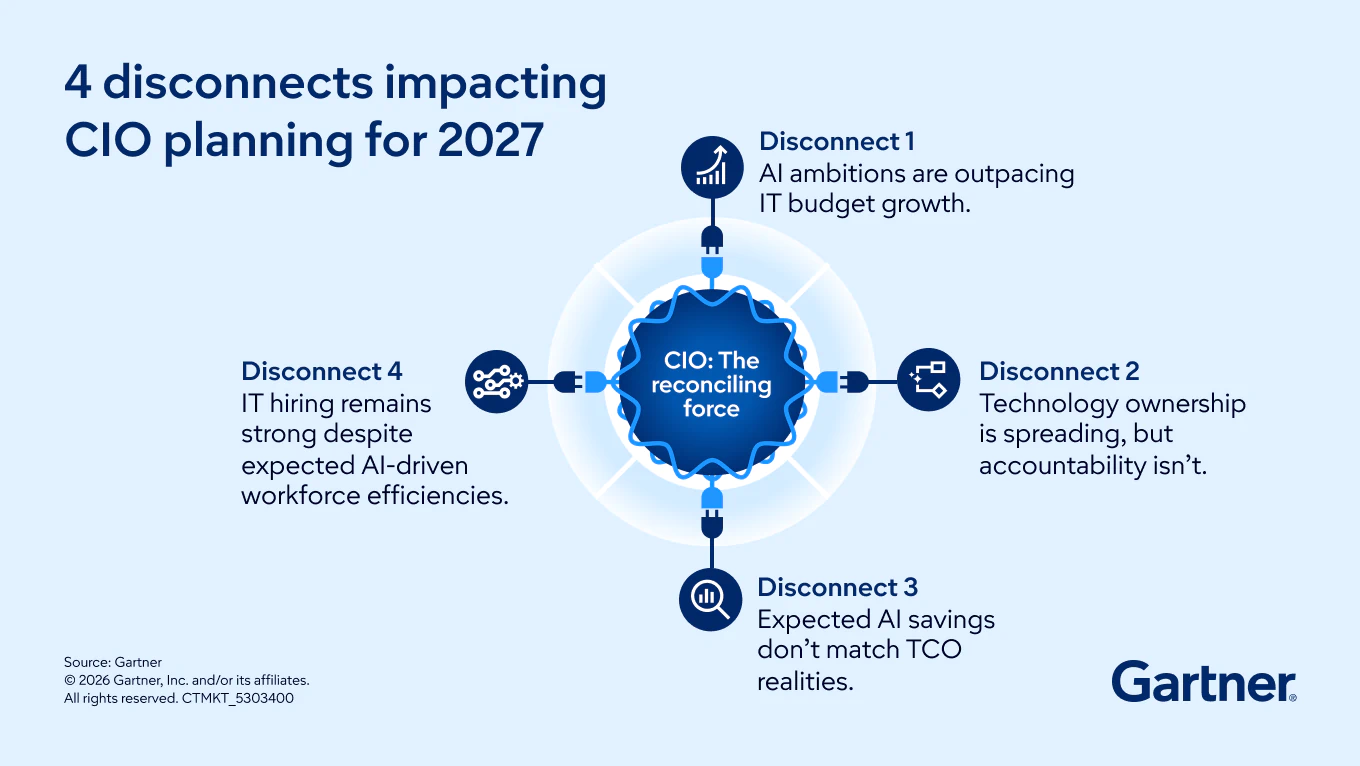
Across industries we are seeing the same shift in 2026: the most credible enterprise AI programs are the ones investing in scaffolding before spectacle. Data readiness, governance, integration and a repeatable path to production are becoming the real work, while the demos that grab attention are increasingly the easy part. Sentara's deal is a healthcare instance of that broader correction, and it is a useful counterexample to the pilot-first culture that has left so many organizations with a graveyard of proofs of concept and little in production.
For CIOs in any regulated sector, the takeaway is that sequencing is strategy. Choosing to build the foundation first is not a sign of timidity or slow ambition. It is the recognition that AI at enterprise scale is mostly an integration and governance problem wearing the costume of a modeling problem. Sentara has decided to solve the costume problem last. If the framework delivers the portability it promises, the system will be positioned to scale validated use cases quickly and safely. If it does not, at least the failure will be visible early, which is more than many faster movers can say.