A Central Bank on a Leak Site
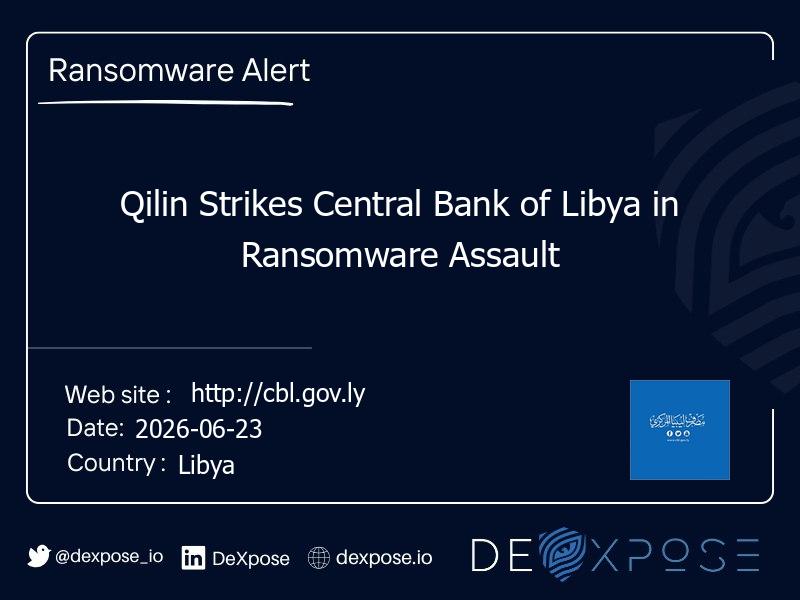
There is a line that ransomware crews used to mostly avoid, and the Qilin group has just stepped over it in public. Around June 22, 2026, Qilin listed the Central Bank of Libya on its data leak site, claiming it had breached the institution and threatening to publish confidential banking data unless the bank opened negotiations. The extortion note is characteristically terse: the data will be leaked if no negotiations occur, and the bank should make contact immediately to prevent further exposure. A national monetary authority is now a named entry on a criminal extortion board.
Central banks are not ordinary victims. They sit at the center of a country's payment rails, hold the state's reserves, and underwrite confidence in the currency itself. An attack on one is not merely a corporate incident, it is a stress test of national financial stability. That is precisely why these institutions have historically been treated as off limits even by criminals wary of the heat that comes with hitting them. Qilin's willingness to claim this target signals either growing confidence or growing indifference to consequences, and neither is reassuring.
What the Bank Has Said
The bank's own timeline predates the public claim. The Central Bank of Libya disclosed a cyberattack on June 9, 2026, stating that a limited number of its systems and technical services had been targeted. According to the bank, its cybersecurity teams detected the incident immediately and responded in line with approved emergency response and business continuity plans. The affected systems were isolated, and the bank said the necessary technical measures were taken to mitigate any potential impact on operations.
Reporting around the incident, drawn largely from unnamed sources rather than formal statements, indicated that the bank's core platforms remained secure after being fully isolated and separated to protect critical operations. That is the response you want to see on paper: detect, contain, segment, continue. Yet there is a meaningful gap between an internally managed incident on June 9 and a public extortion listing weeks later. Containment limits the damage. It does not erase the possibility that data was exfiltrated before the isolation took hold, which is exactly what a leak-site claim asserts.
Double Extortion Is the Whole Business Model
Qilin runs the now-standard double extortion playbook, and understanding it explains why containment is not the end of the story. The model has two levers. First, the attackers encrypt systems and demand payment for a decryptor to restore them. Second, before encrypting, they steal data and demand a separate payment to prevent its publication. A victim with flawless backups can defeat the first lever by restoring from clean copies and ignoring the decryptor. The second lever is immune to backups, because you cannot restore your way out of stolen data already in someone else's hands.
That is why the bank's emphasis on isolation, while genuinely important, addresses only half the threat. If Qilin holds confidential banking data, the extortion clock is running regardless of how cleanly the network was segmented afterward. For a central bank, the leverage is acute. The data could include counterparty details, internal communications, regulatory material, or information touching the stability of the financial system. The reputational and geopolitical weight of a leak gives the attackers exactly the pressure they are counting on, which is the point of choosing such a target.
Why the Target Selection Matters
Qilin has been one of the more active ransomware operations of 2026, and its recent run shows an appetite for high-consequence targets. Hitting a central bank fits a broader trajectory in which financially motivated crews increasingly aim at institutions whose disruption carries systemic weight, betting that the pressure to pay rises with the stakes. For a fragile state, the calculus is even starker, because the institution may lack the deep security budgets and mature response capabilities of a major commercial bank while carrying enormous symbolic and operational importance.
The lesson for every financial institution, sovereign or commercial, is that the perimeter assumption is dead. Attackers will get a foothold, so the questions that matter are how far they can move once inside and how quickly you notice. The bank's reported response, immediate detection followed by isolation and separation of critical systems, is the model worth emulating, and it is the difference between a contained incident and a catastrophic one. Segmentation that prevents lateral movement is what kept core platforms reportedly secure, and that architecture has to be designed before the attack, not improvised during it.
What Boards Should Be Asking
Boards at financial institutions should read this incident as a prompt to pressure-test their own assumptions. Ask whether the network is segmented well enough that a foothold in one system cannot become control of the payment rails. Ask whether incident response and business continuity plans have been exercised under realistic conditions rather than merely written and filed. Ask how exfiltration would be detected, because the double extortion model means the data theft, not the encryption, is the part that survives even a clean recovery. These are not technical footnotes, they are governance questions.
There is also a hard policy question lurking underneath, one no central bank wants to face publicly: whether to engage at all. Paying funds the next campaign and offers no guarantee the data stays buried, while refusing risks publication of sensitive material. The only winning position is to never need to choose, which means investing so that backups are clean, segmentation holds, and exfiltration is caught early. The Central Bank of Libya's containment appears to have limited the operational blow. Whether it limited the data loss is the question Qilin is now using to apply pressure, and it is the question every institution should be able to answer before its name appears on a leak site.