A grocery agent launches far from Silicon Valley
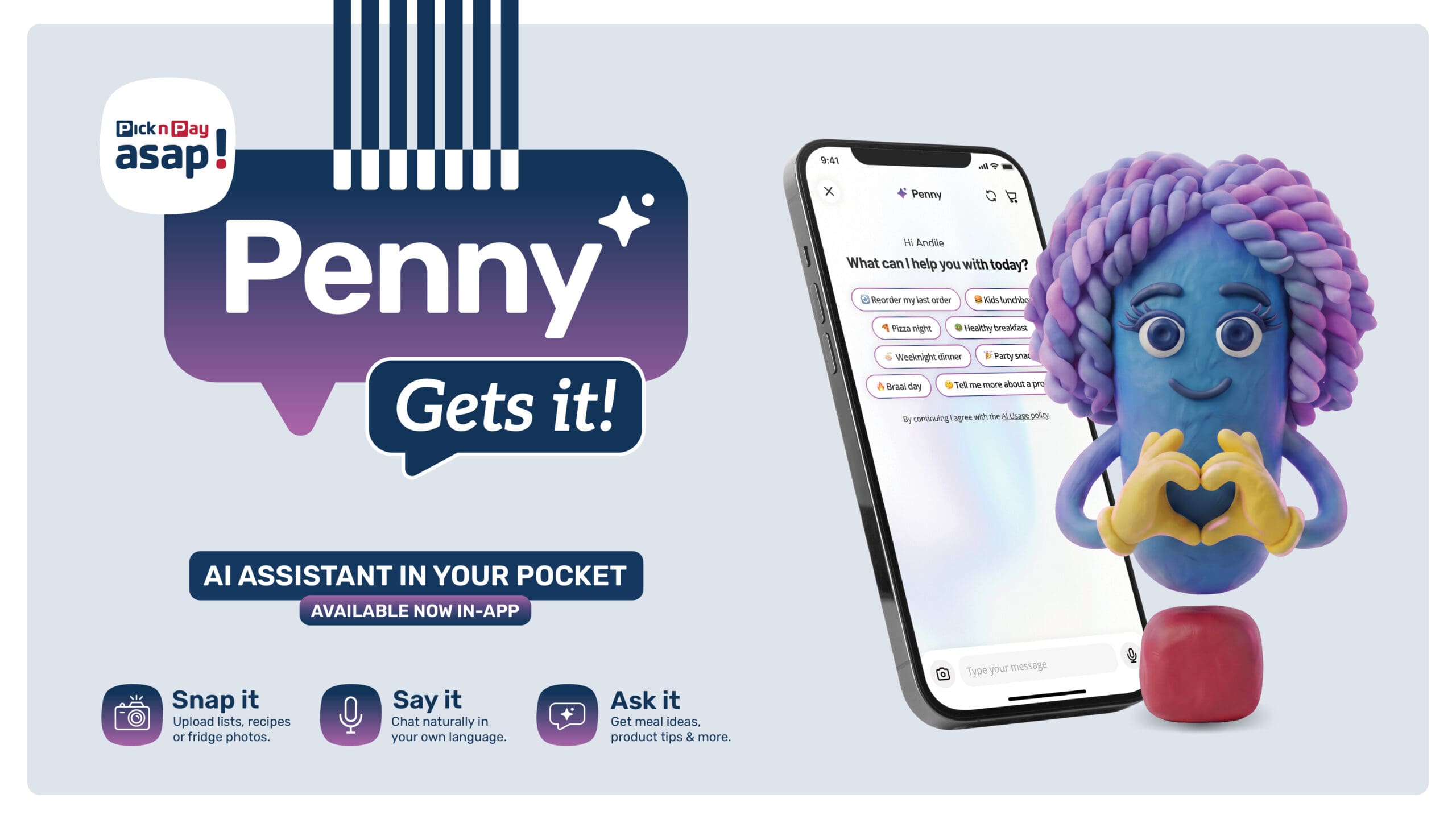
On July 6, 2026, Pick n Pay began the full public rollout of Penny, a conversational AI shopping assistant embedded in its asap! on-demand grocery app. First announced to press on July 2, Penny is built on Google's multimodal Gemini models and is billed as South Africa's first fully integrated AI grocery companion. Shoppers can build a basket by talking to the app in their own words, in multiple languages, rather than hunting through categories and typing exact product names. It is a small national launch by global revenue standards, yet it is one of the cleaner examples this year of a mainstream grocer shipping an agentic experience into the hands of everyday customers.
We flag it precisely because it did not come out of Seattle, Bentonville or Mountain View's home turf. Much of 2026's agentic-commerce coverage has fixated on Walmart, Amazon and the ChatGPT ecosystem. Penny is a useful corrective: the frontier model is now a rentable utility, and a mid-sized retailer in Johannesburg can wire it into a live app in a competitive market. For retail leaders, the lesson is that the moat is no longer the model. It is the catalog, the loyalty data and the operational plumbing you connect to it, and those are assets every incumbent already owns.
What Penny actually does
Penny is aggressively multimodal, which is the most interesting part of the design. A customer can dictate a shopping list as a voice note in any language, type a request, or upload a photo of a handwritten list, a recipe, or a product they want to reorder. They can even snap a picture of their fridge and ask Penny to suggest meals from what is missing. From there the assistant handles recipe-to-basket conversion, ingredient substitutions, meal planning and budget-conscious shopping, then serves personalized recommendations drawn from Smart Shopper loyalty history. The effort of translating a fuzzy human intention into a structured order is shifted from the shopper to the machine.
"We're moving from search-and-scroll shopping to conversation-led shopping that makes buying groceries faster, smarter and far more intuitive," said Enrico Ferigolli, Pick n Pay's retail executive for omnichannel. His framing matters because it names the real target: the search box. Keyword search has been the default commerce interface for two decades, and it quietly punishes shoppers who do not know a product's exact name or brand. In markets with many languages and varied literacy levels, that friction is not a rounding error. A voice-and-photo interface that meets customers where they are is a genuine accessibility upgrade, not just a novelty demo.
The Gemini bet, and the API guardrails
Penny runs on Google's Gemini models, and Google is happy to lean into the story. "The power of multimodal AI is that people don't have to adapt to technology, the technology adapts to them," said Kabelo Makwane of Google South Africa. That is marketing language, but it points at the correct product principle. The hard engineering here is less about the language model and more about grounding it: connecting a general-purpose model to a specific retailer's live inventory, pricing and promotions so it recommends things a customer can actually buy today, in stock, at the right price, in their delivery radius.
Notably, Penny reaches Pick n Pay's product catalog, Smart Shopper data, order history and content through dedicated APIs rather than direct access to core systems. We think that architectural choice deserves attention from every retail CIO evaluating an agent. Mediating the model through APIs is how you scope what it can see, log what it does, and avoid handing a probabilistic system a raw connection to systems of record. It is the difference between a governable feature and a liability. Retailers rushing to bolt an LLM onto a storefront should copy the boundary, not just the chatbot.
A turnaround story wearing an AI badge
Context is everything here. Pick n Pay is South Africa's second-largest retailer by revenue, and it has spent recent years fighting a painful turnaround after weak trading and steady market-share losses. Digital is its brightest line: the online business grew turnover 32.7% on a like-for-like basis in its 2026 financial year, with on-demand delivery up 37.6% year on year. Penny is not a science project bolted onto a healthy franchise. It is a bet placed on the one part of the business that is clearly working, aimed at compounding that momentum by making the app stickier and the basket larger.
"For years, the focus has been on faster delivery. The next disruption is removing the effort from shopping itself," Ferigolli said, adding that "consumers no longer just want speed, they want shopping apps to think for them." We would push leadership to hold that ambition to account with hard metrics: conversion on assisted sessions, basket size, reorder frequency and retention among Penny users versus the rest. Convenience features are easy to launch and hard to justify. The retailers that win with agents will be the ones that can prove the assistant moved revenue, not just impressed a demo audience.
The Sixty60 shadow and a two-model arms race
Penny does not arrive in open water. Rival Shoprite's Checkers Sixty60 has been the runaway leader in South African on-demand grocery, and Shoprite launched its own AI assistant, Pixie, in April 2026. The interesting wrinkle is that the two brands are pursuing different philosophies. Reporting frames Pixie as leaning toward predictive replenishment, anticipating what you need and prompting you to top up, while Penny leans into open-ended conversational discovery, letting shoppers express intent in whatever form is easiest. Both are legitimate readings of where AI adds value in grocery, and both are now live in the same market at the same time.
For retail strategists, this is a rare natural experiment worth watching. Prediction optimizes the known, recurring shop; conversation optimizes discovery, edge cases and the messy reality of how people actually plan meals. The likely answer is that mature assistants need both, a predictive spine for the weekly staples and a conversational layer for everything else. What South Africa offers the rest of the industry is a live, competitive proving ground for those approaches, in a price-sensitive, multilingual market that punishes friction and gimmicks faster than a comfortable Western one would.
What retail leaders should take from a first mover
Three takeaways travel well beyond Johannesburg. First, multimodal input is the real unlock, not the chat bubble: voice and photo capture collapse the gap between intent and order, and they widen the addressable audience to shoppers that search boxes have always underserved. Second, your loyalty and order-history data is the fuel that makes a rented model feel proprietary; Penny is only as personal as Smart Shopper lets it be. Third, emerging-market incumbents can now leapfrog straight to agentic experiences, which means the competitive pressure to ship is no longer confined to the usual American giants. The starting line has moved.
The caution is equally clear. Building on Gemini deepens Pick n Pay's dependence on a single AI platform for a customer-facing experience it cannot easily walk back, and pricing, model behavior and availability are now partly outside its control. That is a strategic trade every board should name out loud rather than discover later. Our read: Penny is a well-scoped, genuinely useful launch that gets the architecture right and the ambition roughly right. Whether it becomes a durable advantage or a costly convenience feature will be decided by measurement discipline over the next few quarters, not by the launch-day headlines.