Two lawsuits, one shared root cause
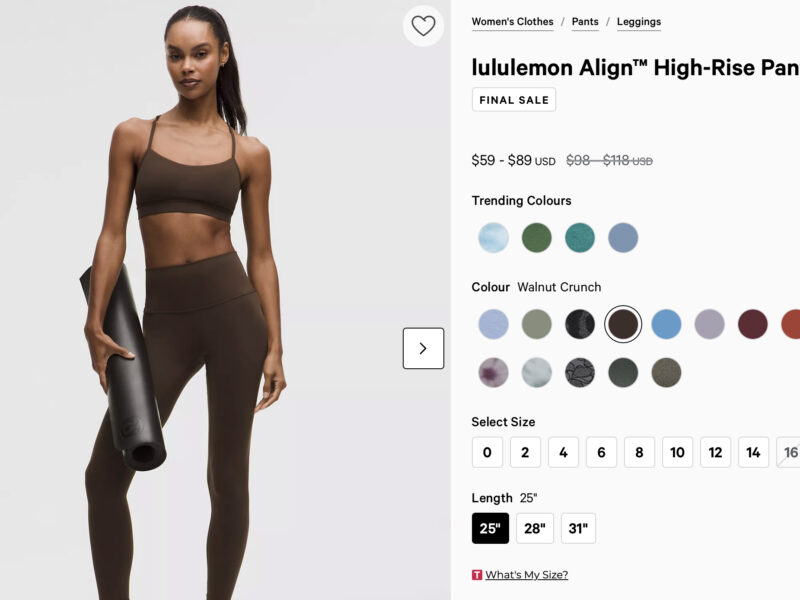
Lululemon was sued in Los Angeles Superior Court by plaintiff Annette Cody, who alleges the company displayed fictitious regular prices and corresponding phantom discounts. The complaint cites Wunder Train tights listed with a strikethrough price of 98 dollars discounted to 59 dollars, even though the 98 dollar price had not actually been charged since October 2025. Nike faces a parallel class action alleging it advertised a 190 dollar reference price on Air Max 2017 sneakers from September 8, 2025 through March 14, 2026, while the shoes were continuously marked down throughout that entire window. The Nike suit seeks compensation for all California consumers who purchased Nike products at a discount from an advertised higher reference price on the company's direct-to-consumer website or app since July 21, 2022.
Both cases center on the same underlying claim: a former price displayed as a legitimate baseline was, in fact, not a price the retailer had actually charged recently. California's False Advertising Law requires that an advertised former price reflect a true market price within the past 90 days, which gives both cases a specific, checkable technical standard rather than a vague deception claim. That specificity is what makes this a technology and pricing governance story, not just a legal one.
This is what happens when reference-price logic goes stale
Neither complaint alleges an intentional scheme to deceive shoppers; both describe a pattern where a product simply stayed marked down for so long that the system's stored reference price stopped reflecting reality. That is a specific and common failure mode in e-commerce pricing systems: a reference price gets set once, sale pricing runs continuously or near-continuously afterward, and no automated check exists to confirm the reference price still qualifies as a legitimate recent price under applicable law. The technology did exactly what it was configured to do. Nobody built the guardrail that should have caught a reference price aging past the legal lookback window.
This pattern scales badly precisely because it is invisible until someone brings a lawsuit. A retailer with thousands of SKUs and an automated markdown engine has no practical way to manually verify that every displayed reference price reflects a real recent sale price, which means the exposure grows quietly across the catalog until litigation surfaces it. Georgetown marketing professor Anita Rao's observation that consumers are paying closer attention to prices as everything feels more expensive is the demand-side explanation for why plaintiffs are looking harder right now, but the supply-side problem, stale reference-price logic, has likely existed in these systems for years.
The lawsuit volume trend says this is not going away
Advertising and e-commerce attorney Rob Freund noted that phantom discount lawsuits roughly doubled from 2024 to 2025, and both the Nike and Lululemon suits were filed within the past several weeks of each other. That trajectory suggests plaintiffs' firms have identified pricing display as a reliably litigable pattern across the retail sector, not an isolated issue at any single company. Once a legal strategy proves repeatable against one well-known brand, it typically gets applied to the next several retailers with similar automated pricing infrastructure, and Nike and Lululemon are unlikely to be the last two names on this list. The individual dollar amounts at stake in either suit are almost beside the point next to that growth curve.
For retail technology leaders, the doubling rate is the number worth acting on. A litigation category growing that fast, built around a technical standard that is straightforward to test for, rewards getting ahead of it before a complaint arrives rather than responding to one after the fact. Building the audit now costs a fraction of what defending a class action costs later, and the underlying fix, a validation check on reference-price age, is small enough that most engineering teams could ship it in a sprint once ownership is assigned.
The fix is an audit, not a rebuild
The corrective engineering work here is narrower than it might first appear. Retailers do not need to abandon reference pricing or markdown-driven merchandising strategies; they need an automated check that flags any SKU where the displayed former price has not been an actual active price within the required lookback window, typically 90 days under California's standard, with state-specific variations elsewhere. That is a rules-based validation layer that can sit on top of existing pricing infrastructure rather than a rebuild of the pricing engine itself, and it is the kind of guardrail that should have existed before either of these suits was filed.
The organizational fix matters as much as the technical one. Pricing display compliance tends to fall into a gap between merchandising, which owns markdown strategy, legal, which owns regulatory interpretation, and engineering, which owns the systems that render the price on the page. None of those three teams individually owns the failure mode both lawsuits describe. Retail technology leaders should assign explicit ownership of reference-price compliance now, because the two-year lookback period cited in the Nike suit shows how long stale pricing logic can run unchecked before it surfaces as litigation.
Why this matters beyond apparel
Nike and Lululemon both run direct-to-consumer sites with heavy promotional cadences, but the underlying pricing architecture, automated markdowns with a stored reference price, is standard across most of e-commerce, from home goods to electronics to beauty. Any retailer running similar logic carries similar exposure, and the category most at risk is exactly the kind of retailer that runs frequent, near-continuous promotions, since that is precisely the pattern that makes a reference price go stale fastest.
The broader lesson for retail CTOs is that pricing algorithms need the same compliance instrumentation increasingly expected of AI-driven personalization and recommendation systems, since both are automated decision systems touching customers directly. A pricing engine that has run untouched and unaudited for years because it has not caused a visible problem has simply never been checked, which is a different thing entirely from being compliant. Given the litigation trend, treating an unaudited pricing engine as low risk is no longer a defensible position for any retailer with significant DTC volume.