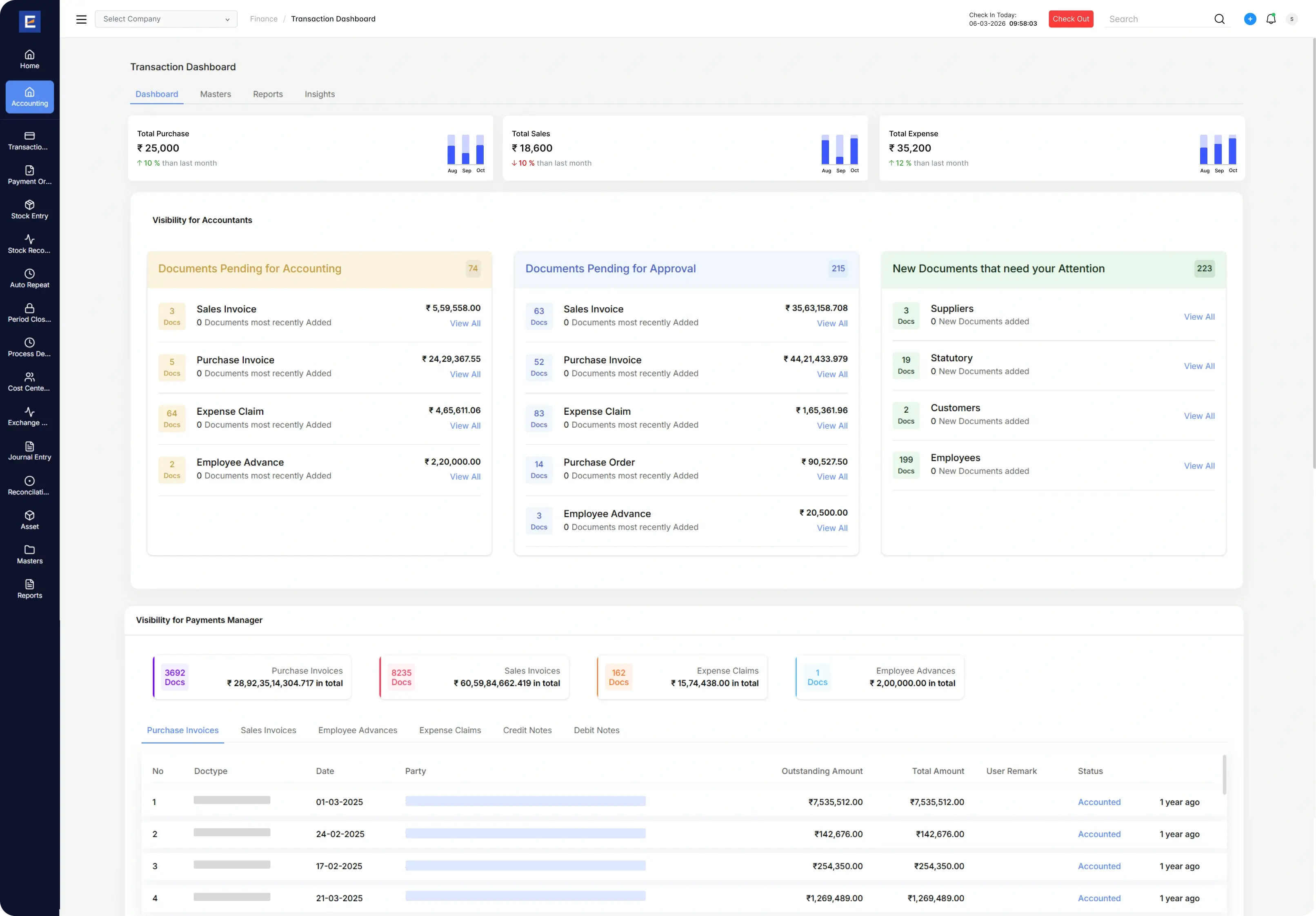
What NetAcct shipped
On July 17, Bengaluru-based NetAcct Solutions launched Entries ERP, an AI-native enterprise resource planning platform built by a team that includes former Freshworks leaders. The product runs on what the company calls the Entries AI Platform and markets itself as India's leading AI-native ERP. In a single system it bundles accounting and financial reporting, inventory, manufacturing and production planning, procurement, sales and CRM, HRMS and payroll, compliance, projects, document management, and business intelligence. NetAcct says more than 500 organizations already use the platform, spanning startups, manufacturers, professional services firms, and chartered accountant practices.
The launch is modest against the scale of SAP or Oracle, yet the pedigree makes it worth a senior technology leader's attention. Freshworks built a global SaaS business out of Chennai by undercutting incumbents on price and simplicity, and alumni carrying that playbook into ERP signal where AI-native challengers intend to compete. Entries targets the mid-market band that global suites serve expensively and legacy local tools serve poorly, which is exactly the segment where an AI-first design has the most room to change the cost and effort of running back-office operations.
The AI-native pitch against fragmented tools
The core pitch is consolidation. Entries positions itself as a replacement for the patchwork of point tools that mid-market finance teams stitch together, one system for the ledger, payroll, inventory, and compliance in place of a spreadsheet-and-integrations sprawl. That message resonates with a familiar CIO pain point, since fragmented tooling is where reconciliation errors, data gaps, and month-end delays accumulate. For a growing company, replacing five disconnected applications with one platform is a governance improvement before it is an efficiency one.
AI-native is the differentiator NetAcct leans on hardest. The company describes the intelligence as designed into the platform from the ledger up, rather than bolted onto an existing suite as a copilot. That claim is hard to verify from a launch announcement, and buyers should treat it as a thesis to test in evaluation. The relevant question is whether the automation touches the transactional core, where the accounting actually happens, or whether it decorates the reporting layer that sits on top of a conventional system.
Infinity and the agent inside the ledger
The agent inside Entries is named Infinity, and NetAcct describes it operating directly on the transactional workload. Its stated tasks include extracting data from purchase invoices through OCR, generating journal entries automatically, reconciling bank statements, detecting revenue leakage, monitoring compliance, and answering questions through conversational reporting. That list places the agent in the parts of the finance function that consume the most manual hours: data entry, matching, and reconciliation. If Infinity performs those reliably, the labor case for a small finance team is straightforward.
The design mirrors the pattern larger vendors are pursuing, with agents handling detection and routine bookkeeping while people handle judgment and exceptions. For a mid-market buyer, the appeal is that this arrives as a single subscription instead of a platform license plus a separate agent framework plus an integration project. The risk is the one every agent in the ledger carries, namely accuracy and auditability. An agent that posts entries has to be traceable and correctable, and that is the capability any evaluation should stress-test before trusting it with the books.
Compliance is the wedge in India
Entries leans on Indian compliance as its wedge, with built-in handling for GST, e-invoicing, and TDS. Compliance is a shrewd place for a local challenger to plant a flag, because it is both mandatory and painful, and global suites often treat country-specific tax rules as an afterthought bolted on through partners. A platform that automates GST filing and e-invoice generation natively removes a recurring source of penalty risk and manual effort for exactly the companies NetAcct is targeting.
This is also where local challengers hold an advantage that scale cannot easily erase. Indian tax and filing rules change frequently, and keeping current is a maintenance burden that a focused domestic vendor can carry more nimbly than a global roadmap can. For a CIO or finance leader in India, native compliance that stays current is a concrete reason to consider a challenger, provided the rest of the platform meets the bar. Compliance automation is the feature most likely to survive contact with a real month-end close.
What it signals for the ERP build versus buy debate
For technology leaders, Entries is a data point in the ERP build versus buy debate now running through the mid-market. AI-native entrants are betting that a growing company will choose an integrated, automated platform over the two established alternatives: assembling best-of-breed point tools, or deploying a scaled-down edition of a global suite. Each of those alternatives carries real cost, whether in integration effort or in license and implementation overhead. A single AI-first platform is pitched as the way to avoid both.
The caution is that ERP is the hardest software to switch once it holds the ledger, so a challenger has to earn trust that a demo cannot fully establish. The 500-plus organizations give NetAcct early proof, yet the enterprise-grade questions still apply: data portability, audit trails, uptime, and the vendor's durability. For most large enterprises this launch is a signal rather than a purchase decision, evidence that the AI-native ERP category is filling in below the incumbents and will pressure their mid-market pricing over time.
Where the story is still thin
The announcement leaves important gaps. NetAcct disclosed no funding figure, named no founders or executives in its launch materials, and offered no third-party validation of the 500-organization count or the automation claims. For a category as trust-dependent as ERP, that thinness matters. Buyers evaluating Entries will want audited references, security and compliance certifications, and clarity on who stands behind the platform and how it is capitalized, none of which the launch provides.
None of that negates the trend the launch represents. AI-native ERP challengers are emerging in exactly the mid-market segment where incumbents are most exposed on price and complexity. For CIOs, the practical takeaway is to watch the category rather than the single product. When agent-driven automation reaches the transactional core of accounting at a mid-market price point, it changes the negotiating position of every finance team weighing a suite upgrade, and it gives challengers a credible opening the incumbents will have to answer.