The Problem Ossie Names Out Loud
Every data organization has lived the failure Ossie is designed to fix. Marketing defines monthly active users one way, finance defines it another, the BI tool caches a third version, and the new AI agent invents a fourth. The Open Semantic Interchange calls this semantic drift, and it is the quiet reason so many dashboards disagree and so many executives stop trusting the numbers. The initiative launched in September 2025 with a blunt goal: a definition should mean the same thing to every tool that touches it.
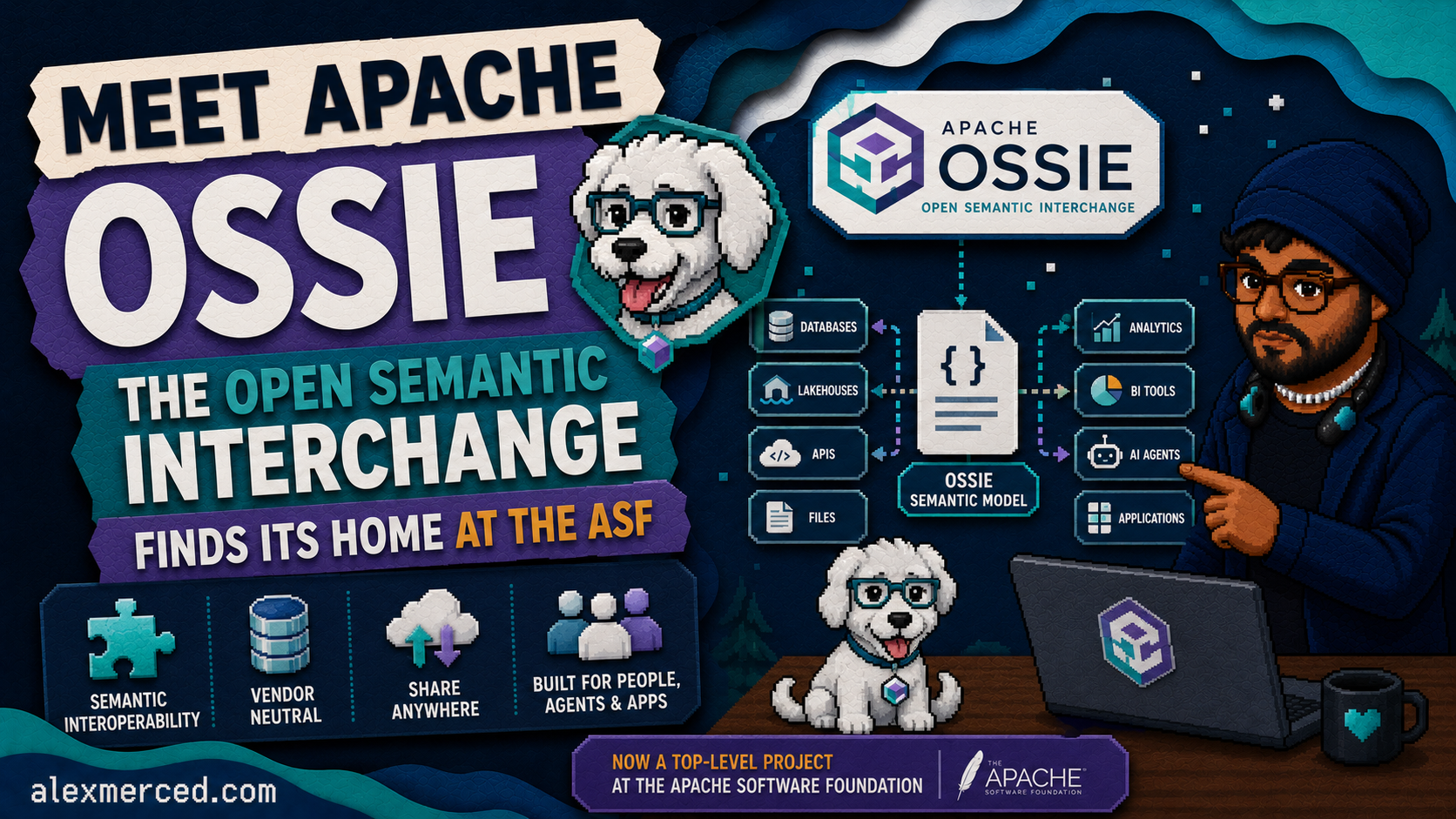
In June 2026 that effort found a permanent home, entering the Apache Incubator under the name Ossie. The repository opened in November 2025, a v0.1 specification landed in January 2026 under the Apache 2.0 license, and incubation followed. The governing principle is compact and worth remembering: define once, understood everywhere. That phrase captures why this matters more in the agent era than it did in the dashboard era. Agents act on definitions, and a wrong definition becomes a wrong action rather than a misleading chart.
What Ossie Actually Standardizes
Ossie is a specification, not a product, and the distinction is the whole point. It defines a vendor-neutral format for expressing semantic models, meaning the metrics, dimensions, entities, and relationships that describe what an organization's data means. A metric like net revenue or active customer gets a canonical, machine-readable definition that any conforming tool can read and honor. The spec does not run queries or store data. It describes meaning in a way that survives the trip between systems.
This is deliberately narrow, and narrowness is what makes standards succeed. By refusing to be an engine or a storage layer, Ossie sidesteps the competitive dynamics that usually kill cross-vendor efforts. Snowflake, Databricks, dbt Labs, and the rest are not being asked to give up their query engines or their pricing. They are being asked to agree on how a business definition is written down. That is a small enough surface to align on and a valuable enough problem to justify the effort.
The Coalition Is the Story
The backer list is where this gets genuinely interesting. Open Semantic Interchange began with Snowflake, Salesforce, and dbt Labs, with Salesforce in initial governance. Core development now includes Snowflake, Dremio, and dbt Labs. More than fifty organizations have joined overall, and the roster includes direct competitors such as Databricks, ThoughtSpot, Collibra, and AtScale. Getting Snowflake and Databricks to back the same specification is not a common sight, and it tells you the pain is widely felt.
We read the breadth of the coalition as the strongest signal that this effort has legs. Standards fail when one vendor tries to steer them for advantage, and they succeed when enough rivals conclude that a shared substrate grows the whole market. Landing at the Apache Software Foundation reinforces that neutrality, because ASF governance makes it structurally harder for any single contributor to capture the project. For buyers, that governance is the reassurance that a portable metric definition will stay portable.
How Ossie and Polaris Fit Together
Ossie does not stand alone. It pairs naturally with Apache Polaris, the open Iceberg catalog that graduated to a top-level Apache project in February 2026. The division of labor is clean. Ossie defines the format of semantic models, and Polaris provides the governed catalog where those definitions live and are served alongside the tables they describe. Converters and an agreed API specification form the handshake between them. In early July, Polaris even canceled a vote on its own semantic model API specifically to align with Ossie rather than fork the effort.
That alignment is a maturity signal for the open lakehouse. Instead of two overlapping standards competing for the same ground, the catalog project deferred to the semantics project so the ecosystem converges on one answer. For architects, the emerging shape is legible: Iceberg for table format, Polaris for the governed catalog, and Ossie for the meaning layered on top. Each piece is neutral, open, and increasingly interoperable, which is exactly the stack that reduces long-term lock-in.
Why This Matters for AI Readiness
The timing is not accidental. Every major data platform is now pitching agents that answer business questions over governed data, and every one of them depends on a semantic layer to ground those answers. Snowflake's Cortex Sense and Databricks Genie both assemble business context so an agent can translate a vague question into the right query. Without a shared definition of what the metrics mean, each vendor's agent grounds itself in its own private semantics, and cross-tool answers drift apart again.
A neutral semantic standard is the antidote. If monthly active users is defined once in Ossie and honored by every engine and every agent, then the answer an executive gets does not depend on which tool happened to run the query. That consistency is a prerequisite for trusting agents with decisions rather than just summaries. We would argue the semantic layer is now the most underrated part of an AI-ready data stack, precisely because it determines whether agent outputs are reliable enough to act on.
What Data Leaders Should Do Now
Treat Ossie as a standard to track and pilot rather than a production commitment today, because it is early in incubation and the specification is still maturing. The useful move is to inventory where your critical metrics are defined right now, and to count how many conflicting definitions of your top twenty KPIs actually exist across BI tools, warehouses, and spreadsheets. Most teams are unpleasantly surprised by that number, and the exercise builds the case for a portable layer.
Then press your vendors on their Ossie roadmap. Ask Snowflake, Databricks, dbt, and your BI provider when they will export and import conforming semantic models, and make interoperability a scored line item in your next renewal. The strategic prize is straightforward. If your metric definitions become portable, you keep leverage over which engine and which agent you use, because meaning no longer lives trapped inside a single vendor's proprietary layer. That optionality is worth protecting early.