A Format Defined by Where It Is Not
Carrefour Belgium's BuyBye network has reached 12 autonomous, AI-driven locations, and the defining feature of this rollout has become the places the company keeps choosing to put them rather than the checkout technology inside each unit. A Carrefour Belgium spokesperson summarized the strategy plainly: making customers' lives easier also means being present where a traditional store format simply cannot operate economically. That is a materially different growth thesis than the cashierless convenience stores most major retailers have piloted and then quietly shelved in dense urban shopping districts over the past several years.
The current footprint includes a Zaventem service center, a Carrefour Express location in Yvoir, ibis hotels at Charles de Gaulle Airport and Brussels-South Station, the NATO base SHAPE in Mons, and MontLégia Hospital in Liège. Every one of those sites shares a common trait worth noting: round-the-clock or extended-hours demand from a largely captive population that a standard staffed store, with labor costs sized for ordinary retail foot traffic patterns, would struggle to serve profitably through a conventional staffing model and opening hours.
The Newest Additions
The two newest modules opened at Charleroi hospital, split deliberately by the audience each is meant to serve. One sits at the main reception desk, serving patients, staff, and visitors passing through the building's main entrance throughout the day. The other sits near the operating theatre itself, serving the 200 to 300 medical professionals who work in that specific part of the hospital and have limited practical ability to leave the ward for food during a long surgical shift. Splitting a single hospital site into two purpose-built modules shows a level of site-specific design that generic vending or micro-market formats typically skip entirely.
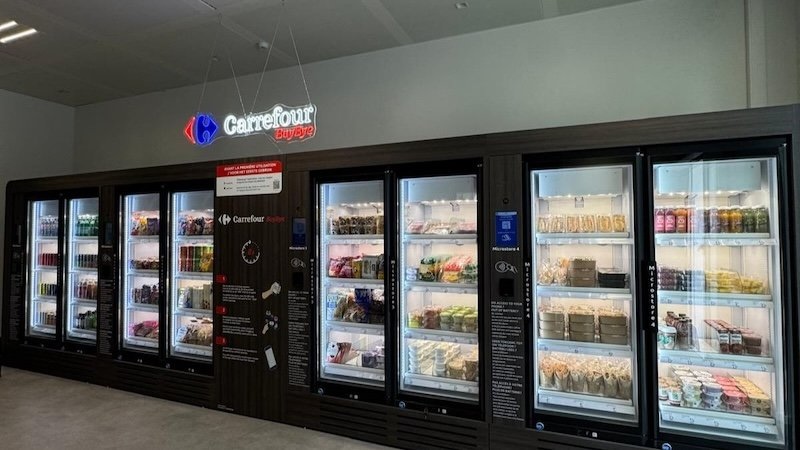
Separately, the Hasselt location at Corda Campus is now Carrefour's largest and most recently opened BuyBye site, built around eight refrigerated display cases plus a cash machine, open from 8 a.m. to 10 p.m. every single day of the week without exception. It was the seventh BuyBye location to open, and its considerably larger scale relative to earlier sites suggests Carrefour is iterating deliberately toward a bigger standard format as it learns what sustained office campus demand actually looks like in practice.
What the Hospital Deployments Reveal
Hospitals represent a genuinely demanding test for an unmanned retail format to pass. Staff work rotating shifts around the clock, visitor traffic is largely unpredictable, and the product category that matters most in this setting, fresh and balanced meals, is exactly the inventory type that is hardest to manage well without a human physically checking expiry dates and shelf condition. Carrefour's spokesperson described the hospital units as meant to offer fresh, balanced, and affordable meals at any hour of the day or night, which is a considerably harder operational promise to keep than simply restocking packaged snacks in a vending machine on a fixed schedule.
If Carrefour can keep fresh food quality consistent across these unattended hospital sites over time, it has effectively validated the format for every other 24-hour institutional environment it is now targeting more broadly. That is the real significance hidden inside the hospital expansion: it functions as a genuine stress test for inventory freshness management under fully autonomous operation, not simply another location count added quietly to a quarterly press release for investors.
Crossing Into France
Carrefour's plan to open three BuyBye units in Lyon, in direct partnership with Carrefour France, marks the first time the autonomous format moves beyond Belgium's borders into a new national market. Using the French national business as the launch partner, rather than attempting to expand independently from Belgium, suggests Carrefour intends to replicate its Belgian playbook of embedding units inside institutional sites rather than general retail locations, leveraging a local operator who already understands the target buildings, tenants, and regulatory environment on the ground.
Cross-border expansion of an unmanned retail format this early is a meaningful signal in its own right. Many retail technology pilots stay confined permanently to a single national subsidiary because local regulation, payment infrastructure, or labor rules complicate a direct copy-paste rollout elsewhere. Carrefour choosing to expand BuyBye into France at only 12 Belgian sites suggests the underlying technology and operating model are modular enough to transplant successfully with a local partner, rather than being tightly bound to Belgium-specific conditions that would resist replication.
Why This Is Not Another Amazon Go
Most public conversation about autonomous retail still centers on urban, high-footfall formats modeled loosely on Amazon Go, competing head-on with convenience stores purely on checkout speed and basket size. Carrefour's BuyBye sites are pursuing something distinctly different: they occupy institutional, captive-audience locations, airports, hospitals, military bases, and corporate campuses, where the realistic competing option is often no food access at all outside fixed cafeteria hours, rather than simply a slower checkout line down the street.
That distinction carries real commercial weight. A format competing directly against existing convenience stores has to win decisively on speed and price to justify the investment. A format filling a genuine access gap inside a hospital or a 24-hour corporate campus clears a much lower bar for success, and it faces far less direct competitive pressure once installed, which likely explains how Carrefour scaled to 12 sites without the broader public debate that dogged comparable urban autonomous-store rollouts elsewhere in Europe and North America.
What Enterprise Retailers Should Take From This
For retail executives evaluating autonomous store investment, Carrefour Belgium's trajectory offers a specific and actionable lesson: the strongest near-term return on unmanned retail technology likely comes from institutional sites with captive, round-the-clock demand, rather than from trying to out-compete convenience retail head-on in dense city centers. The unit economics of staffing a genuinely 24-hour location are the real driver of the underlying business case, not the novelty of walking out of a store without scanning a single item at a register.
The Lyon expansion also suggests a repeatable playbook worth copying elsewhere: identify institutional partners with a genuine access gap, tailor each module specifically to the audience inside that building, and let a national sister company replicate the proven model abroad. Retailers operating in markets with comparable hospital, transit, and corporate campus density should treat Carrefour's 12-site Belgian network as a working case study worth studying closely, not as a one-off pilot, when weighing where their own unmanned retail investment would actually generate a return.