What Dream actually found
Israeli security firm Dream disclosed a campaign that used AI tooling to do reconnaissance at a scale no human team could match manually. The attackers used the FOFA search engine to identify roughly 19,000 internet-exposed Palo Alto Networks firewall management interfaces. From that pool, they fingerprinted the operating system version on about 5,000 of them, then narrowed that down to 240 precise targets running vulnerable PAN-OS builds. Dream found evidence that 25 of those servers, spread across the United States, Japan, South Korea, and Taiwan, were fully rooted.
The targeting funnel matters as much as the final compromise count. Going from 19,000 candidates to 240 confirmed targets to 25 successful roots in a matter of days is a triage problem, and triage is exactly what AI tooling accelerates. Dream said the attackers appeared to use AI to help orchestrate the campaign, which fits a broader pattern security vendors have flagged through 2026: offense is getting faster at the reconnaissance and targeting stage well before it gets more capable at novel exploitation.
The vulnerability chain itself
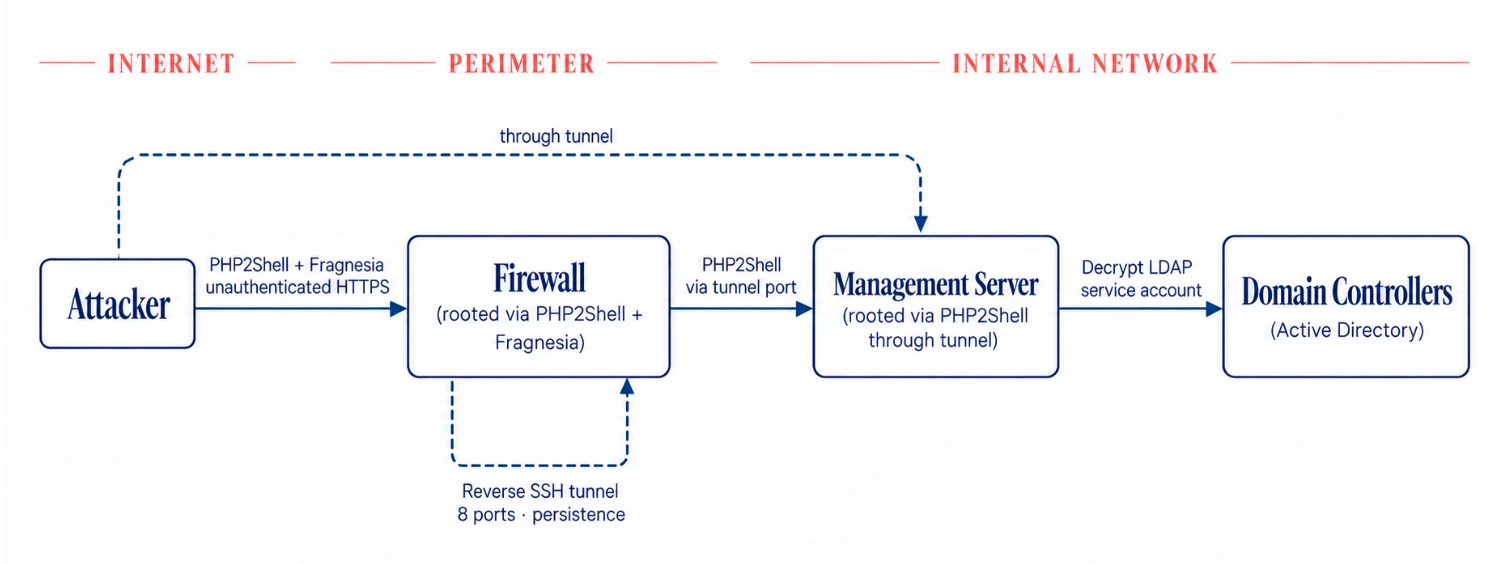
The entry point was a pair of PHP vulnerabilities, CVE-2026-109618 and CVE-2026-109619, both carrying a CVSS v4 score of 9.2. PHP shipped patches on October 21. Palo Alto Networks confirmed the vulnerable component runs inside PAN-OS on its next-generation firewalls, and every version released before that patch window is exposed if the management interface faces the internet. The first confirmed compromises happened just three days after the PHP patch landed, which is an aggressive but increasingly normal window for opportunistic exploitation of internet-facing infrastructure.
Researchers found no single exploit worked across every vulnerable PHP build, which forced the attackers to tune their payloads per target version rather than spray one exploit everywhere. That detail is actually reassuring in isolation, since it suggests the ceiling on fully automated mass exploitation hasn't been reached yet. But it also means the attackers were willing to do version-specific engineering across hundreds of targets, which is exactly the kind of repetitive, parallelizable work that AI-assisted tooling handles well.
Why this collided with two other zero-days
This campaign didn't arrive in isolation. CISA separately added a VMware ESX logging and audit-trail flaw, CVE-2026-41709, to its Known Exploited Vulnerabilities catalog on October 28, with a federal patch deadline of November 11. CrowdStrike attributes exploitation of that flaw to Warp Panda, a China-nexus group it says has been using the bug since early 2026 to blind logging before pivoting into vCenter and deploying custom malware it calls BRICKSTORM and SharpStorm against the US legal sector, including theft of Microsoft 365 session tokens.
At the same time, CISA's deadline for Fragnesia, a Linux kernel privilege escalation flaw tracked as CVE-2026-46300, lands on October 31, the same day we're publishing this. Fragnesia is exactly the kind of local-escalation bug that turns a webshell into full root, and CISA explicitly warns it can be chained with the PHP2Shell flaws to do precisely that. Three unrelated vulnerability disclosures converging on the same week, with overlapping federal deadlines, is not a coincidence security teams should read as calm. It's a sign the KEV catalog itself is becoming a leading indicator of which systems to triage first.
What Palo Alto and CISA are telling customers
Palo Alto Networks' guidance is blunt: restrict management interface access to a single jump box until patches are fully deployed, and the company says it is contacting a small number of directly affected customers. That's a tacit admission that internet-exposed management planes remain the single biggest unforced error in firewall deployments, years after vendors across the industry have repeated the same guidance. The fact that 19,000 Palo Alto management interfaces were discoverable via a public search engine in the first place is the real headline, independent of whatever CVE eventually gets exploited against them.
CISA's posture has shifted too. Chaining a web-facing PHP bug with a Linux kernel escalation and publishing both with overlapping deadlines signals the agency is trying to get ahead of exactly this kind of multi-stage attack path, rather than reacting to single CVEs in isolation. For enterprise security teams, that's a useful signal: KEV entries that land within days of each other and reference each other's chaining potential deserve coordinated incident response planning, not three separate ticket queues.
What this means for your security roadmap
If your perimeter still has management interfaces reachable from the open internet, in any product, this week is the forcing function to fix that, not the next audit cycle. The attack economics here are straightforward: AI-assisted reconnaissance made scanning 19,000 targets and triaging them to 240 cheap enough that a single actor could run the entire funnel in days. That cost curve is not going back up, and it applies to whatever perimeter product you run, not just Palo Alto's.
The second lesson is about patch velocity. Three days from PHP's patch to first confirmed compromise is now a realistic worst case for any widely deployed component, and your vulnerability management SLAs should be built around that number rather than the 30 or 90 day windows many teams still use for non-internet-facing systems. CISOs briefing their boards this quarter should treat the compressed exploit timeline, not any single CVE, as the finding that justifies budget for faster patch orchestration and stricter management-plane segmentation.