A growth number that should silence doubters, next to a cash number that should not
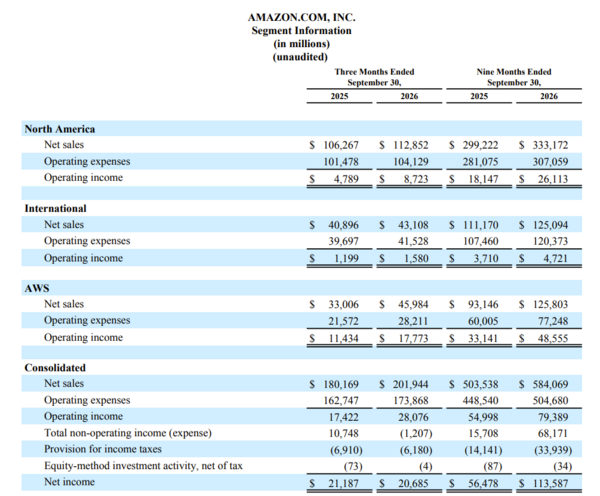
AWS posted 39% year-over-year revenue growth in the third quarter, reaching $46 billion with operating income of $17.8 billion, a pace that implies a $184 billion annual run rate for the cloud unit alone. That is a reacceleration that answers a question that had been hanging over Amazon for much of the past two years: whether AWS could keep growing at a rate comparable to Microsoft Azure and Google Cloud, both of which had been growing faster off smaller bases.
Set against that acceleration, Amazon's trailing twelve-month free cash flow swung to negative $42.4 billion, compared with positive $14.7 billion the year before. Amazon's overall earnings per share of $1.89 missed analyst expectations of $1.96, on revenue of $201.9 billion that came in just under the $202.26 billion consensus. A company can grow its best segment at 39% and still show its investors a cash flow statement that looks like a business in the middle of a capital crisis, because that is functionally what heavy AI infrastructure investment does to a balance sheet in the short term.
Why the earnings miss is not really about AWS
Amazon attributed part of its earnings shortfall to a difficult year-over-year comparison tied to its investment in Anthropic, which is a reminder that Amazon's financial results are now entangled with the fortunes of a company it does not control. North America e-commerce contributed $8.7 billion in operating income on $112.9 billion in revenue, and international added $1.6 billion on $43.1 billion, both reasonably healthy figures, which points the drag on overall earnings toward the AI investment accounting rather than toward the core retail business underperforming.
That distinction matters for how seriously to weigh the headline earnings miss. Amazon has taken on enough AI-related financial exposure, through Anthropic and through its own infrastructure buildout, that a single quarter's accounting treatment of that exposure can move the entire company's reported profitability on its own. Enterprise customers evaluating AWS's stability should separate the AWS growth story, which remains strong on its own terms, from the Amazon earnings story, which is now hostage to AI investment accounting in ways it simply was not two years ago.
What Jassy's 85% number actually means for capex going forward
CEO Andy Jassy's stated rationale for continued aggressive investment is specific and worth taking at face value: 'the vast majority of global IT spend, about 85% is still on-premises.' That is Amazon's explicit justification for projecting AWS growth above 40% in both 2027 and 2028, and it frames the current roughly $220 billion annual capex figure as a floor rather than a ceiling, one that scales upward with however much of that remaining 85% actually migrates over the coming years.
For enterprise technology leaders still running meaningful on-premises infrastructure, Jassy's framing is worth reading as a direct statement of where AWS's sales organization believes the real opportunity sits for the next several years. It is also worth treating with appropriate skepticism: a cloud provider has an obvious incentive to frame on-premises infrastructure as a migration opportunity rather than a legitimate long-term architecture choice, and 85% of global IT spend staying on-premises this long into the cloud era suggests plenty of workloads have good reasons to stay where they are.
Why Lambda's billion-dollar run rate is the detail worth noticing
Buried inside the AWS results is a smaller but telling figure: AWS Lambda, the serverless compute product, has reached a $1 billion annual revenue run rate on its own. That is a meaningful milestone for a single product line within a $184 billion annual business, and it signals that AWS's growth is not purely a story of GPU rental for AI training, a meaningful share of it is coming from the kind of event-driven, pay-per-execution compute that enterprises have been steadily shifting workloads toward for operational and cost reasons unrelated to the AI buildout entirely.
That diversification matters for how durable AWS's growth actually is relative to competitors whose cloud growth is more narrowly concentrated in AI training and inference workloads. A cloud business growing broadly across serverless, database, and AI infrastructure simultaneously has more insulation against a slowdown in any single category than one whose growth is almost entirely attributable to the current AI infrastructure cycle specifically.
The negative free cash flow number in context
A swing from positive $14.7 billion to negative $42.4 billion in trailing free cash flow is a roughly $57 billion swing, which is a scale of capital reallocation that would alarm most companies' boards regardless of the growth story attached to it. Amazon is betting that AWS's current growth rate justifies front-loading capital expenditure now rather than growing capacity incrementally as demand materializes, a bet that depends entirely on AI demand continuing to outpace what Amazon can build, rather than catching up to it.
This is not a liquidity crisis for a company of Amazon's scale; it has ample access to capital markets and a retail business generating substantial operating cash flow elsewhere. But it is a meaningful shift in how much financial risk Amazon is carrying on AWS's growth story specifically, and it puts Amazon in the same broad category of AI-infrastructure-driven cash burn that has made investors nervous about neocloud operators with far less balance sheet cushion than Amazon actually has.
What this means for enterprises negotiating with AWS right now
A cloud provider burning cash at this scale to fund capacity has a strong incentive to fill that capacity as quickly as possible, which historically translates into more aggressive commitment-based discounting and more willingness to negotiate favorable terms for customers willing to sign multi-year capacity commitments. Enterprise buyers currently negotiating AWS contracts have more leverage in this environment than the 39% growth headline alone would suggest, precisely because that growth is costing Amazon considerably more than it is currently generating back in free cash flow, and Amazon's sales organization knows it.
The fair caveat is that Jassy's 40%-plus growth projection for 2027 and 2028 assumes AWS can keep converting that capex into revenue at a comparable pace, and a lot can change in a market this volatile over a two-year horizon. Treat AWS's current financial posture as a negotiating opportunity worth acting on now, rather than as a permanent structural advantage buyers can assume will still be sitting on the table at renewal time two years from now, once this capex cycle has either paid off or forced a correction.