Moving the agent off the laptop and into a managed container
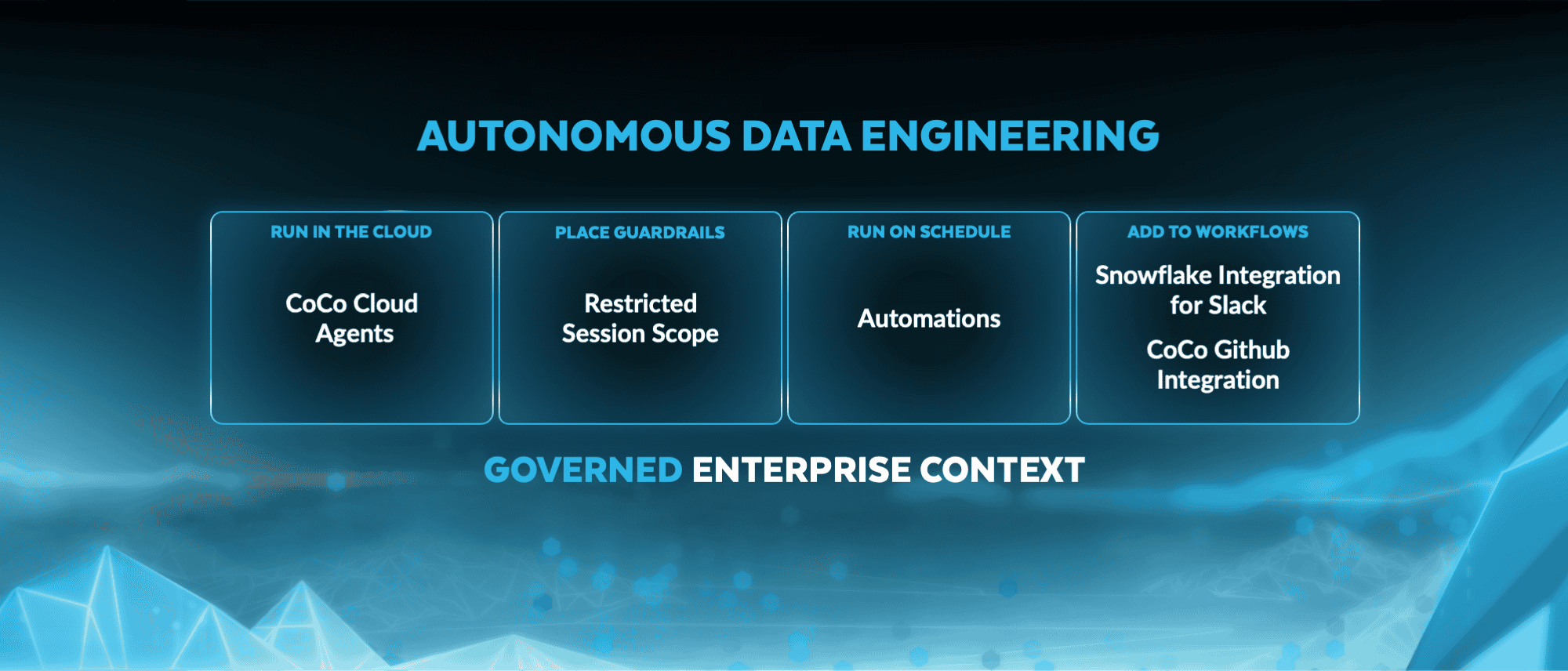
CoCo Cloud Agents represent a specific architectural shift: rather than running Snowflake's Cortex Code agent locally on an individual engineer's machine, work now happens inside a secure, Snowflake-managed cloud container, with each session getting its own isolated environment. That change matters operationally because work tied to a single engineer's laptop stops the moment that engineer logs off or closes their machine, while work running in a managed cloud container can continue unattended, overnight or over a weekend, and still be waiting, finished or flagged, when that engineer returns.
Engineers can restrict exactly what a given Cloud Agent session is permitted to do, which addresses a reasonable concern about handing an autonomous agent broad, unscoped access to a production data environment. The agent operates inside a shared Snowflake Workspace, which keeps its activity visible to the rest of the team rather than confined to one person's local environment where nobody else could observe or audit what the agent actually did while running.
Turning pipeline maintenance into a scheduled, delegable task
CoCo Automations let an engineer describe a recurring task in plain language, a daily pipeline health check, an investigation into why a specific job keeps failing, and have that task run on a defined schedule without anyone needing to manually trigger it each time. Teams can package these into reusable CoCo Skills and share them across projects, which means one engineer's well-constructed monitoring routine can become the whole team's standard practice rather than knowledge that stays locked inside one person's head or one person's personal scripts.
That shift, from an engineer manually checking pipeline health when they happen to remember or when something visibly breaks, to a scheduled agent checking continuously and proactively around the clock, is the specific labor pattern Snowflake is targeting with this release. Routine monitoring work that previously competed for an engineer's limited attention against clearly higher-value tasks now runs quietly in the background by default, which is a genuinely different operating model from most prior data-engineering tooling that still required a human to initiate every check manually.
Why the review step is the detail that actually matters here
When a scheduled CoCo run identifies a problem, the agent traces the likely root cause and proposes a specific fix, but that proposed fix still has to pass through the team's existing code review process, including through a direct GitHub integration, before it can reach production. That approval gate is the detail separating this release from a fully autonomous system that would make changes to production data pipelines without any human in the loop at all, and it is also the detail that should determine how comfortable a given engineering team actually is adopting this capability at scale.
A review gate only provides real protection if engineers treat each proposed fix with the same scrutiny they would apply to a human colleague's pull request, rather than rubber-stamping agent-generated changes because the agent has been reliable in the past. Snowflake's architecture creates the structural opportunity for careful review; whether that review actually happens with real rigor depends entirely on each adopting team's own internal discipline, which is not something any vendor's product design can fully guarantee on its own.
The advantage of running inside the data platform, not beside it
Because CoCo operates inside Snowflake directly rather than as an external tool connecting to Snowflake over an API, it has native access to an organization's existing data lineage, catalog metadata, and governance policies without needing a separate integration layer to expose that context to it. A third-party AI coding assistant working against Snowflake from outside would need to be explicitly taught, and continuously kept in sync with, an organization's lineage and governance rules; CoCo simply inherits them because it is already operating from within the platform that defines them.
That native integration is a genuine structural advantage specifically for Snowflake customers, and it is also a predictable competitive argument Databricks, with its own Unity Catalog and agent tooling, and other data platform vendors are making in parallel about their own ecosystems. The broader pattern across the data platform industry is converging on the same thesis: agent tooling works best, and is safest to trust with production changes, when it runs natively inside the platform it is operating on rather than bolted onto it from an external layer.
What Kleinerman's framing reveals about where the real bottleneck sits
Christian Kleinerman's framing, that every AI success story has a data team behind it, and that those teams still maintain data accuracy largely by hand today, points at a specific bottleneck Snowflake is targeting: a shortage of capacity to keep the underlying data itself clean, current, and reliable enough for AI applications built on top of it to actually trust. That is a meaningfully different problem than the one most agentic AI announcements in 2026 have focused on, which tend to center on agents doing customer-facing or employee-facing work well above the data layer that quietly feeds them.
If Kleinerman's framing is accurate, and a growing body of enterprise AI deployment data suggests it largely is, then data engineering maintenance work is a legitimate and underappreciated constraint on how fast organizations can actually deploy AI applications more broadly, regardless of how capable the applications themselves have become. An organization with brittle, manually-maintained data pipelines cannot safely scale agent-driven applications built on top of that data, no matter how sophisticated those applications are, because the data feeding them remains the weaker link.
What this means for data teams evaluating whether to adopt this now
Data engineering teams considering CoCo Cloud Agents and Automations should start with a narrow, well-understood set of recurring tasks, like a single pipeline health check with clearly defined success criteria, rather than immediately delegating broad categories of maintenance work to the agent. Building confidence in how the agent actually behaves on real, lower-stakes production tasks before expanding its scope is a more defensible rollout strategy than trusting the vendor's own framing of its reliability from the outset.
The customer quotes Snowflake included in its own announcement, from auxmoney, New American Funding, Minted, Nexon, Cboe Global Markets, and Klarent, describe faster pipeline delivery and reduced infrastructure work, which are plausible early benefits but are also, as with any vendor-supplied customer quote, selected specifically to support the announcement rather than independently verified. Data leaders evaluating this capability should ask those same customers, or similar peers already running it in production, direct questions about failure rates and the specific kinds of fixes the review process has actually rejected, not just the ones it approved.