The Scale Play Begins in the Classroom
Amazon's expansion of its AI education initiative to nearly 500,000 US students is not a corporate social responsibility announcement. It is a strategic move in a race that every major technology company now recognises as existential: whoever trains the next generation of technology workers on their infrastructure and tooling builds a pipeline of practitioners, advocates, and future procurement decision-makers. AWS's decision to more than double its original funding commitment to $800,000 — driven, according to the company, by strong inbound demand from school districts — reflects an education market that is ready for AI curriculum at scale for the first time.
"The strong response from school districts showed us how many educators are ready to bring AI into the classroom," said Bettina Stix, Amazon's global director of community impact. The program now covers 18 education partners across seven US regions, including large public school districts, charter networks, individual schools, and state-level education service centres. Fairfax County Public Schools, one of the largest school districts in the country, is scaling the program to all its high school students — a deployment that alone represents a meaningful fraction of the 500,000 headline figure.
What Amazon Is Actually Building in Schools
The curriculum architecture matters as much as the scale numbers. Amazon is not simply offering AWS training courses repackaged for K-12. The company partnered with PlayLab, a nonprofit focused on classroom-ready AI tools, to develop custom tools for students and educators that are designed to integrate with existing lesson structures rather than replace them. PlayLab's approach — described by its head of strategic partnerships Hilah Barbot as meeting districts where they are — prioritises teacher agency over AI automation, a pedagogical choice that reflects the concerns that have caused some districts to ban AI tools outright.
Alongside the PlayLab tools, Amazon is providing hands-on training for educators, AWS cloud computing curriculum that introduces students to the infrastructure concepts underlying AI applications, and participation in the Presidential AI Challenge, which offers $1.5 million in student prizes. The AWS promotional credits — up to $30 million available to participating organisations — give schools access to cloud computing resources that would otherwise be inaccessible on typical district technology budgets. For students in the program, this means genuine hands-on experience with production cloud infrastructure rather than simulated environments.
The 2028 Target and What It Implies
Amazon's stated long-term goal is to support AI skills training for 4 million US learners and enable AI curricula for 10,000 educators by 2028. The trajectory from 500,000 students today to 4 million by 2028 implies a roughly eight-fold expansion over two years — a scale that requires not just Amazon's direct investment but a significant multiplier effect through school district adoption, state-level education policy, and the educator training pipeline. Reaching 10,000 educators is the more tractable target; the teacher training multiplier is the mechanism through which the student reach scales.
The 2028 timeline is also significant for competitive reasons. Google has its own AI education programs through Google for Education and its partnership with ISTE. Microsoft has embedded Copilot into the Teams for Education suite that is deployed in millions of classrooms through existing Microsoft 365 EDU agreements. Apple has historically dominated device deployment in K-12 through Device Management and the App Store. Amazon's explicit scale targets are a challenge to each of these incumbents to match the commitment, and the public nature of the goal creates accountability that corporate program announcements typically avoid.
The EdTech Investment Surge
Amazon's move lands in an EdTech market that is seeing renewed institutional investor confidence after a difficult 2023-2024 period. Preply, the language learning marketplace connecting over 100,000 tutors with learners across 180 countries, hit a $1.2 billion valuation in Q1 2026 — one of the few EdTech companies to cross the unicorn threshold in the current environment. MagicSchool AI, which provides AI-powered productivity tools for educators, closed a $45 million Series B. EdSights, whose AI chatbot helps students navigate college life and improve retention, raised $80 million.
The common thread across these rounds is that capital is following companies with demonstrated scale, strong retention, and a credible AI story rooted in actual learning outcomes rather than AI branding. The EdTech sector's painful correction from the pandemic-era peak — when remote learning inflated valuations across the category — has left a more disciplined investment landscape in which product-market fit must be demonstrated, not projected. Amazon's entry as a curriculum partner validates the AI education category in a way that venture funding alone cannot: it signals that the world's largest cloud provider sees K-12 AI literacy as a prerequisite for its own long-term workforce pipeline.
The Policy and Equity Dimension
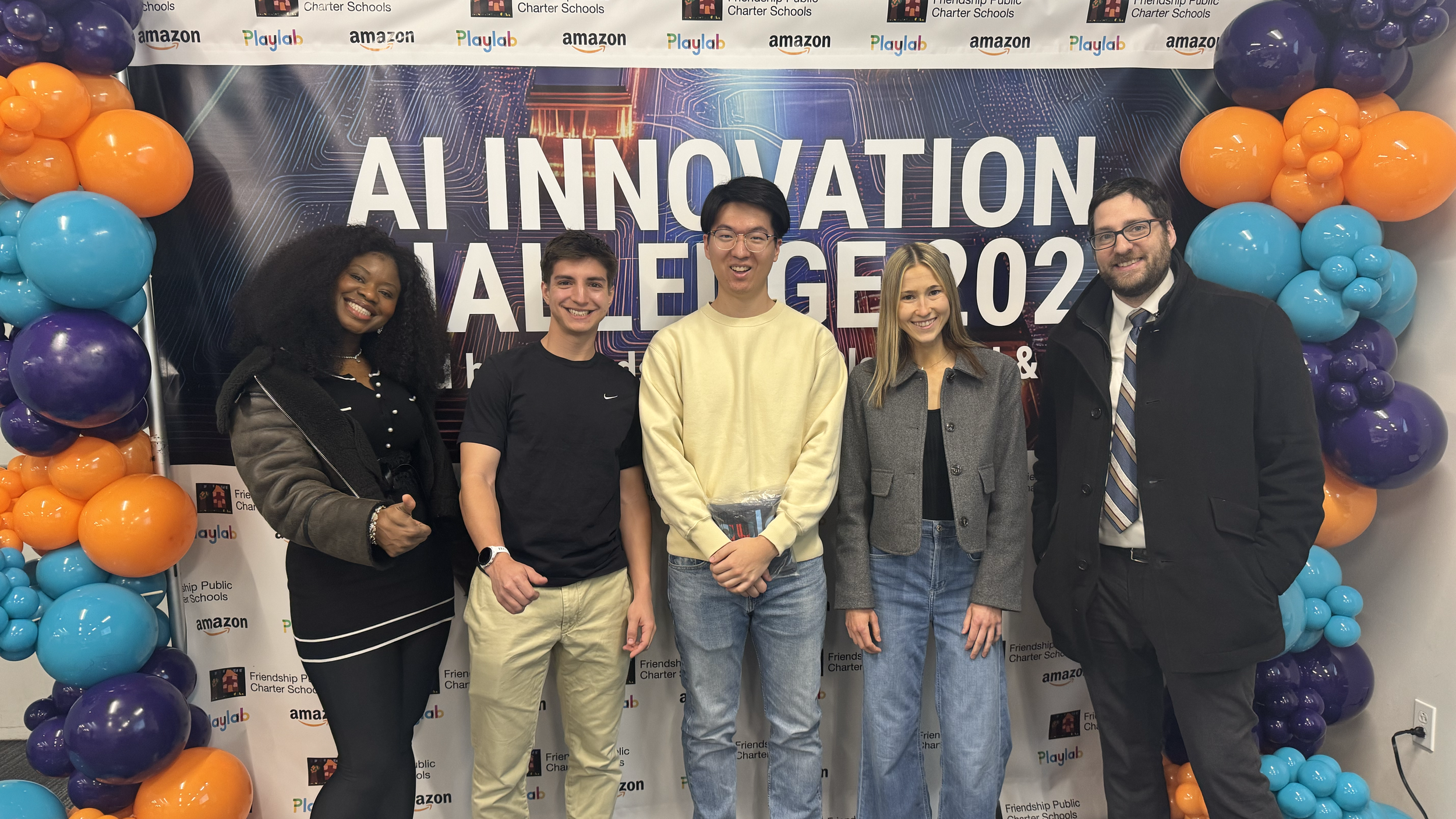
The expansion of Amazon's program to Fairfax County and Friendship Charter Schools in Washington DC — two very different types of institutions serving very different student populations — reflects a deliberate choice to avoid the pattern that has historically characterised technology-in-education initiatives: high adoption in well-resourced districts and negligible penetration in under-resourced ones. Whether this intention holds as the program scales will be the critical test. FERPA compliance, data governance for student information, and the specific populations reached by the AWS promotional credits all deserve scrutiny.
The Common Sense Media Youth AI Safety Institute, established this year to independently test AI products used by children against developmental safety standards, is beginning its evaluation of classroom AI tools. That oversight function is arriving at the right moment. As Amazon, Google, Microsoft, and emerging EdTech providers compete to embed AI in K-12 at scale, the question of what student data those systems collect, how it is used, and whether the pedagogical claims being made are supported by evidence is exactly what independent testing bodies exist to answer. The EdTech AI race is accelerating; the governance of it is still catching up.
What School Districts and Enterprise HR Leaders Should Watch
For school district technology and curriculum leaders, Amazon's expanded program is worth evaluating not just on its own terms but as a signal of what classroom AI infrastructure will look like in three years. The districts that build educator capacity and student fluency with AI tools now — even imperfect, early-stage tools — will have a meaningful advantage when the next generation of AI curriculum arrives. The question is not whether AI will be a core literacy; it is which districts will have the teachers capable of delivering it.
For enterprise HR and workforce development leaders, the 4 million learner target is a pipeline projection worth tracking. The students entering the workforce in 2028 and 2029 from districts that participated in Amazon's program will have hands-on experience with AWS infrastructure that their predecessors did not. That shifts the baseline expectation for entry-level cloud and AI roles, and it shifts the competitive landscape for the talent acquisition strategies that enterprise technology organisations are building today. Workforce planning that ignores the EdTech developments of 2026 will be planning for a workforce that no longer exists.