Amazon Is Selling the Engine, Not Just the Car
For the past two years, Amazon's Alexa for Shopping has been one of the most commercially validated AI shopping applications in existence. More than 300 million customers used it annually, and Amazon has attributed nearly $12 billion in incremental sales to the conversational shopping capabilities it enabled. The technology worked well enough that Amazon replaced its earlier Rufus generative AI assistant with Alexa for Shopping in May 2026. Now AWS is doing something strategically interesting: it is selling that engine to the retailers Amazon competes with.
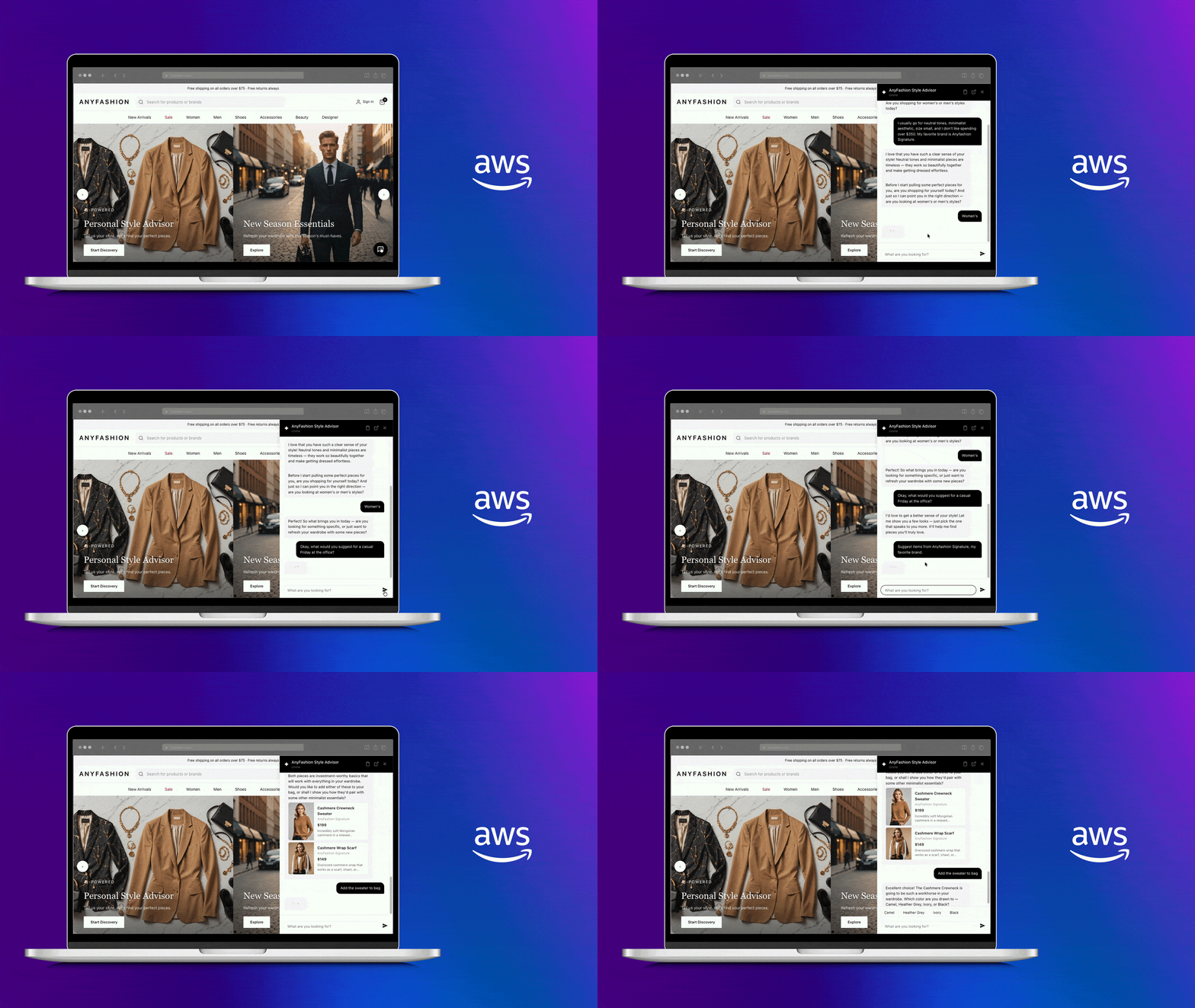
The AWS Agentic Shopping Assistant packages the architecture, starter code, and deployment guidance derived from Amazon's own Alexa for Shopping implementation into a solution that retailers can deploy against their own product catalogs, customer data, and brand voice. Kate Spade, the luxury accessories brand operated by Tapestry, has become the first production customer, launching a gift concierge experience powered by the solution. According to AWS, additional retailers are currently in testing phases, though the company has not named them.
What the Platform Actually Delivers
The Agentic Shopping Assistant is built on three AWS services: Amazon Bedrock, which provides the underlying large language model infrastructure; AgentCore, Amazon's agent orchestration layer that handles multi-step shopping tasks; and OpenSearch, which powers product discovery and semantic search across retail catalogs. Retailers bring their own product data, inventory signals, customer preference history, and brand guidelines to the stack. AWS provides the architecture and starter code; the AWS Generative AI Innovation Center team supports deployment.
The deployment timeline Amazon claims is approximately 60 days — significantly faster than the years it would take a retailer to build an equivalent system from scratch. That claim should be stress-tested against the specifics of each retailer's data infrastructure, but the direction is credible. The underlying AWS services are mature, and the architecture patterns for conversational shopping are well-established at this point. What has historically been expensive is the integration work: connecting the AI layer to real-time inventory, pricing, and personalisation systems. That is where the 60-day estimate will vary most in practice.
The 3.5x Conversion Claim and What It Means
Amazon's headline commercial metric for the platform is conversion rate: conversational shopping sessions convert at 3.5 times the rate of traditional keyword search. That is a significant enough differential that, if it holds across diverse retail categories and customer bases, it would justify substantial investment in building and operating agentic shopping experiences. The caveat is selection bias — customers who engage in conversational shopping sessions may be further along in their purchase journey, or more motivated, than the average keyword searcher.
For retailers evaluating the business case, the conversion metric is a starting point rather than a conclusion. The more important questions are about customer lifetime value, return rates, and the cost of running conversational AI infrastructure at scale. Agentic commerce adds a new cost structure to retail operations: inference costs per conversation, which vary with session length and complexity, and the operational burden of keeping the AI's product knowledge current as catalogs and pricing change. Amazon has absorbed those costs at scale; retailers deploying the solution will need to model them carefully.
Why Amazon Is Selling to Its Competitors
The strategic logic of Amazon enabling its retail competitors with this technology is worth examining. The most obvious reading is that AWS's cloud revenue interests outweigh Amazon Retail's competitive interests — a dynamic that has played out repeatedly across AWS's history, from enabling competitor e-commerce operations to selling logistics software. A second reading is more nuanced: Amazon recognises that agentic commerce is coming regardless of what any single company does, and it would rather be the infrastructure provider for the category than cede that position to Microsoft, Google, or Shopify.
There is also a data angle. Amazon's AI shopping recommendations have historically been trained on Amazon's own transaction and browsing data — the richest retail dataset in existence. The Agentic Shopping Assistant on AWS gives Amazon visibility into how its AI architecture performs across diverse retail contexts, catalog structures, and customer bases. That is valuable training signal, and the terms under which customer data flows within the AWS infrastructure will be a point of scrutiny for any retailer considering the platform.
The Competitive Landscape Shifts
The launch lands in a market where every major technology company is competing for the agentic commerce position. Shopify has built AI-powered shopping assistant capabilities into its merchant platform. Google is integrating shopping agent functionality into Gemini and the broader Search experience. Salesforce's Agentforce has retail-specific agent templates. Microsoft Copilot is being extended into enterprise retail workflows. The question for retailers is not whether to deploy agentic shopping capabilities but which infrastructure to build on.
Amazon's offer is compelling for retailers that are already AWS customers, have their product and customer data in AWS-native services, and want to move quickly without building core AI capabilities themselves. Its limitation is the same one that has always applied to deep AWS integration: it concentrates strategic technology dependency in a company that also competes in your market. For retailers that have been deliberately diversifying their technology infrastructure away from Amazon, the Agentic Shopping Assistant is a genuinely difficult decision.
What Retailers Should Do Now
The 60-day deployment claim creates a sense of urgency that retail technology leaders should resist slightly. The decision to build an agentic commerce experience is less about deployment timeline and more about data readiness. Retailers whose product catalog data, customer preference data, and inventory signals are well-structured and accessible via API are in a position to move quickly. Retailers whose data is fragmented across legacy systems, inconsistently structured, or subject to significant governance constraints will find that the 60 days is a post-data-cleanup estimate.
We see the AWS Agentic Shopping Assistant launch as an inflection point in retail AI adoption. The technology is now broadly accessible, the commercial case is supported by real performance data, and the competitive pressure to deploy is becoming acute. Retailers that establish agentic shopping experiences in 2026 will accumulate the conversational interaction data and the customer behaviour signals that train the next generation of personalisation models. Those who wait until 2027 or 2028 will be starting the learning curve later, with a more established competitive field to navigate.
.jpg)