When a cost line becomes a board agenda item
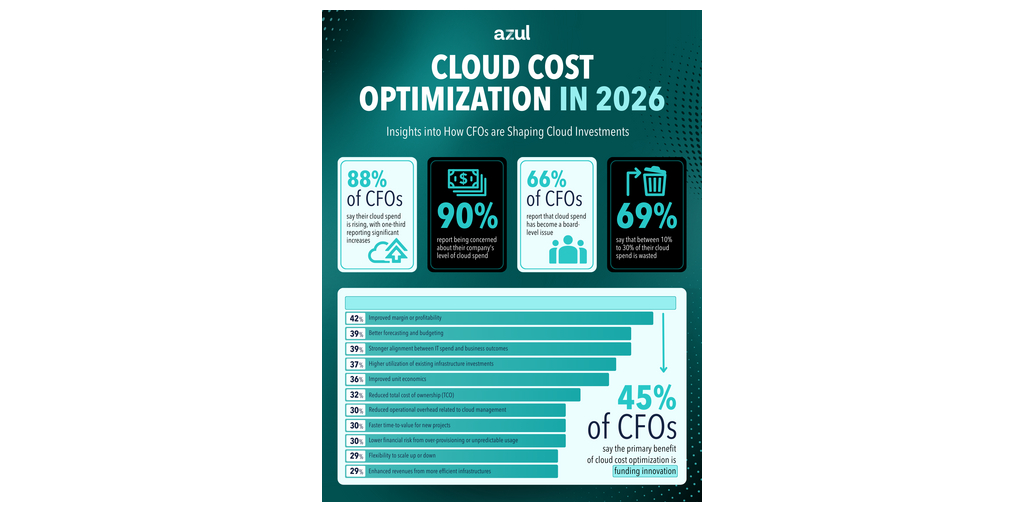
Azul's survey of 300 CFOs puts a number on something most enterprise technology leaders have felt anecdotally for the past two years: cloud cost has stopped being purely an IT operations concern and become a board-level issue. Eighty-eight percent of surveyed CFOs reported rising cloud costs, and 66 percent said cloud cost optimization now reaches board-level discussion, a threshold that a routine infrastructure line item rarely crosses on its own.
That escalation matters organizationally as much as financially. A cost concern discussed at board level typically pulls in scrutiny, reporting requirements, and accountability structures that a purely operational IT decision never faces, which means cloud architecture choices that used to be made by engineering teams with budget oversight are increasingly subject to governance processes designed for capital allocation decisions, not technical ones.
The visibility gap behind the anxiety
The more structurally important finding in Azul's survey is not the cost increase itself but the admission, from a meaningful share of the same CFOs, that they lack clear visibility into what is actually driving that spend. That gap is a familiar one to anyone who has sat in a FinOps planning meeting: finance holds budget authority, but engineering holds the actual provisioning decisions, instance types, autoscaling policies, data egress patterns, that determine the bill finance eventually sees.
Without shared visibility into that technical detail, a CFO's response to rising costs tends toward blunt instruments, across-the-board budget caps, mandated vendor renegotiation, generic austerity directives, rather than the kind of targeted optimization that actually reduces waste without degrading performance. The survey's finding suggests that gap persists at a surprisingly large share of enterprises despite years of FinOps as an increasingly mainstream discipline.
A caveat worth keeping in view
Azul commissioned this survey, and Azul is a commercial Java vendor whose own product pitch centers substantially on JVM-level tuning, garbage collection optimization, and runtime efficiency as direct levers for reducing cloud compute costs. That commercial interest does not make the underlying survey data wrong, 300 CFOs reporting rising costs is a real data point regardless of who funded the research, but it is a reasonable reason to treat any specific remediation recommendation in Azul's own commentary on the results with the same scrutiny applied to any vendor-commissioned research pointing toward that vendor's own product category.
Enterprise finance and technology leaders reading surveys like this one should separate the data, which describes a real and widely felt cost pressure, from the implied solution, which in this case happens to align closely with what the commissioning vendor sells. That distinction matters for any board-level discussion drawing on this kind of research to justify a specific vendor selection rather than a broader cost governance process.
AI workloads are reshaping the cost conversation
A significant driver behind this cost pressure, though not unique to Azul's survey, is the shift toward AI workloads that behave very differently from the steady-state compute capacity planning models enterprises built over the previous decade of cloud adoption. GPU instance pricing carries a meaningfully different cost structure than general-purpose compute, and inference-driven consumption, which can spike unpredictably based on user demand or model usage patterns, is far harder to forecast and budget against than batch processing or steady web traffic.
That unpredictability is a large part of why FinOps teams built around monthly reserved-instance planning and historical usage trending are struggling to keep pace with AI-driven spend. Enterprises scaling production AI workloads should expect their existing cost forecasting models to require real rework, not incremental adjustment, to account for the fundamentally different consumption pattern AI inference introduces compared to the workloads those models were originally built around.
What CFOs and CIOs should actually do about this
The most direct response to the visibility gap this survey surfaces is not a new tool purchase but a structural one: establishing a joint finance-engineering review cadence where cost data and provisioning decisions are reviewed together, rather than finance receiving a bill after the fact and engineering making architecture decisions without real-time cost feedback. That joint cadence is the actual mechanism FinOps practice is built around, and its absence, more than any specific tooling gap, is what produces the visibility problem CFOs are reporting.
For AI-specific spend in particular, enterprises should build separate forecasting models and separate accountability structures from their general cloud cost governance, given how differently GPU and inference costs behave compared to traditional compute. Treating AI workload costs with the same tools and cadence built for steady-state infrastructure spend is a likely contributor to why so many CFOs in this survey report feeling cost pressure without a clear sense of its specific sources.
None of this requires board-level anxiety to resolve this quarter. It requires finance and engineering sharing the same cost data in the same conversation often enough that provisioning decisions and budget decisions stop happening in isolation from each other.