A nine billion dollar bet on food infrastructure
Wonder, the food platform founded by Marc Lore, closed a $650 million Series D on July 16 at a $9 billion pre-money valuation. The round brings total capital raised to roughly $3 billion since 2018 and lands as Lore signals a public offering as early as 2027. For technology leaders watching the collision of commerce, logistics, and automation, the raise matters beyond the headline number. Wonder is assembling a vertically integrated stack that spans chef-developed menus, owned kitchens, delivery, and at-home meal brands. The company has tripled its footprint from 46 locations in May 2025 to 140 today, a pace that reads more like infrastructure buildout than restaurant expansion.
We read this financing as a vote for owning the full production and fulfillment layer rather than renting pieces of it. Wonder acquired Grubhub in 2024 and folded Blue Apron into its at-home offer, giving it demand aggregation, last-mile delivery, and meal manufacturing under one roof. Existing backers Accel, GV, and New Enterprise Associates returned, and the placement was run by Goldman Sachs, Jefferies, and J.P. Morgan. That syndicate composition tells us the company is preparing capital markets for a listing rather than simply extending private runway. The question for the sector is whether integrated food infrastructure can hit software-like margins at national scale.
The robotics layer under the brand
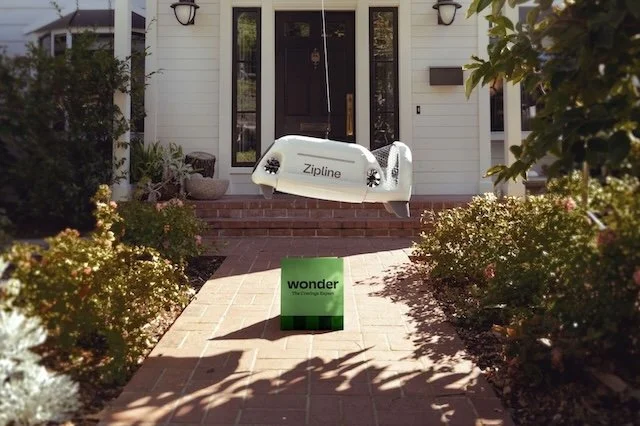
The part of Wonder's story most relevant to retail and CPG technologists sits below the menu. The company operates what it calls the Infinite Kitchen, an automated system that assembles bowls and meals with minimal human handling, and it has partnered with Zipline on drone delivery. Lore framed the raise squarely around this layer, saying Wonder is building the technology, robotics, and infrastructure behind a new kind of food platform to make quality food more affordable and convenient. Automation here targets the two costs that have historically capped food-service margins, namely labor per order and error rates in assembly, both of which compound across a growing store network.
We have seen robotics narratives inflate valuations before, so the operative test is throughput and reliability at unit level rather than demo-floor theatrics. Wonder's advantage is that it controls the menu, the recipe, and the machine simultaneously, which lets it design food specifically for automated assembly instead of retrofitting robots into human workflows. That vertical control is the same pattern that lets Amazon tune warehouses around its own catalog. If the Infinite Kitchen delivers consistent labor savings as the footprint scales toward several hundred sites, the economics shift from restaurant to platform. That is the bet the $9 billion mark is pricing.
The economics Wonder is selling
Wonder's pitch to investors rests on collapsing the cost structure of restaurant-quality food. Cathie Wood, whose ARK Invest joined as a new backer alongside AllianceBernstein and Kayne Anderson Rudnick, said the platform is redefining the economics and experience of restaurant-quality food at scale. NEA co-CEO Tony Florence added that his firm's continued investment reflects its confidence in that model and in Lore's ability to keep executing at scale. The recurring word is scale, and it signals where the capital goes. Wonder intends to fund physical expansion, marketplace growth, and further spending on technology, robotics, and AI across its owned network of kitchens and brands.
For CxOs in adjacent categories, Wonder is a live experiment in whether owning every layer beats orchestrating partners. Grocers and quick-service chains have largely chosen the orchestration route, stitching together third-party delivery, cloud kitchens, and packaged-goods suppliers. Wonder is arguing that integration yields better data, tighter quality control, and eventually lower cost per meal. The risk is capital intensity, since kitchens and robots carry heavy fixed costs that punish any shortfall in volume. The reward, if utilization holds, is a defensible moat competitors cannot assemble quickly. We expect this integrated versus orchestrated question to define the next several years of food commerce strategy.
What the investor roster signals
The composition of this round deserves attention on its own. Public-market crossover investors such as ARK and AllianceBernstein rarely enter a private company at a $9 billion mark without a near-term liquidity thesis. Their presence, combined with a placement agent lineup drawn from the three largest listing underwriters, points to an IPO window Lore himself put at early next year. Wonder has now raised roughly $3 billion across its life, a figure that demands a public exit to return capital. We read the July financing as the penultimate private step before Wonder tests whether public markets will underwrite a food company on technology multiples.
That framing carries a warning for enterprise buyers evaluating Wonder as a partner or benchmark. A company optimizing for a 2027 listing will prioritize growth metrics that impress equity analysts, and footprint expansion from 46 to 140 sites in fourteen months fits that pattern. Technology leaders should separate the durable operational story, namely automated kitchens and integrated logistics, from the capital-markets choreography around it. The robotics and infrastructure investments are real and worth studying. The valuation is a market wager on how quickly those investments convert into margin. Both can be true, and CTOs benefit from tracking the operational metrics independently.
The read for retail and CPG leaders
Wonder sits at the intersection of several trends enterprise leaders already track, including automation of physical labor, vertical integration of commerce, and the blurring line between retailer, manufacturer, and delivery network. Its buildout offers a preview of what a food business designed from scratch around robotics and owned data looks like. For CPG companies, Wonder is a potential channel and a potential competitor, since a platform that controls menus and manufacturing can launch private brands at will. For grocers, it is a reminder that prepared food, the highest-margin category in the store, is now a target for well-capitalized technology entrants.
We advise treating this raise as a signal rather than a verdict. The technology thesis is sound and the capital is committed, yet the proof arrives only when Wonder reports unit economics under public scrutiny. Enterprise leaders should watch three metrics as the IPO approaches, namely labor cost per order in automated kitchens, utilization across the expanding footprint, and gross margin on the at-home meal business. Those numbers will reveal whether integrated food infrastructure earns the technology valuation now attached to it. Until then, Wonder remains the most instructive live test of the vertically integrated commerce model in the food category.