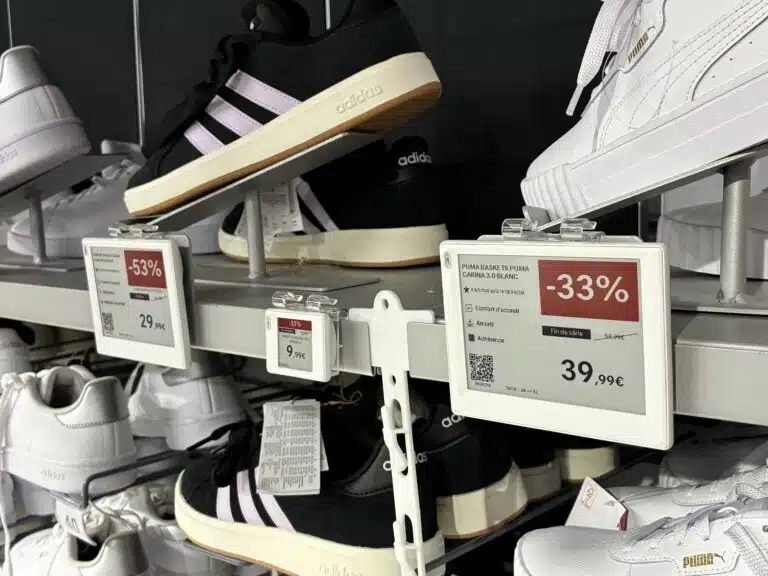
A rollout that crossed into infrastructure scale
Vusion announced on July 15 that Decathlon has equipped 700 stores with its electronic shelf label solutions, spanning 54 countries across Europe, South America, and Asia-Pacific. The milestone makes the French sporting-goods retailer Vusion's most globally deployed customer to date. Decathlon operates roughly 1,900 stores and more than 100,000 teammates worldwide, so the 700-store figure represents over a third of its estate now running on digital price tags. For technology leaders, the number worth noting is the geographic spread, since maintaining synchronized pricing across 54 country-level tax, currency, and regulatory regimes is a materially harder problem than deploying labels within a single market.
We view this as the point where electronic shelf labels stop being a store-level convenience and become chain-level infrastructure. At 700 stores the labels function as an addressable network, one that lets Decathlon push a price change to every shelf in a region within seconds rather than dispatching staff with paper tags. Xavier Dete, Decathlon's VP of Innovation, framed the payoff plainly, saying that thanks to ESLs the retailer has further enhanced the in-store experience while improving operational efficiency. The dual claim, better experience and lower cost, is the combination that has kept ESL adoption accelerating across European grocery and specialty retail through 2026.
The labor math behind the labels
The operational case for electronic shelf labels has always started with labor. Manual price changes consume hours of associate time per store each week, and every promotion, markdown, or supplier adjustment multiplies the effort. Digital labels collapse that work to a single system push, freeing staff for customer-facing tasks in a period when retail labor remains scarce and expensive. Decathlon's scale amplifies the return, since a chain applying frequent seasonal and promotional pricing across sporting categories benefits disproportionately from automation. We see this as the clearest near-term return in physical retail technology, one that boards approve without the speculative leaps that many AI projects still require.
The second benefit is accuracy, and it carries more weight than it first appears. Vusion states that the deployment nearly eliminates discrepancies between the shelf price and the price charged at checkout. Price mismatches erode customer trust, trigger regulatory scrutiny in several European markets, and generate refund and dispute costs that rarely show up in project business cases. By synchronizing shelf and till through one source of truth, Decathlon removes an entire class of operational error. For CxOs, this is the underappreciated part of the ESL story, since pricing integrity protects both margin and brand reputation in ways that compound quietly over time across a large estate.
Riding the network the retailer already owns
One technical detail in the announcement rewards attention. Vusion's labels connect natively to Decathlon's existing Cisco Meraki network infrastructure, requiring no additional networking hardware to run. That design choice matters at 700-store scale because incremental hardware, gateways, and access points are where large ESL deployments usually bog down in cost and installation time. Riding the retailer's installed network turns a hardware project into a largely software and label logistics exercise. We flag this because integration friction, not the labels themselves, is what determines whether a rollout reaches hundreds of stores or stalls after a single-market pilot. Decathlon's pace suggests the integration held up well.
This also signals where the ESL category is heading architecturally. Early deployments shipped proprietary gateways and closed radio protocols that locked retailers into a vendor's full stack. Leaning on standard enterprise networking lowers the barrier for chains that already invested in unified store connectivity, and it makes multi-country rollouts far more repeatable. For CIOs evaluating shelf-edge digitization, the lesson is to weigh how a vendor integrates with existing infrastructure as heavily as the label economics. A solution that demands parallel network buildout carries hidden cost and schedule risk that a network-native approach avoids. Decathlon's result is a useful reference point on that specific question.
From price tags to a programmable shelf edge
The strategic reason to watch large ESL deployments is what the installed network enables next. Once every shelf carries an addressable digital display, the retailer holds a programmable surface that can support dynamic pricing, real-time stock signals, and eventually in-store retail media. Grocery chains across Europe have already begun testing time-of-day and demand-based pricing on ESL estates, and specialty retailers are close behind. Decathlon has not announced dynamic pricing, and we would caution against assuming it, yet the infrastructure it just completed is the prerequisite for those capabilities. The 700-store network is an option on future functionality as much as a pricing and labor tool today.
We temper the enthusiasm with a governance caution. Dynamic pricing invites regulatory and reputational risk, particularly in consumer categories where shoppers notice and resent visible price volatility. The technical ability to change prices instantly is not a license to do so, and retailers that move too aggressively will draw scrutiny from regulators already watching algorithmic pricing in 2026. The disciplined path uses the ESL network first for accuracy and labor savings, the benefits Decathlon cites today, and layers advanced pricing only where customer trust can absorb it. Enterprise leaders should build the capability while setting clear policy on how far to exercise it in practice.
The read for retail technology leaders
Decathlon's milestone offers a clean benchmark for any retailer weighing shelf-edge digitization at scale. The deployment demonstrates that ESL can cross 54 markets on existing network infrastructure while delivering the two benefits that justify the spend, namely labor reduction and pricing accuracy. It also lands during a broader 2026 wave of physical-retail digitization, from shelf-scanning robots to computer-vision inventory systems, all of which depend on the same underlying push toward instrumented stores. ESL is often the first and lowest-risk step in that progression, which is why we treat this rollout as a signal of where mid-market and enterprise specialty retail is heading.
For CTOs, the practical takeaways are concrete. Prioritize vendors that integrate with your existing store network rather than mandate parallel hardware, model the return on labor and pricing accuracy before reaching for speculative dynamic-pricing upside, and treat the label network as a platform that later store technologies will build upon. Decathlon reached 700 stores by keeping the integration simple and the business case grounded in operational savings. That discipline, more than any single feature, is what carried the deployment from pilot to global scale. Retailers still debating shelf digitization now have a large, multi-country proof point to reference.