The Capex Number That Matters
Urban Outfitters Inc. is planning $475 million in capital expenditures for fiscal 2027, and roughly half of that budget is going toward logistics rather than new stores, brand marketing, or digital storefront work. That allocation is a strong signal about where the parent company sees its growth coming from over the next several years. Nuuly, the subscription rental business, has become large enough and is growing fast enough that its physical infrastructure now commands a capital commitment comparable to what a much bigger retailer might spend across its entire store fleet.
CFO Melanie Marein-Efron and Nuuly president and CTO David Hayne are effectively betting that automation investment now prevents a much larger cost problem later, as subscriber volume continues to scale past what manual fulfillment processes can handle economically. Hayne put the operational reality bluntly: shipping, receiving, laundering, and inspecting wardrobes for half a million subscribers requires significant investment. That is not a hypothetical concern; it is the operating cost structure Nuuly is already living with today, before the next wave of subscriber growth arrives.
Why Nuuly Outgrew Its Own Warehouse
The numbers behind this investment are genuinely striking for a subscription apparel business. Nuuly's subscription segment net sales grew 28.6% year over year, and average active subscribers surged 30.4% in the quarter ending July 31. Growth at that rate compounds quickly into a physical capacity problem: every new subscriber adds garments that need to be received, laundered, inspected, stored, and reshipped on a recurring monthly cycle, and that cycle does not pause for a facility expansion to catch up.
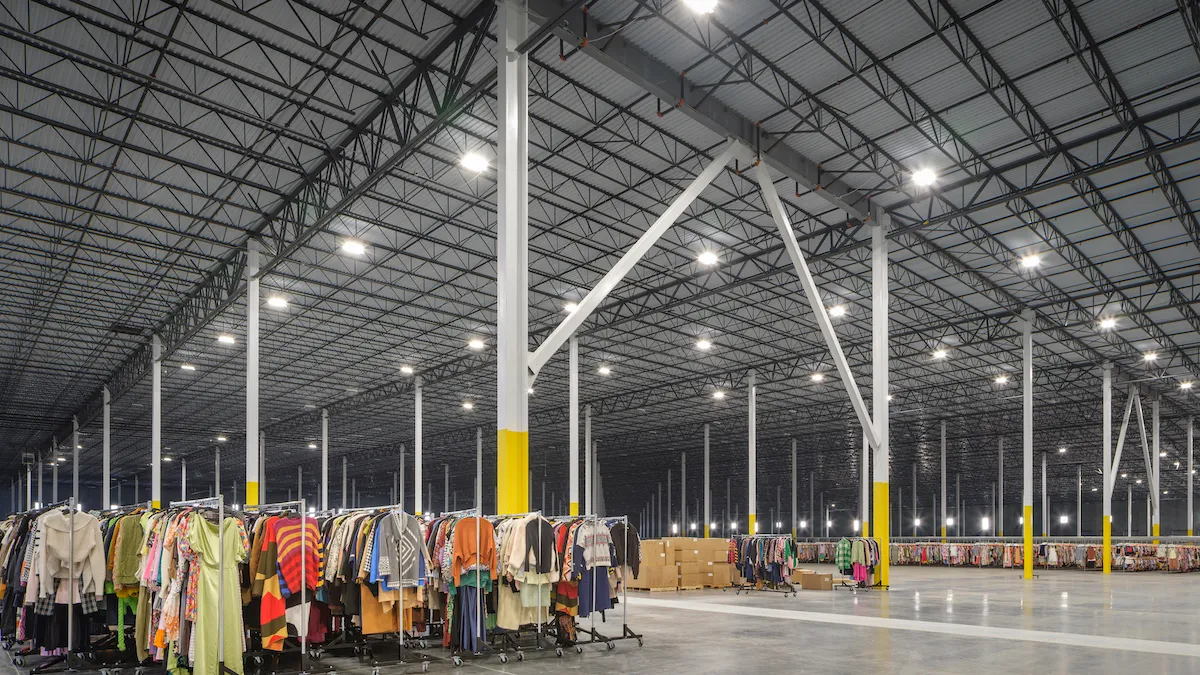
The Kansas City facility has already been expanded to 1 million square feet, up from its original footprint, and now supports up to 600,000 subscribers. That expansion alone tells you the original facility was sized for a much smaller business than the one Nuuly has become. Scaling a rental subscription model is fundamentally a reverse logistics problem, every item goes out and comes back repeatedly, and reverse logistics at volume is exactly the kind of workflow that punishes manual processes the hardest as growth accelerates.
The Automation Rollout, Step by Step
Nuuly is not automating everything at once, which is worth noting as a deployment model other retailers running large fulfillment operations should study. Garment storage automation launches this month, giving the company its first live automated system to evaluate before committing further capital. An automated order sortation system follows in the fourth quarter, addressing the step where individual subscriber orders get matched to the right garments and consolidated for shipment. Automated picking, arguably the most complex piece given the variability of soft goods compared to boxed retail products, is not scheduled until mid-2027.
That staged sequencing, storage first, then sortation, then picking last, reflects a sensible risk management approach to warehouse automation. Storage automation is the most mechanically straightforward of the three and the easiest to validate before layering on more complex systems. Companies that try to automate picking and sortation simultaneously, without a proven storage and inventory foundation underneath, tend to run into far more integration problems than those that sequence the rollout the way Nuuly is doing here.
The Labor Math Behind the Investment
Automation investment of this scale is ultimately a labor cost decision as much as it is a capacity decision. Manual sortation and picking processes scale roughly linearly with order volume, meaning every additional 100,000 subscribers requires a proportional increase in warehouse staffing, hiring, training, and management overhead that compounds as the facility grows. Automated systems have a much steeper upfront capital cost but a flatter marginal cost curve as volume increases, which is exactly the trade Nuuly needs to make now that it has crossed into genuinely large scale operations.
The company has not disclosed the specific dollar figure attached to the automation portion of its logistics capex, but the scale of investment, roughly $237 million if the 50% logistics allocation splits evenly, suggests this is a multi-year infrastructure commitment rather than a pilot program. Retailers evaluating similar automation investments should model the crossover point where automated fulfillment cost per unit drops below manual fulfillment cost per unit, since that crossover point is what ultimately justifies capital spending at this magnitude.
Philadelphia and the Long Game
Nuuly's second automated facility, opening in Philadelphia in late 2028, will expand the company's total network capacity from its current single-facility model to a two-site operation supporting roughly 1.2 million subscribers across the combined network. That is more than double current subscriber capacity, and the multi-year timeline, roughly two years out from now, gives the Kansas City facility time to prove out its automation systems before Nuuly commits the same architecture to a second, geographically distant site.
Running two automated fulfillment centers instead of one also changes Nuuly's operational risk profile in a positive way. A single facility handling all subscriber volume is a single point of failure for the entire business; a two-site network gives Nuuly geographic redundancy and the ability to route volume around a facility-level disruption, whether that disruption is a system outage, a weather event, or a labor issue at one location. It also shortens average shipping distance for subscribers on the East Coast, which should modestly improve delivery times without any additional technology investment beyond the facility itself.
What This Tells Other Subscription Retailers
The broader lesson here extends well past apparel rental. Any subscription commerce model with a physical reverse logistics loop, meal kits, beauty boxes, equipment rental, furniture subscriptions, will eventually hit the same wall Nuuly is now automating its way past: manual fulfillment processes that worked fine at modest scale become the binding constraint on growth once subscriber counts cross into the hundreds of thousands. The warning sign is usually the same one Nuuly hit, a facility that has already been expanded once and is approaching capacity again.
For enterprise technology and operations leaders running or advising subscription businesses, the practical takeaway is to model the automation investment decision well before the facility actually hits its ceiling. Nuuly's staged rollout, storage automation first, sortation in the following quarter, picking over a year later, is a reasonable template for sequencing that kind of investment without betting the entire operation on an unproven system all at once. Waiting until a facility is already at capacity to start that sequencing removes the margin for error a phased rollout depends on.