A 1 million-a-day target forces real accountability
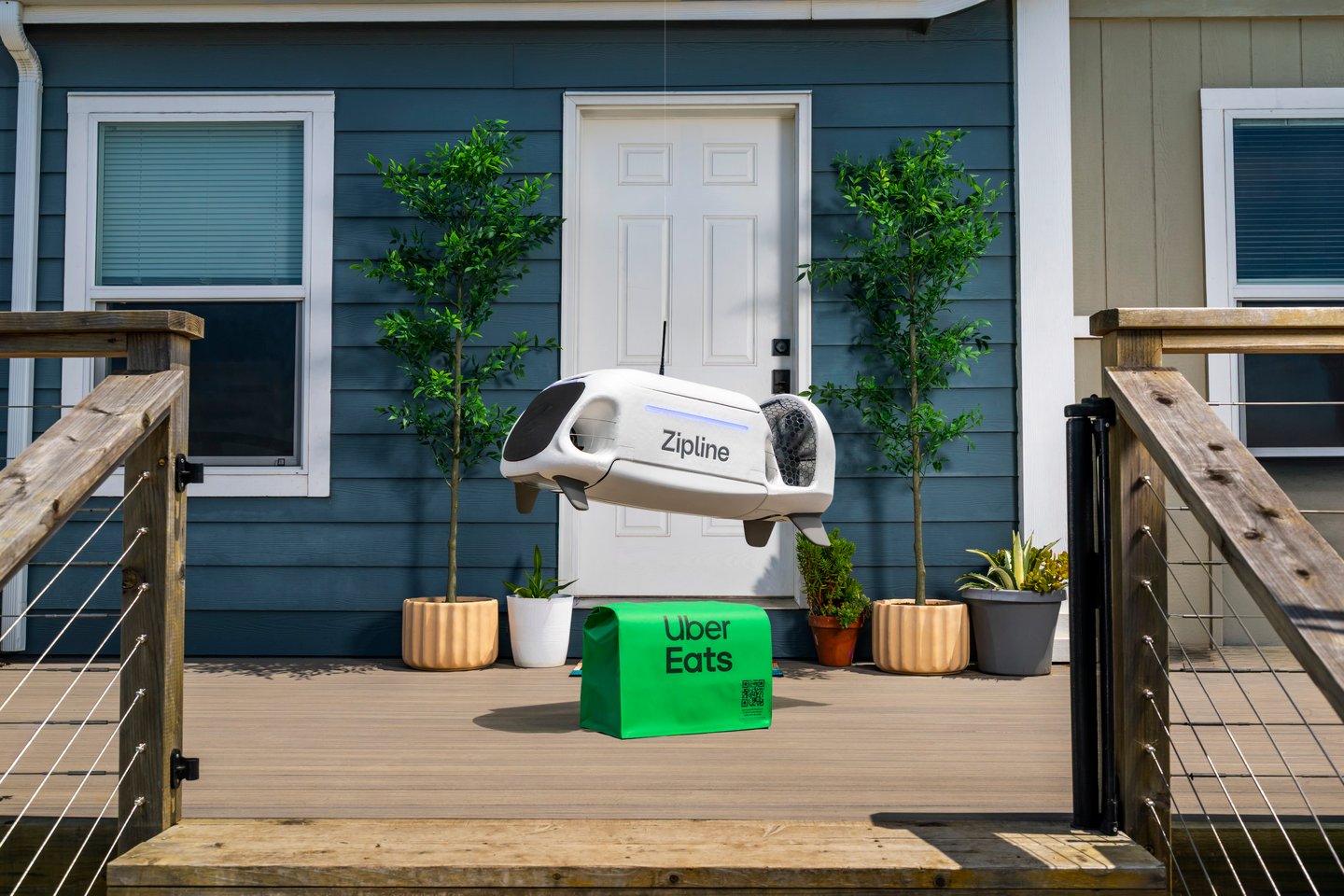
Most delivery robotics and drone announcements avoid hard numbers, preferring vague language about scale and expansion that is impossible to hold anyone accountable to later. Uber and Zipline did the opposite, committing publicly to 1 million drone deliveries per day by the end of 2029, a five-year-out target stated in plain, checkable terms. That specificity reads as either genuine confidence in the underlying operating data or real exposure if the timeline slips, and either way it gives industry watchers, and Uber's own board, a concrete number to hold the partnership against three years from now.
Put that figure in context. Uber Eats currently serves 825,000 retailers across more than 11,000 cities globally, a base large enough that 1 million daily drone deliveries would require drones to become a genuinely meaningful share of total Uber Eats volume rather than a novelty tier reserved for a handful of pilot markets. That is a fundamentally different order of ambition than the drone pilots most retailers have run to date, which have typically stayed capped at a few thousand deliveries per market and rarely scaled past a single metro area.
Zipline was already the adult in the room on drone logistics
Uber did not pick a startup with a demo reel and a slide deck. Zipline already operates drone delivery for Walmart, Chipotle, Wonder, and Popeyes, giving it operating experience across grocery, quick-service, and prepared-food logistics that few competitors in the space can match at comparable scale. That existing commercial footprint, spanning different payload types, packaging formats, and delivery windows, is likely what made Uber comfortable putting direct investment behind the partnership rather than structuring it as a narrower, arms-length commercial agreement the way most retail robotics deals are still written today.
For retail and restaurant operators evaluating drone delivery vendors of their own, Zipline's client roster is itself a useful signal worth studying closely. A vendor operating across grocery, big-box, and quick-service restaurants simultaneously has already solved a wider range of payload, regulatory, and airspace problems than a vendor focused on a single vertical or a single delivery format. That breadth of proven operating experience should weigh more heavily in vendor selection than flashy range or top-line speed specifications that rarely survive contact with real regulatory and weather conditions.
The Flytrex Relationship Shows Uber Is Deliberately Hedging Its Drone Bet
This is Uber's second drone delivery partnership, following a Flytrex deal in September 2025, and the sequencing matters. Running two drone vendors simultaneously functions as a deliberate hedge against the operational and regulatory uncertainty still baked into commercial drone delivery at this stage of the industry's development. Airspace rules, insurance frameworks, and municipal permitting all vary significantly by region and change frequently, and no single vendor currently has uniform coverage or uniform regulatory standing across every market where Uber operates today.
This multi-vendor approach is a more realistic posture than the single-partner announcements that dominate most retail robotics coverage, and it is the model other large delivery and retail networks should study closely before committing. Locking into one drone or robotics vendor before the regulatory landscape stabilizes concentrates operational and reputational risk unnecessarily. Uber's structure instead lets it shift volume toward whichever partner performs better in a given region, without having to renegotiate its entire drone strategy every time one market's rules change.
The CEO's Framing Points Toward Broad Retail Expansion
Dara Khosrowshahi's statement that the partnership is about shaping the future of delivery broadly is worth taking literally rather than reading as standard executive boilerplate around a new deal. Zipline's existing Walmart relationship already spans general merchandise well beyond prepared food, and Uber's own retail delivery ambitions have been expanding steadily beyond restaurants for the past two years through Uber Direct and related retail partnerships. The Zipline partnership gives Uber a credible drone capability to bring into those broader retail delivery conversations, extending its pitch to retailers well past the food and grocery categories where it built its initial reputation.
Retailers currently negotiating last-mile delivery contracts with Uber Direct or similar services should ask specifically whether drone capacity is on the near-term roadmap for their region, and at what cost structure relative to standard ground delivery. A retailer that locks in a multi-year delivery contract without any drone option built in now may find itself renegotiating from a materially weaker position once Zipline's coverage through Uber expands into that market and competitors have already secured preferential terms.
Sub-30-minute delivery becomes the baseline expectation to plan around
Uber Eats already averages under 30 minutes for delivery across its existing network, a bar drones are being added to improve on rather than establish for the first time. That framing matters for how retail and restaurant operators should read this announcement. The more accurate read is a cost and capacity story rather than a pure speed story, since the existing service level is already competitive. Drones reduce the marginal cost of short-radius deliveries and free ground couriers to handle longer or more complex orders, which is where the real margin upside sits for both Uber and its retail partners over the next several years.
For retail leaders, the practical planning implication is to stop treating drone delivery as an experimental channel to monitor from a comfortable distance and start modeling it directly into 2027 and 2028 fulfillment cost structures now, while contract terms and regional coverage are still being negotiated. A vendor with a public 1 million-per-day target and direct investment from a company the size of Uber is signaling that this is being built as core infrastructure, not a pilot program that quietly disappears the moment early metrics disappoint anyone involved.