The launch closes the gap between AI hype and merchant reality
Most agentic commerce announcements in the West have been protocol papers and pilot programs. Alipay shipped something merchants can turn on this month. The platform takes a retailer's existing web pages, product catalog, and service workflows and republishes them in formats that AI agents can parse and act on, without asking the merchant to rebuild anything. That is the detail that matters most for a CIO audience: the barrier to entry for agentic commerce just dropped from a multi-quarter integration project to something closer to a configuration exercise.
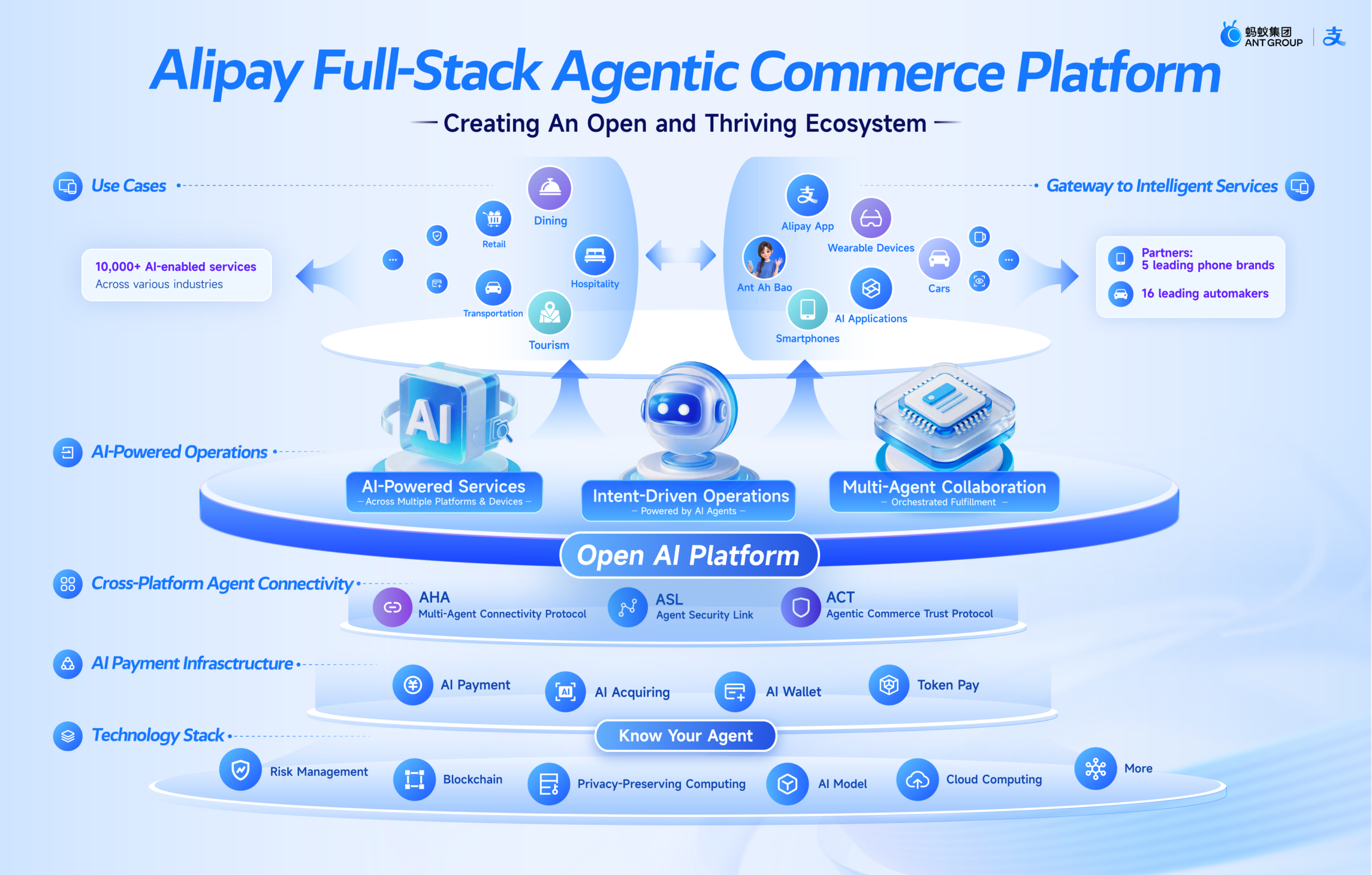
Alipay built this with tiered adoption in mind. A merchant with almost no AI capability can turn on baseline agent compatibility, while a more sophisticated retailer can layer in deeper personalization and agent-native promotions. That flexibility is the part Western platforms have struggled to match. Shopify, Google, and OpenAI have each shipped pieces of the agentic commerce stack, but none has bundled discovery, payment, identity, risk, and fulfillment into a single onboarding motion the way Alipay just did.
Distribution is the story, not the protocol
Protocols are cheap to publish and expensive to get adopted. What makes this launch different is the distribution Alipay already controls. Five smartphone brands representing 70 percent of the Chinese market and 16 automakers are integrated with Ah Bao, Alipay's consumer AI agent, which already connects to more than 10,000 everyday services. That combination represents a national footprint that most agent platforms in the US and Europe would need years to assemble from scratch, and it is the single biggest reason this launch deserves attention beyond China's borders.
The AHA interoperability protocol is designed to let different agents and devices talk to the same merchant infrastructure, which matters because no single company will win the agent layer outright. Ant Group is betting that owning the merchant-side plumbing is more durable than owning any one consumer-facing agent. Enterprises building agentic commerce strategies in other markets should note that bet: the money is shifting toward infrastructure that multiple agents can plug into, not toward a single proprietary assistant.
A six to 12 month timeline is aggressive, and Ant Group means it
Cyril Han's public framing, that AI agents will become a primary interface between users and merchants within six to 12 months, reads as promotional until you look at the incentive structure Alipay built to hit it. The company is offering 100 million free tokens per user as an adoption incentive, a subsidy large enough to signal Ant Group expects real usage friction and wants to buy past it quickly rather than let organic adoption set the pace. That kind of spend is a leading indicator worth tracking, because companies rarely subsidize adoption this aggressively unless internal usage data already supports an accelerated timeline.
For retail CIOs outside China, the useful signal is the scale of willingness to subsidize adoption, more than the token giveaway itself. Companies planning for agentic commerce as a slow, multi-year evolution tend not to spend at this level this early. Ant Group's spend implies it expects a land grab, and land grabs reward whoever has functioning infrastructure ready when the volume arrives. Retailers still treating agent readiness as a 2027 roadmap item should read that spending pattern as a clock starting now, not later.
The bundled trust layer solves what US agent pilots keep stumbling on
Every agentic commerce conversation in the US eventually stalls on the same question: who is liable when an agent completes a bad transaction, and how does a merchant verify the agent is acting on a real customer's behalf. Alipay's platform bakes identity verification and risk management directly into the merchant stack rather than leaving it to each retailer or each agent vendor to solve independently. That is a meaningfully different architecture than the API-first approach US platforms have taken.
It also explains why a payments company is the one shipping the most complete agentic commerce stack to date, ahead of search engines and cloud providers that have dominated the conversation so far. Alipay already owns the trust and settlement layer that agentic commerce depends on, along with the merchant relationships needed to make identity verification and risk scoring reliable at scale. Retailers evaluating vendors in this space should weight payments and identity infrastructure providers more heavily than they have been, because that layer is turning out to be the actual bottleneck holding back agent-native checkout, well ahead of whatever conversational model sits on top of it.
What this means for retailers outside China
No Western retailer can plug into Alipay's stack directly, but the architecture is instructive for how enterprise agent-readiness projects should be scoped. Organizations piloting agent readiness by exposing a narrow product API to one AI partner at a time are effectively solving last year's problem at a fraction of the necessary scale. Alipay's approach treats the entire storefront, catalog, and service workflow as agent-addressable by default, with tiered controls for how much autonomy to grant at each stage. That is the target state most enterprise retail architectures should be designing toward now, even where the specific protocol and vendor mix will look different outside China.
The competitive risk is straightforward. Chinese merchants on Alipay's platform will have agent-native commerce live within months, at a cost close to zero incremental integration work. Western retailers still negotiating pilot terms with individual AI vendors are giving up real time in a race where the infrastructure layer is consolidating fast. Boards should be pushing their retail technology leaders for a concrete timeline on agent readiness this quarter, given how quickly that infrastructure gap is closing for competitors operating in faster-moving markets.