What the president actually said
On October 21, 2026, President Trump posted on Truth Social that new, large-scale data centers are, in his words, mandated by me to make their own electricity, with any excess power returned to the local community or the grid. He went further, suggesting developers should make direct financial arrangements with host communities, including payments to residents living near these sites, framing onsite generation as both an energy policy and a local goodwill gesture rolled into one post.
Data Center Knowledge is careful to note the obvious limit here: this is a public statement, not a formal regulation or executive order. Nothing currently requires any developer to do anything differently. But if it were ever converted into actual policy, developers who have already locked in grid connections, power purchase agreements, or other committed energy plans could face a difficult and expensive scramble to retrofit arrangements made years earlier under entirely different assumptions.
The equipment reality undercuts the mandate before it starts
Whatever Washington eventually decides, the hardware math runs on its own schedule. Gas turbines suitable for onsite data center generation are, by multiple industry accounts, effectively sold out through 2031 for some models, a backlog that predates this specific announcement and has nothing to do with any policy debate. A mandate that developers generate their own power does not manufacture turbines any faster, and demanding compliance on a timeline the supply chain cannot physically support just shifts the bottleneck from policy to procurement.
That gap matters because it sets the real boundary on how fast any onsite power mandate, formal or informal, could actually take effect even with full industry cooperation and unlimited capital behind it. Developers who started securing generation equipment years ago, well before this statement, have a real head start over anyone now reacting to an October social media post, and that head start is effectively locked in by backlog length rather than by capital, ambition, or political pressure applied after the fact. Anyone starting the procurement process today is already years behind, no matter how the policy question eventually resolves.
The projects already doing this, on their own terms
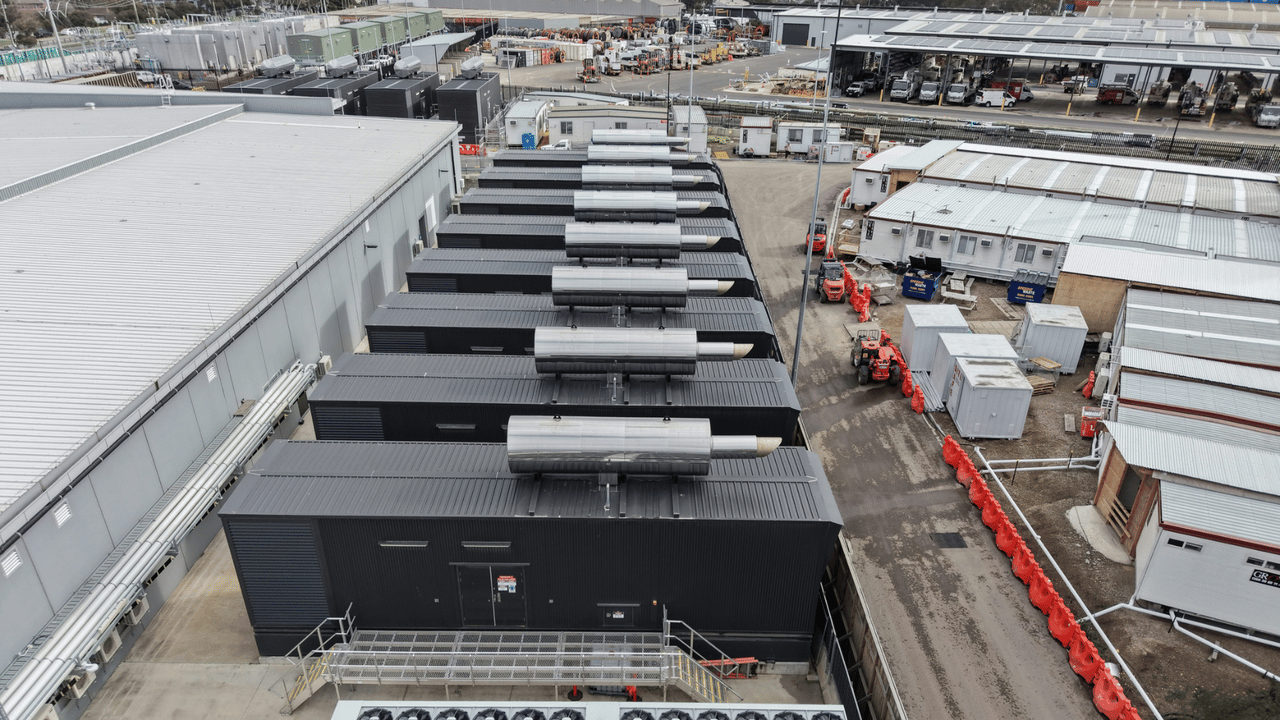
Some developers were building hybrid power strategies long before this post, for commercial reasons that had nothing to do with politics. The Stargate campus in Abilene, Texas, is targeting 1.2 gigawatts once all phases complete, currently running on natural gas, fuel cells, and gas engines with plans to add solar and wind. Applied Digital's campus in Ellendale, North Dakota, arranged 400 megawatts of stranded wind power, and a separate Applied Digital site in Texas will draw from Soluna's 150 megawatt Briscoe wind farm.
These are not off-grid facilities in any strict sense. They are hybrid by design, blending onsite generation with grid interconnection because that combination is more reliable and often cheaper than either option alone. Soluna CEO John Belizaire put the underlying logic bluntly: we have said for a long time that the constraint in AI is energy access, not chips. These projects are the evidence for that claim, built well ahead of any presidential statement forcing the issue.
What the experts say is actually achievable
Patrick Hughes, senior vice president at the National Electrical Manufacturers Association, who helped develop the AI Data Center Energy Performance Framework alongside ASHRAE and the Pacific Northwest National Laboratory, says it is possible for a standalone AI data center to provide sufficient onsite power to fuel its own operations. He is equally clear about the cost of that possibility: doing so reliably requires significant operational management and maintenance, resources and expertise that add real operating cost on top of the capital already sunk into generation equipment.
The barriers extend well past the turbines themselves. Permitting timelines, fuel and component supply chains, interconnection rules that vary by utility and by state, and local community concerns about emissions, noise, and water use all shape what is actually achievable at any specific site. Every one of those factors varies enough by location that a single national mandate could not account for the differences without carving out exceptions almost immediately, state by state and utility by utility, which is precisely the kind of regulatory complexity a one-line social media post tends to skip over entirely.
The framework that is more useful than the headline
The AI Data Center Energy Performance Framework that NEMA, ASHRAE, and PNNL have been building takes a more flexible position than Trump's post, supporting grid-interactive designs and energy storage alongside onsite generation rather than demanding either a fully off-grid facility or a purely grid-dependent one. That flexibility reflects how the facilities actually being built today operate in practice, as hybrids tuned to local power markets and local constraints rather than following one rule for every site in the country.
For operators and their enterprise customers, this framework is a far more useful planning reference than the presidential post that prompted this round of coverage, precisely because it was written by engineers rather than drafted for maximum attention. It describes a spectrum of viable configurations rather than a binary mandate, weighing trade-offs between storage, grid-interactivity, and onsite generation by site and by climate, and it comes from the standards bodies that will still be writing detailed specifications long after this particular news cycle has moved on to whatever headline follows it.
What this means for your site selection and power strategy
Treat the mandate language as noise and the underlying signal as real: energy access has become the binding constraint on new AI infrastructure capacity, ahead of chip supply, and every serious developer is already building hybrid power strategies for that reason regardless of what any single policy statement demands. Site selection decisions that weight power availability and generation flexibility as heavily as GPU allocation or network latency are no longer optional diligence, they are table stakes.
When evaluating a colocation partner or a build-to-suit site, ask specifically what portion of its power comes from onsite generation versus grid connection, what equipment lead times it has already secured, and how it plans to handle a scenario where either source underperforms. The developers who answer that question with specifics, rather than with a reference to a political headline, are the ones who were already solving this problem before anyone demanded they do.