The migration tax this actually removes
Moving a Hive table into Apache Iceberg has historically meant weeks of engineering work: building a pipeline to read the old format, handle type conversion, validate the output, and provide a rollback path in case something broke mid-migration, all while production queries kept running against the source table. AWS announced on November 4, 2026, through a post by Channy Yun on the AWS News Blog, that Amazon S3 Tables now handles this as a managed, API-driven process instead, with no pipelines to build and no compute to provision separately.
That framing understates how much operational risk used to live in this specific project. Type conversion bugs and incomplete rollback plans were the two most common ways a Hive-to-Iceberg migration went sideways in production, and both of those failure modes are exactly what AWS is now promising to handle on the customer's behalf. For any data platform team that has delayed an Iceberg migration because nobody wanted to own that risk internally, this removes the most common excuse for staying on Hive another year.
How the managed path actually works
The process runs in three stages: start, sync, and complete. S3 Tables first scans every source object in scope and generates a compatibility report before touching anything, so a team knows what it is dealing with before committing to the migration. From there, it can sync repeatedly, copying and converting data while the source table keeps serving live production writes, with no requirement to freeze the original table while the migration runs in the background.
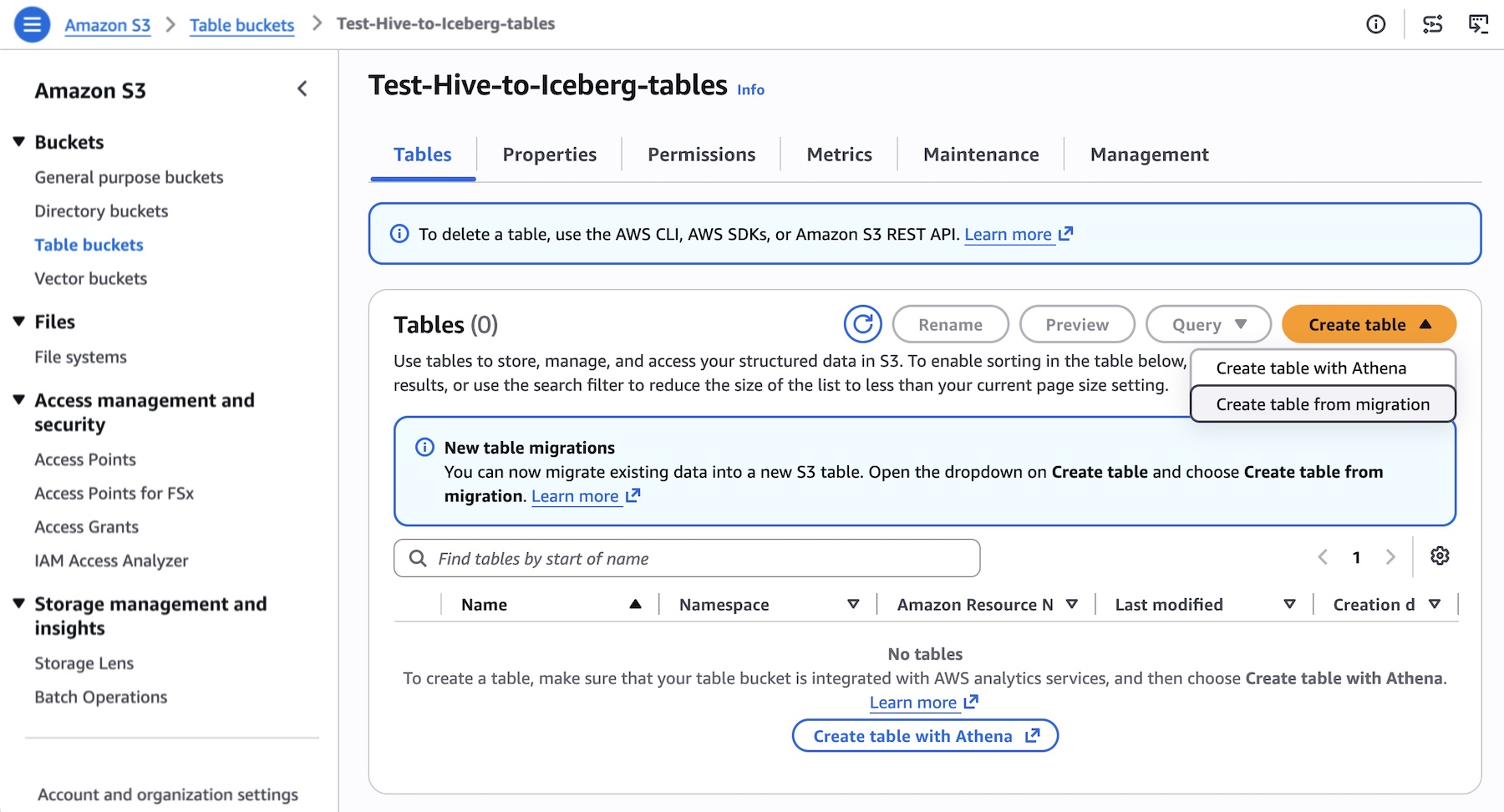
The destination table stays read-only throughout this process and only flips to read-write once the migration completes, at which point AWS says only a few minutes of downtime are needed at the actual cutover moment. The whole workflow can run through the AWS console, the CLI's start-table-migration command, AWS SDKs, or the Agent Toolkit for AWS, which ships a dedicated skill that walks coding agents like Kiro through IAM policy analysis and plan validation step by step.
What is still explicitly out of scope
This is a first version of the capability, and the limits matter for planning purposes before anyone assumes it covers their specific data estate. At launch, it only supports Hive tables that are already registered in AWS Glue and stored as Parquet, the single most common combination in modern AWS-native data lakes but hardly the only one in use across most enterprise environments, and the migration has to happen within the same AWS account and the same Region as the source table, with no cross-account or cross-region path offered yet.
That rules out a few common enterprise scenarios right away: cross-account consolidations after an acquisition, cross-region moves as part of a data residency change, and any Hive tables stored in formats other than Parquet, such as ORC or plain text, which are common enough in older data warehouses that plenty of teams will still need to convert format before they can even start this process. Expect AWS to broaden these constraints over time, the way most AWS services expand scope after launch, but plan around today's limits rather than tomorrow's roadmap.
Once migrated, tables feed a genuinely open query layer
Once a table is migrated into S3 Tables, it is queryable through Amazon Athena, Amazon SageMaker Unified Studio, or any tool that speaks the Apache Iceberg REST catalog API, which is a meaningfully longer list than what could reliably read the original Hive tables without extra glue code. Iceberg's growing ecosystem of compatible engines, spanning Spark, Trino, Flink, and several commercial warehouses, is precisely why so many data platform teams have wanted off Hive for a while now.
This launch is also AWS tacitly confirming which open table format it is backing operationally, not just supporting through compatibility. Databricks has made a similar bet with Delta Lake, and the resulting format rivalry affects how portable your data actually is if you ever want to run the same tables against a different cloud or a different engine. Picking the format your primary cloud provider is actively investing migration tooling into is now a simpler, lower-risk decision than it was a year ago.
The pricing removes the usual build-versus-buy argument
AWS says customers pay only for the data copied during migration, with the Hive-to-Iceberg conversion itself carrying no separate charge, and source objects sitting in S3 Intelligent-Tiering keep their existing access tier rather than getting bumped to a more expensive one as a side effect of the migration. That is a meaningfully different cost structure than building and running a custom migration pipeline, which carries engineering salary cost regardless of whether the data itself moves cheaply or not.
The service is live today in a solid first set of Regions: US East in both Northern Virginia and Ohio, US West in Oregon, four Asia Pacific Regions including Mumbai, Singapore, Sydney, and Tokyo, and three European Regions including Frankfurt, Ireland, and Stockholm. That is a reasonably broad launch footprint by AWS's usual standards for a brand-new managed capability, though teams operating primarily outside those specific Regions will need to wait for further expansion or deliberately route their migration traffic through a supported Region as a workaround in the meantime.
What this means for your lakehouse roadmap
If your organization has an aging Hive-based data lake and has been putting off a lakehouse modernization project because the migration itself looked too expensive or too risky to schedule, this specific objection just got substantially weaker. A managed path that validates, converts, and syncs data with minutes of downtime is a different risk calculation than a custom pipeline your own team has to design, test, and support through its first production incident.
Check whether your current tables are AWS Glue-registered and stored as Parquet, since that determines whether you can use this path today or need an interim format conversion step first. Either way, this is a reasonable trigger to revisit any lakehouse modernization project that has been sitting in the backlog for lack of migration tooling, because the tooling gap that justified the delay is now measurably smaller than it was a month ago.