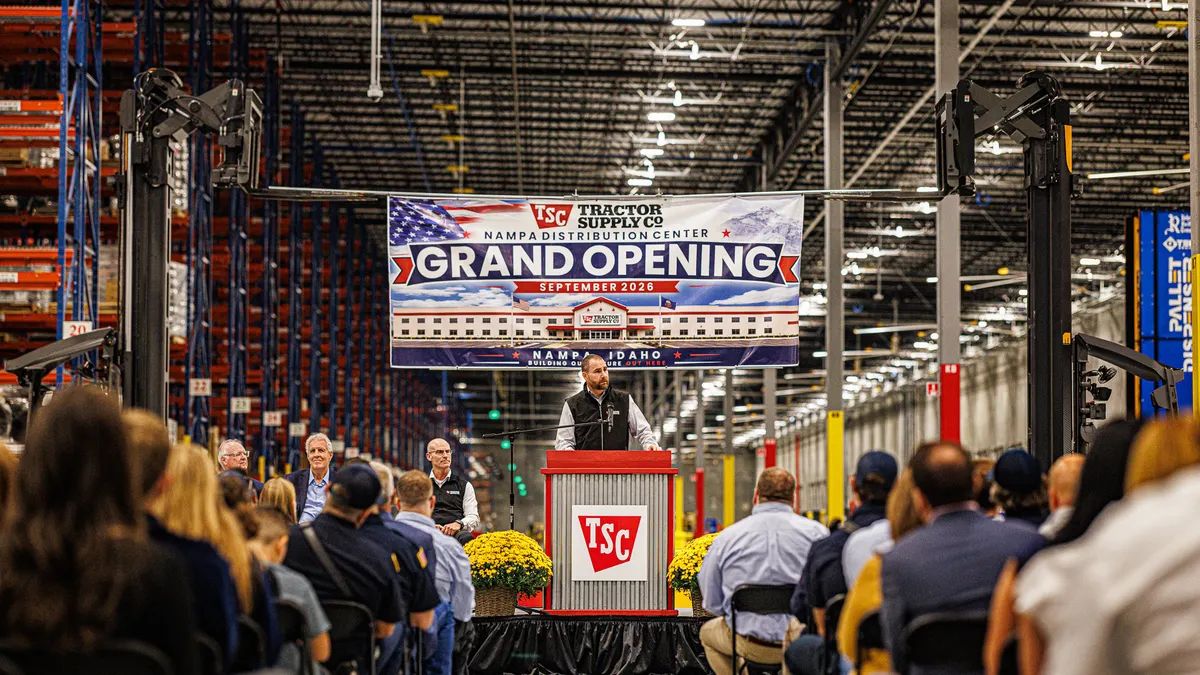
What Tractor Supply actually built
Tractor Supply opened its eleventh distribution center in Nampa, Idaho, an 865,000-square-foot facility that represents more than $200 million in investment, 80 truck docks, and acreage reserved for future expansion. The site began receiving inventory in August and was set to start outbound shipping in October. In its first year it will serve 123 stores across nine states, with capacity to scale to more than 200 stores once fully ramped, a sizable buffer built in from day one rather than bolted on after demand outgrew the building.
Chief supply chain officer Craig Ledbetter described the facility as setting 'a new standard for how products move through our supply chain,' and the company's own release called out an automated architecture 'fully integrated across the operations of the distribution center.' The facility is the first Tractor Supply location to include an automated storage and retrieval system from Knapp, a logistics automation provider, alongside a dedicated AI innovation team tasked with applying what the company calls 'practical artificial intelligence to operational needs.'
Why automation came first, not AI
The detail worth noticing is the order of operations. Tractor Supply built the automated storage and retrieval system as the foundation, then positioned a dedicated AI team to operate on top of it, rather than announcing an AI initiative first and hoping the physical plant would catch up. That sequencing reflects a hard truth most supply chain technologists already know and many boards still resist: AI applied to a warehouse running on inconsistent manual processes mostly produces better-documented inconsistency, not better outcomes.
An automated storage and retrieval system standardizes how inventory moves, gets stored, and gets picked, which means the data an AI layer would eventually work with becomes clean and structured by construction rather than by cleanup effort after the fact. Building the AI team into a facility already running on that foundation, instead of asking the AI team to first make sense of an unautomated warehouse's data, is the less glamorous but more durable way to get value out of both investments.
What the Knapp system actually solves
Automated storage and retrieval systems like Knapp's exist to solve a specific, unglamorous problem: moving high volumes of SKUs in and out of storage faster and more accurately than manual picking, while reducing the labor and error rate tied to humans walking warehouse floors. For a retailer where 81% of merchandise reaching stores in fiscal 2025 already flowed through its distribution network, that is not a peripheral upgrade. It is an improvement to the artery that carries most of the business's physical product.
That context matters for how to read the AI team's mandate. An AI layer sitting on top of an ASRS can plausibly do useful work quickly: demand forecasting tied to actual pick-and-pack velocity, exception handling for the inventory that does not fit standard flows, and continuous tuning of how the automated system allocates space. None of that is speculative in the way AI pilots at less automated facilities tend to be, because the operational substrate underneath it is already standardized.
What a 'dedicated AI innovation team' signals at this stage
The phrase 'dedicated AI innovation team' can mean almost anything, from a genuine engineering function to a rebranded ops-improvement group with a trendier name. Tractor Supply's own description, applying practical AI to operational needs, reads as intentionally modest, and that restraint is itself informative. The company is not claiming an AI-driven warehouse or an autonomous fulfillment breakthrough. It is describing incremental application of AI to a facility that was already going to be built around automated retrieval regardless of where AI capability landed.
That framing is a useful model for other retailers under pressure to have an AI story for investors. A team whose job is explicitly to apply AI to operations that already run cleanly is more likely to ship something real within a year than a team asked to retrofit AI onto a legacy facility while also trying to fix the underlying process problems that made the facility inefficient in the first place.
The capital case: one node in an eleven-node network
More than $200 million for a single distribution center is a serious capital commitment, and it lands alongside a period of real store growth: Tractor Supply opened 28 new stores in the second quarter of 2026 alone, and had 70 locations across Idaho, Oregon, Nevada, and Washington as of the end of fiscal 2025. The Nampa facility is explicitly built to support that regional growth, with headroom to nearly double the store count it serves without another capital project.
That is the part of this story that should reassure CTOs skeptical of automation capex: the investment is sized to the actual growth plan for the region it serves, not to a speculative AI narrative. The automation and the AI layer on top of it are both justified by the same underlying driver, more stores needing reliable replenishment, which is a far more durable business case than automation justified primarily by the need to appear technologically current.
The sequencing lesson for everyone else
The broader takeaway for PE-backed retail and commerce operators evaluating their own supply chain technology roadmaps is about order, not ambition. Automation that standardizes a physical or operational process first creates the clean, structured data that makes an AI layer genuinely useful later. Skipping straight to an AI initiative on top of an unautomated, inconsistent process tends to produce impressive demos and disappointing production results, because the underlying data was never going to support the claims being made about it.
Tractor Supply's Nampa facility is not a dramatic AI story, and that is precisely why it is a useful one. It is a capital investment in physical automation, sized to real growth, with an AI team positioned to extract incremental value once the foundation is in place. That is a sequencing decision every retail technology leader evaluating a nine-figure automation budget should be able to articulate just as plainly before signing off on it.